

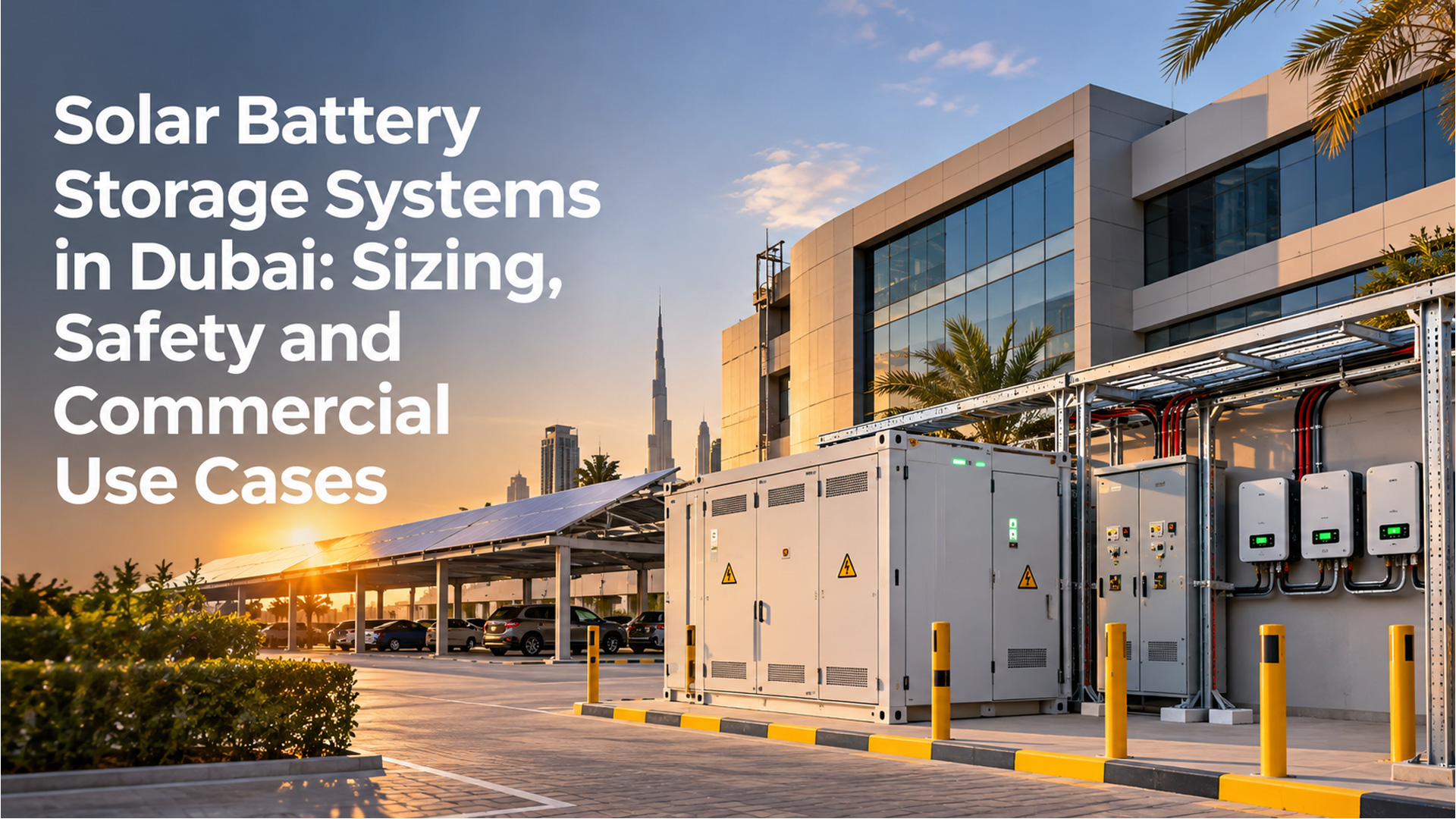
🔋 Batteries can make solar more useful after sunset and during outages, but only when they are sized for a clear purpose and installed with safety in mind.
Solar panels produce power when the sun shines. Many businesses and homes need it at other times too, or want protection when the grid supply is interrupted. That gap is why interest in solar battery storage in Dubai keeps growing among villa owners, warehouses, farms, remote facilities and commercial buildings.
Batteries are not a default add-on, however. In a grid-connected building with net metering, a battery may not pay back on energy savings alone. In an off-grid site, it may be essential. The value depends on what the battery is meant to do, how it is sized, and whether it is installed and approved correctly.
Direct answer: Solar battery storage stores surplus solar energy for later use or for backup power. Size it from the purpose (backup, self-consumption, peak reduction or off-grid supply), the critical loads and the hours of autonomy required, not from the size of the solar array. Lithium iron phosphate batteries are widely used for safety and cycle life. In Dubai, grid-connected systems must follow DEWA’s requirements through approved consultants and contractors, so confirm the battery configuration before purchase.
What Battery Storage Can Do
- Backup power: keep selected loads running during a grid interruption
- Self-consumption: store daytime solar to use in the evening
- Peak reduction: reduce demand during high-load periods where tariffs or capacity limits make this worthwhile
- Off-grid supply: provide power through the night where there is no grid
- Generator fuel reduction: let diesel generators run less often at remote sites
- Power quality support for sensitive equipment
Each purpose leads to a different design. A backup system for servers and security needs a few hours for a small load. An off-grid farm may need storage for the whole night.
Grid-Tied, Hybrid and Off-Grid Systems
| System type | Battery role | Typical application |
| Grid-tied without battery | No storage; surplus exported under net metering | Most commercial rooftops connected to DEWA |
| Hybrid (grid-tied with battery) | Backup and evening self-consumption | Villas, offices and businesses needing resilience |
| Off-grid | Battery is the night-time supply | Farms, remote sites, temporary facilities |
| Solar plus generator | Battery reduces generator run hours | Construction and remote industrial sites |
Our guides to grid-tied solar systems in Dubai, hybrid solar systems and off-grid solar systems explain each configuration in more depth.
Sizing a Battery System
Start with the loads
List the loads the battery must support, their power draw in kilowatts and how many hours they must run. Separate critical loads from loads that can be shed.
Energy and power are different
Battery capacity in kilowatt-hours sets how long it can supply power. Inverter and battery power ratings in kilowatts set how much it can deliver at once. Motor-driven loads such as pumps and compressors also need enough surge capacity to start.
Depth of discharge and ageing
Usable capacity is less than nameplate capacity, and batteries lose capacity over their lifetime. Sizing should account for both, as well as round-trip losses.
Charging capacity
The solar array must have enough surplus to recharge the battery, especially during shorter or dustier days. An undersized array leaves a large battery partly empty.
Key insight: A battery sized from the number of solar panels is a guess. A battery sized from the load list, the hours of autonomy and the purpose is a design.
Battery Chemistry and Heat
Lithium iron phosphate (LFP) batteries are widely used in stationary storage because of their thermal stability and cycle life compared with many other lithium chemistries. Lead-acid batteries cost less upfront but offer fewer usable cycles and need more space and maintenance.
Heat is a key consideration in Dubai. High temperatures accelerate battery ageing and can trigger protective shutdowns. Batteries should be installed in shaded, ventilated or air-conditioned spaces within the manufacturer’s temperature limits, with clearance for inspection.
Safety and Approvals
Battery systems store large amounts of energy and must be treated as electrical and fire-safety equipment. Good practice includes:
- Certified battery modules and a battery management system
- Correct protection devices and isolation
- Suitable location, ventilation and separation from escape routes
- Compliance with applicable civil defense and electrical requirements
- Clear labeling and emergency shutdown procedures
For grid-connected systems in Dubai, solar installations connect under DEWA’s Shams Dubai framework through DEWA-enrolled consultants and contractors. Battery arrangements should be confirmed with them against the current DEWA requirements before equipment is ordered.
Commercial Use Cases
Warehouses and logistics sites
Batteries can protect refrigeration, IT and security systems during outages, and may support evening operations.
Farms and remote facilities
Off-grid storage powers pumps, lighting and accommodation overnight, often with a generator as backup.
Offices and retail
Backup for IT, security and critical lighting is a common reason to add storage.
EV charging sites
Storage can buffer solar energy for EV charging, reducing peak demand when several vehicles charge at once, subject to site design.
Common Mistakes With Solar Batteries
- Buying storage without defining its purpose
- Ignoring surge requirements of motors and compressors
- Installing batteries in hot, unventilated rooms
- Oversizing the battery relative to the solar array’s charging capacity
- Assuming a battery always improves payback on a net-metered system
- Skipping approval checks before purchase
Key insight: On a net-metered rooftop, the grid already acts as a kind of storage for surplus energy. Batteries earn their keep mainly through resilience, off-grid supply or specific tariff and capacity situations.
How RBC Engineering Supports Solar and Storage Projects
RBC Engineering supplies solar energy systems for residential, commercial and industrial clients in Dubai and the UAE. For a battery enquiry, share the purpose of storage, critical load list, hours of backup needed, existing or planned solar capacity, electricity bills and installation space. Businesses planning larger rooftops can also review our guide to commercial solar energy systems and the steps in solar installation from site assessment to commissioning.
Frequently Asked Questions
Do I need a battery with solar panels in Dubai?
Not always. Grid-connected systems under net metering can operate without storage. A battery is worth considering when you need backup power, are off-grid, or have specific self-consumption or demand goals.
How long will a solar battery last?
Lifespan depends on chemistry, cycles, depth of discharge and temperature. LFP batteries generally offer long cycle life when kept within their temperature and operating limits.
How big should my battery be?
Size it from the loads you want to support and how long they must run, then allow for depth of discharge, losses and ageing. The solar array must be able to recharge it.
Can batteries power air conditioning?
They can, but air conditioning is a large load that requires substantial capacity and surge handling. Many backup designs prioritize essential loads and exclude large cooling equipment.
Are batteries safe indoors?
They can be when certified equipment is installed with correct protection, ventilation, separation and temperature control, in line with applicable safety requirements.
Do I need approval to add a battery to my solar system?
For grid-connected systems in Dubai, confirm with a DEWA-enrolled consultant or contractor that the configuration meets current requirements before installing.
Store Energy With a Clear Purpose
A well-designed solar battery storage system in the UAE starts with a clear purpose, a real load list and a safe installation location. Get those right and storage turns solar from a daytime-only resource into a more resilient energy supply.
Considering battery storage for a home, business or remote site in Dubai? Call RBC Engineering on +971 55 502 2471, email info@rbcengineering.ae, or share your load and backup requirements to discuss suitable options.