

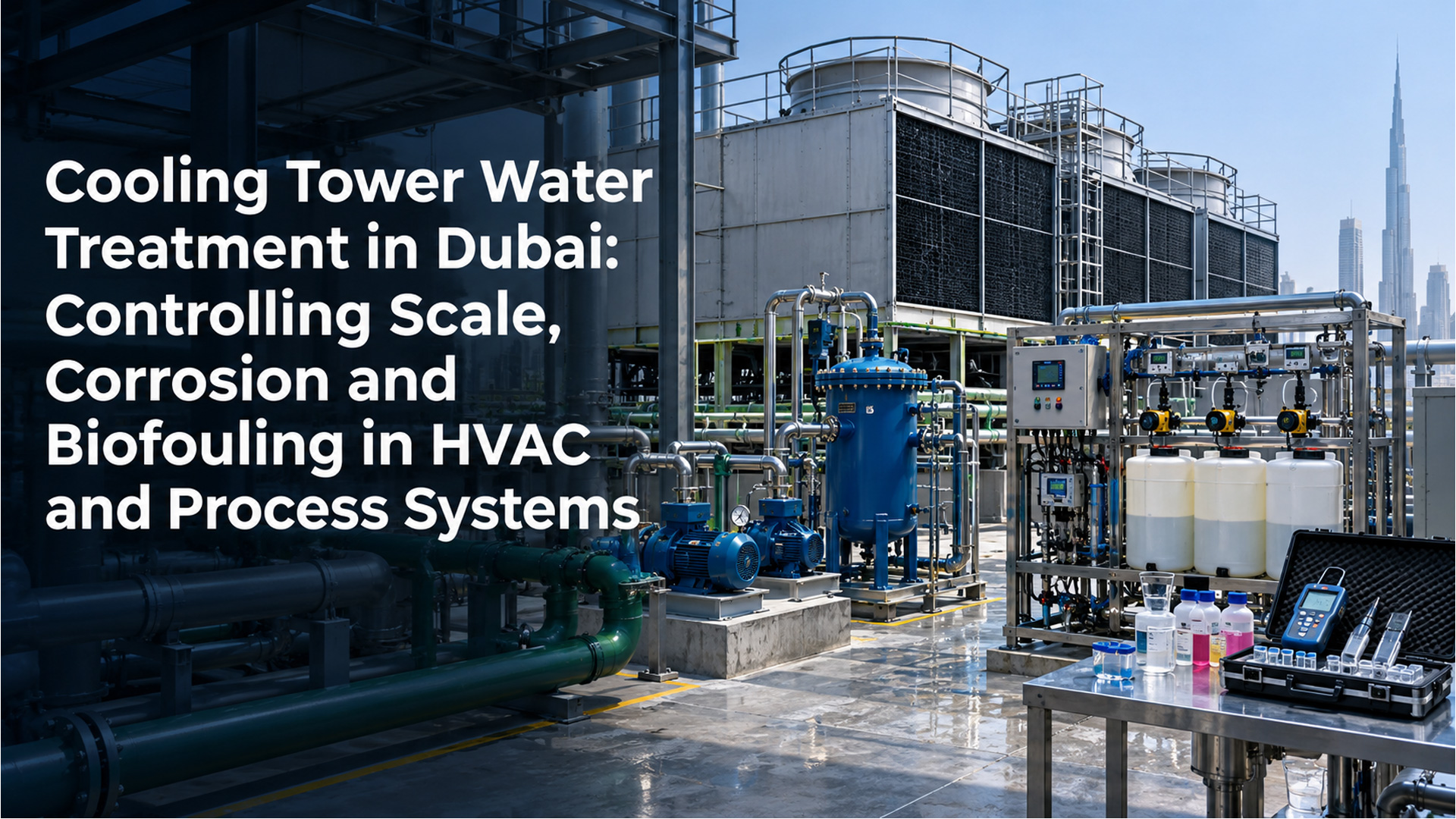
🌡️ A chiller can only reject heat as well as its condenser water allows. Treat that water properly and efficiency, equipment life and hygiene all improve together.
Facility teams often notice a cooling tower problem indirectly. Chiller approach temperatures creep up, energy bills rise in summer, a condenser needs descaling sooner than expected, or a hygiene inspection flags biological growth. In many cases the root cause sits in the condenser water itself, which is why cooling tower water treatment in Dubai deserves the same attention as the chillers it protects.
Open evaporative cooling towers work by evaporating part of the circulating water. That evaporation removes heat efficiently, but it also leaves dissolved minerals behind, while the tower constantly scrubs dust and organic matter from the air. In a hot, dusty climate with long operating hours, both effects are amplified.
Direct answer: Cooling tower water treatment controls three risks: mineral scale, corrosion and microbiological growth, including Legionella. A sound program combines suitable make-up water, controlled bleed-off to manage cycles of concentration, chemical dosing for scale and corrosion inhibition, a biocide strategy, filtration of suspended solids, and regular testing with documented records. The right settings depend on the make-up water analysis, system metallurgy and operating load.
Why Condenser Water Quality Matters for Chiller Performance
Scale on condenser tubes acts as insulation. Even a thin layer raises the condensing temperature, which makes the compressor work harder for the same cooling output. Corrosion thins tubes and pipework and releases particles that cause further fouling. Biofilm adds another insulating layer and shelters bacteria from disinfectants.
The result is a chiller plant that consumes more energy, needs more frequent tube cleaning and carries more risk of unplanned downtime. For buildings and industrial sites already investing in an energy-efficient chiller system, poor water treatment can quietly erase part of that investment.
The Three Problems a Treatment Program Must Control
Scale
As water evaporates, calcium, magnesium, silica and other dissolved solids concentrate. Once their solubility limits are exceeded, especially on hot heat-transfer surfaces, they precipitate as scale. Make-up water chemistry, cycles of concentration, pH and temperature all influence how quickly this happens.
Corrosion
Steel, copper alloys and galvanized surfaces react differently to water chemistry. Low-mineral water can be aggressive to metals, while high chlorides and suspended solids can accelerate localized corrosion. Corrosion inhibitors and correct pH control protect the system, but the chemistry must suit the metals actually present.
Microbiological growth
Warm, aerated water with nutrients and sunlight is an ideal environment for bacteria, algae and biofilm. Legionella bacteria are a particular concern because cooling towers can release aerosols. A biocide program, physical cleaning and good tower design work together to keep counts under control.
Key insight: Scale, corrosion and biological growth are connected. Biofilm accelerates corrosion, corrosion products feed deposits, and deposits protect bacteria. Treating only one of them rarely solves the problem.
Make-Up Water and Cycles of Concentration
Cycles of concentration compare the dissolved solids in the circulating water with those in the make-up water. Running more cycles saves water because less is bled off, but it pushes the system closer to scaling limits.
Many Dubai facilities use municipal water as make-up, which is generally low in dissolved solids. Others use treated sewage effluent or groundwater where available and approved, which changes the treatment requirements significantly. Some sites pretreat make-up water through softening or reverse osmosis so they can run higher cycles without scaling.
The best operating point comes from the make-up water analysis and system conditions, not from a fixed rule. A conductivity controller that opens the bleed-off valve automatically is the usual way to hold the target.
Core Components of a Cooling Tower Treatment System
- Conductivity-based bleed-off control to hold cycles within the target range
- Chemical dosing pumps for scale and corrosion inhibitors, proportioned to make-up or bleed-off
- Biocide dosing, often alternating oxidizing and non-oxidizing products, or another validated strategy
- Side-stream filtration to remove dust and suspended solids picked up from the air
- pH monitoring where chemistry or make-up quality requires it
- Corrosion coupons or monitors to verify that protection is working
- Sampling points and a testing schedule with records kept on site
Equipment for dosing and filtration belongs to the wider family of water treatment equipment, and should be sized to the system volume, circulation rate and evaporation rate.
Legionella and Hygiene Management
Cooling towers in occupied areas need a written water management approach. In practice, that usually includes a risk assessment of the system, a schedule for microbiological testing, procedures for disinfection and cleaning, and clear responsibilities when results exceed action levels. Requirements vary by authority and building type, so the facility should confirm the obligations that apply to its site. Good design helps too: drift eliminators in good condition, no dead legs, and towers positioned away from air intakes.
Operating Conditions in Dubai That Change the Approach
Dubai’s summer loads mean towers run hard for months, with high evaporation and therefore high make-up demand. Airborne dust and sand enter the basin continuously, which makes filtration and basin cleaning more important than in cleaner climates. Lower winter loads can create the opposite problem: low flow, warm stagnant sections and inconsistent chemical levels. A treatment program should account for both seasons.
Key insight: Seasonal changes are a common blind spot. Review dosing rates, bleed-off settings and testing frequency at least as the cooling load moves between summer peak and winter low.
Integrating Water Treatment With the Wider Cooling Plant
Cooling tower water treatment works best when it is considered alongside chiller selection, tower sizing, pumps and controls. For industrial sites, process cooling systems may also use closed loops or heat exchangers that separate tower water from sensitive equipment. Facilities planning new or replacement chillers should review condenser water quality at the same time, because the cleanest heat-transfer surface delivers the efficiency the chiller was selected for.
Treated condenser bleed-off is also one of the streams some facilities review within a wastewater recycling strategy, subject to its quality and the applicable approvals.
Common Mistakes in Cooling Tower Water Management
- Running fixed bleed-off timers instead of conductivity control
- Choosing chemicals without a make-up water analysis or metallurgy review
- Relying on chemicals while ignoring dust, sludge and basin cleaning
- Testing irregularly or not keeping records
- Leaving systems stagnant during low-load periods
- Treating Legionella control as a one-off disinfection rather than an ongoing program
How RBC Engineering Supports Cooling and Water Systems
RBC Engineering supplies chillers and cooling equipment, water cooling and heating equipment and water treatment equipment for commercial and industrial facilities in Dubai and the UAE. For a cooling tower treatment enquiry, share the make-up water source and analysis, system volume, circulation rate, tower and chiller details, current problems and any recent test results. Facilities already experiencing performance loss can also review chiller repair and maintenance needs at the same time.
Frequently Asked Questions
Why does a cooling tower need water treatment?
Evaporation concentrates minerals, and the tower collects dust and microorganisms from the air. Without treatment, the system develops scale, corrosion and biological growth that reduce chiller efficiency and create hygiene risks.
What are cycles of concentration?
It is the ratio of dissolved solids in the circulating water to those in the make-up water. Higher cycles save water but increase scaling risk, so the target is set from the water analysis and controlled through bleed-off.
How often should cooling tower water be tested?
Routine chemical checks are often weekly or more frequent, with microbiological testing on a defined schedule. The exact frequency should follow the site risk assessment and any authority requirements.
Can treated sewage effluent be used as cooling tower make-up?
It may be possible where available and approved, but it usually requires a different treatment approach because of its nutrient and organic content. Confirm suitability and approvals before switching sources.
Does side-stream filtration really help?
In dusty environments, yes. It removes suspended solids that settle in the basin, shelter bacteria and contribute to deposits, which supports chemical treatment.
What is the link between water treatment and chiller energy use?
Scale and biofilm on condenser tubes raise condensing temperature, forcing the compressor to use more energy for the same cooling. Clean surfaces help the chiller operate closer to its design efficiency.
Protect the Chiller by Protecting the Water
A well-run cooling tower chemical dosing and bleed-off program is one of the most cost-effective ways to protect chiller efficiency, extend equipment life and manage hygiene risk. Base it on a proper water analysis, control it automatically, test it consistently, and review it as the seasons change.
Reviewing cooling tower water treatment for a building or plant in Dubai? Call RBC Engineering on +971 55 502 2471, email info@rbcengineering.ae, or share your system details to discuss suitable equipment.