

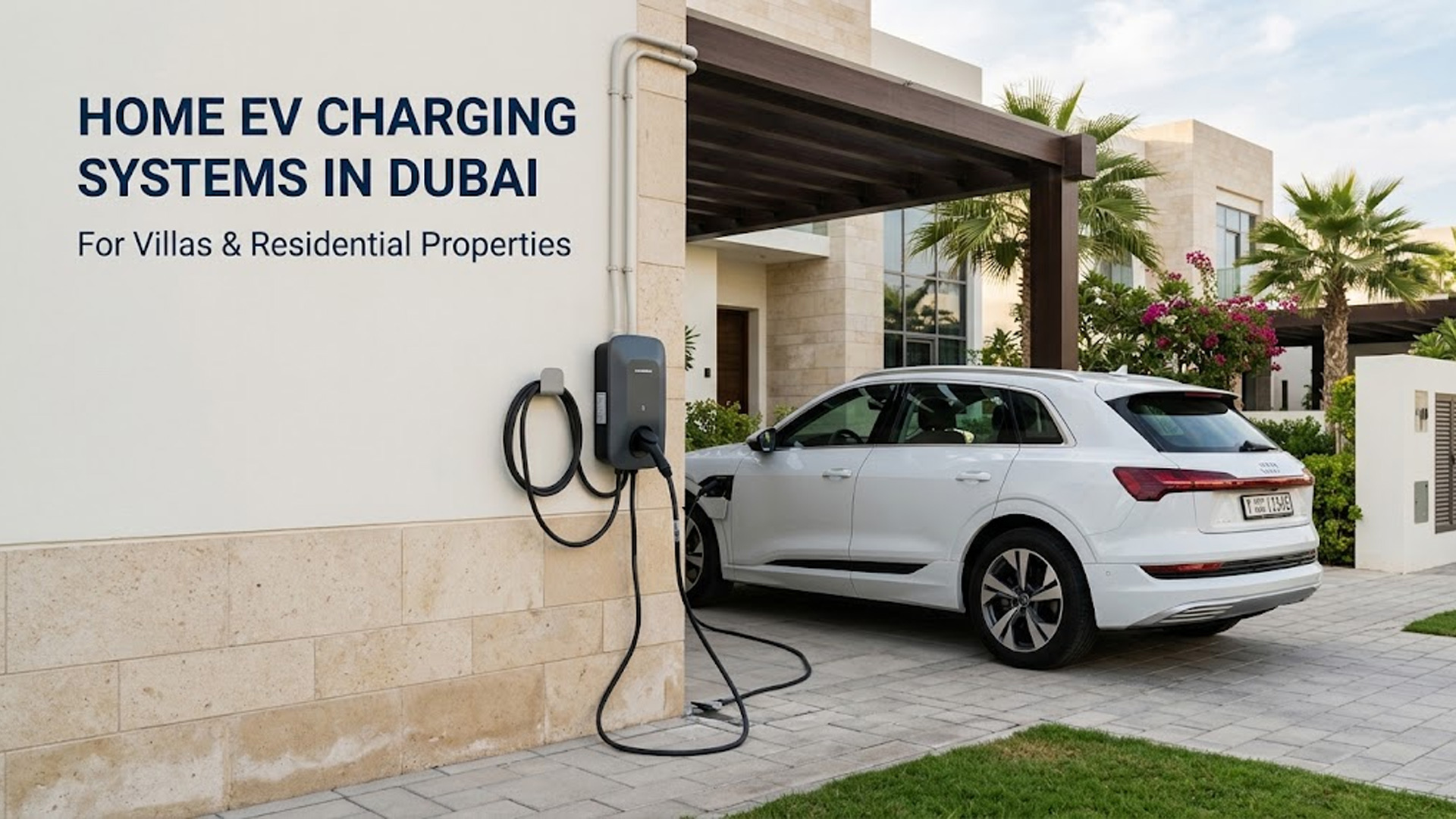
Choose a home charger around the vehicle, parking duration and available electrical capacity—not simply the highest charging power available.
A home EV charging system in Dubai should fit both the electric vehicle and the property. A charger may technically support high output, but the useful charging rate can still be limited by the vehicle’s onboard charger, the electrical supply, circuit capacity or the time the car normally remains parked.
For many residential users, the practical objective is simple: plug in after arriving home and have enough energy available when the vehicle is needed again. Achieving that reliably requires the charger, circuit and charging schedule to be considered together.
Direct answer: A home EV charger should be selected according to the vehicle’s AC charging capability, daily driving distance, overnight parking time, electrical capacity and property layout. Common residential AC charging options include different power levels, but the highest-rated charger is not automatically the best choice for every villa or residential property.
Start With the Vehicle’s AC Charging Capability
The charger’s maximum output does not guarantee that the vehicle will accept that entire power level.
Before selecting equipment, confirm:
- Vehicle make and model
- AC charging capability
- Charging connector
- Battery capacity
- Typical daily driving distance
- Current charging habits
This allows the charger to be matched to the car rather than chosen from the largest number in a product catalogue.
7 kW, 11 kW or 22 kW Home Charging
Different AC EV charger ratings can suit different vehicles and electrical installations.
| Charger Range | Where It May Fit | What Must Be Checked |
| Lower-power residential AC | Vehicles parked for long periods with moderate daily energy requirements | Vehicle acceptance, circuit capacity and charging window |
| 11 kW-class AC charging | Vehicles and properties capable of supporting three-phase charging | Vehicle onboard charger and available three-phase capacity |
| 22 kW-class AC charging | Selected vehicles and electrical systems | Vehicle charging limit, supply capacity and whether the added power creates practical value |
RBC Engineering’s dedicated AC EV charger solutions in Dubai provide the wider commercial and residential AC-charging context.
Calculate How Much Energy the Vehicle Really Needs Each Day
Most home charging decisions should be based on energy replacement rather than repeatedly charging an empty battery from zero.
Consider:
- Typical kilometres driven each day
- Vehicle energy consumption
- Days between charging sessions
- Available overnight parking time
- Occasional longer journeys
If a car remains parked for many hours overnight, moderate AC charging can often provide a practical charging window without requiring the highest possible power.
Check the Property’s Electrical Capacity
The home charger becomes a significant electrical load and should be assessed alongside the property’s existing demand.
Existing loads may include:
- Air conditioning
- Water heating
- Cooking equipment
- Swimming-pool equipment
- Pumps
- Other large household loads
The project should establish whether the available electrical capacity can support the proposed charger without creating an inappropriate load condition.
Why Load Management Can Matter at Home
Where electrical capacity is constrained, load management may help coordinate EV charging with other property loads.
A suitable system can reduce charging output when building demand is high and allow more charging power when capacity becomes available.
This can be more practical than selecting a permanently low charging rate or assuming an electrical upgrade is automatically required.
Charger Location Should Be Planned Before Cabling
Residential installation cost and usability can change substantially depending on the charger position.
Review:
- Normal parking position
- Distance from the electrical distribution point
- Cable route
- Wall or pedestal mounting
- Exposure to weather
- Vehicle charging-port location
- Pedestrian routes
- Future second-EV requirements
Tethered or Socketed Home Charger?
A tethered charger has an attached charging cable, while a socketed charger normally requires the user to connect a separate compatible cable.
A tethered unit can offer daily convenience. A socketed design can provide flexibility around cable replacement and storage.
The better choice depends on user preference, parking arrangement and compatible equipment availability.
Smart Home EV Charging
Residential charging can include useful control features such as:
- Charging schedules
- Energy monitoring
- User authentication
- Remote status information
- Load-management integration
- Solar-coordinated charging where supported by the selected system
Buyers should distinguish genuinely useful functionality from features they are unlikely to use.
Home Charging and Solar Energy
Solar generation and EV charging can complement each other when vehicle charging occurs during solar-production periods.
If a vehicle is normally away from home during the day, however, the direct overlap between rooftop solar generation and charging may be limited unless the system includes a suitable energy-management or storage strategy.
RBC Engineering’s home solar EV charging content explores this integration in more detail.
Do Homeowners Need DC Fast Charging?
For most residential parking situations, AC charging is the more natural technology to assess first because vehicles remain parked for long periods.
DC fast charging serves a different operating requirement and typically makes more sense where rapid turnaround is important.
Commercial and fleet projects needing higher charging power should review DC fast charger solutions rather than treating residential charging as a smaller version of a public fast-charging site.
Home Charger Installation Planning
Installation should be based on the selected charger and actual property electrical system.
A project review may include:
- Confirm vehicle compatibility.
- Define the required charging window.
- Inspect the electrical supply.
- Review existing property loads.
- Select the charger rating.
- Choose charger location.
- Plan cabling and protection.
- Complete installation according to applicable requirements.
- Test charger operation.
- Configure smart functions where used.
For wider design considerations, see RBC Engineering’s EV charging station design guidance.
Apartment and Shared Residential Charging
Apartment buildings and shared residential parking introduce additional questions beyond a single villa charger.
These can include:
- Parking ownership
- Common electrical capacity
- Billing
- User identification
- Cable routes through shared areas
- Expansion to additional EVs
- Property-management responsibilities
These projects should be planned as shared charging infrastructure rather than treating each parking bay independently.
Plan for a Second EV
A household installing its first charger should consider whether another electric vehicle may be added later.
The project does not necessarily need two chargers immediately, but future expansion can influence:
- Cable route
- Distribution capacity
- Load management
- Charger networking
- Parking layout
Maintenance for Residential Chargers
Home chargers generally require less operational attention than heavily used public equipment, but they should still be inspected periodically.
Check:
- Enclosure condition
- Charging cable
- Connector
- Mounting
- Error messages
- Signs of overheating or physical damage
- Software or connectivity where applicable
Any electrical fault should be assessed by appropriately qualified personnel rather than repeatedly resetting equipment without identifying the cause.
For broader operating guidance, review RBC Engineering’s EV charger operation and maintenance resource.
Choose a Home Charger Around Your Vehicle and Property
Provide RBC Engineering with your vehicle model, parking location, expected daily driving, preferred charging window and available property electrical information. These details help narrow the charger requirement before equipment and installation scope are finalised.
Discuss a Home EV Charging Requirement
Frequently Asked Questions
What size EV charger is suitable for a Dubai home?
The appropriate charger depends on vehicle AC charging capability, daily energy requirement, parking duration and available electrical capacity.
Is a 22 kW charger always better than an 11 kW charger?
No. The vehicle may not accept the higher rate, and the property electrical system may not support it. Charging power should be matched to the complete installation.
Can an EV be charged overnight at home?
Yes. Overnight parking provides a long charging window, which is one reason AC charging is commonly considered for residential applications.
Can home EV charging work with solar panels?
Yes, but the practical benefit depends on when the vehicle charges relative to solar generation and on the selected energy-management arrangement.
What is load management for a home EV charger?
Load management coordinates charging demand with the property’s available electrical capacity and can adjust charger output when other building loads change.
Can two EVs be charged at one home?
Potentially. The design should consider total electrical capacity, required energy for both vehicles and whether load sharing or managed charging is appropriate.
Where should a residential EV charger be installed?
The location should suit the normal parking position, cable reach, electrical route, environmental exposure and safe everyday use.