

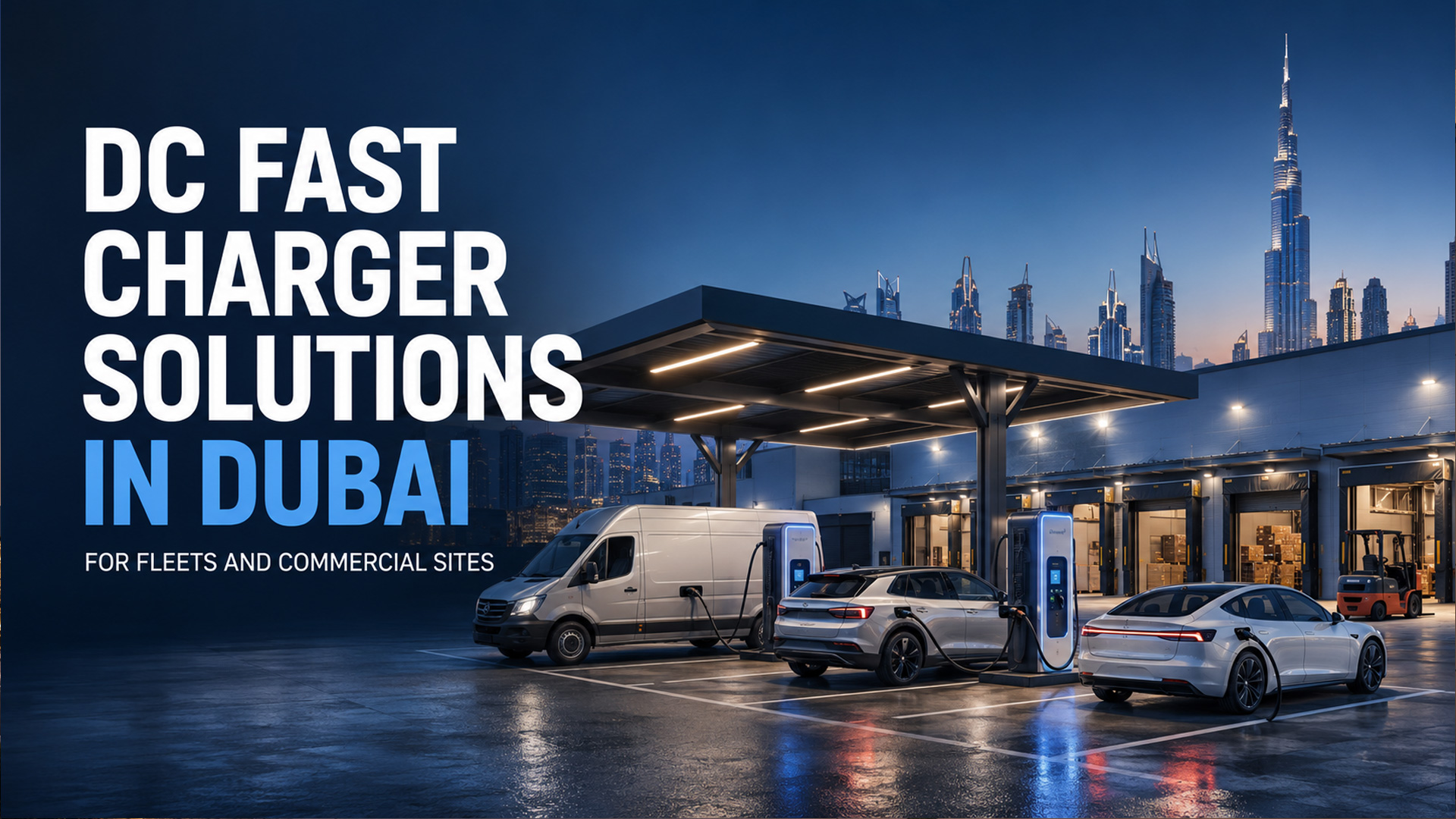
DC Fast Charger Solutions in Dubai for Fleets and Commercial Sites
Design the charging system around vehicle schedules, usable site power and real operational demand.
A DC fast-charging project is not simply a matter of choosing the highest available power rating. The correct system depends on the vehicles using the site, their battery capacities, the energy required between journeys, the time available for charging and the electrical infrastructure that can realistically support the equipment.
A DC fast charger in Dubai is generally suited to fleets, logistics operations, public charging locations and commercial sites where vehicles cannot remain parked for several hours. A complete solution must consider the charger, power supply, protection, connector compatibility, load management, software, user access, commissioning and long-term maintenance.
RBC Engineering supports clients in evaluating these requirements before equipment is specified. Depending on the confirmed project scope, the work may include technical assessment, charger supply, installation coordination, charging-management configuration, testing, commissioning and operational support.
How DC Fast Charging Works
An electric vehicle stores energy as direct current. With AC charging, the vehicle’s onboard charger converts alternating current into direct current before the energy reaches the battery. A DC fast charger performs that conversion within the charging station and supplies controlled direct current to the vehicle.
This arrangement can support higher charging power, but the charger does not independently determine the speed of every session. The vehicle continuously communicates with the station and may reduce the requested power according to battery temperature, state of charge, battery-management limits and other operating conditions.
Actual charging performance can be affected by:
- The vehicle’s maximum DC charging capability
- Battery temperature and condition
- Battery state of charge
- The vehicle’s charging curve
- Connector compatibility
- Available site power
- Power shared across multiple connectors
- Charger configuration and software limits
- Environmental and equipment conditions
The rated output describes the charger’s maximum capability. It does not guarantee that every vehicle will receive that level of power throughout the charging session.
Where DC Fast Chargers Deliver the Most Value
DC charging is most useful where charging time affects the operation of a fleet, the availability of a vehicle or the commercial performance of a site. It may not be the most economical choice where vehicles remain parked for long periods and can receive the required energy from AC chargers.
Fleet Depots
Delivery companies, transport operators, rental fleets and service businesses may use DC charging when vehicles return at different times or must be prepared for another route within a limited window. The system should be based on route energy, return times and departure priorities rather than the number of vehicles alone.
Logistics and Distribution Facilities
Commercial vehicles can have demanding schedules and higher daily energy requirements. A logistics site may use high-power charging for rapid turnaround while retaining lower-powered charging for vehicles parked overnight.
Public Charging Locations
Public stations require dependable equipment, clear user instructions, payment or access controls, remote monitoring and a practical fault-response process. The project must also account for traffic flow, queuing, bay occupation and safe cable handling.
Hotels, Retail Sites and Commercial Destinations
DC charging may suit locations where visitors remain for a shorter period and expect a meaningful energy top-up before departure. The business should compare the cost of the equipment and infrastructure with realistic usage rather than assuming that high-power charging is necessary for every destination.
Transport and Mobility Operations
Taxi, ride-hailing, bus and mobility operators may require charging systems designed around shift changes, vehicle availability and predictable departure times. Charger redundancy becomes particularly important when charging is essential to daily operations.
How to Select the Right DC Charger Power
The appropriate charger rating is determined by the energy that must be delivered within the available charging time. Selecting equipment without this calculation can produce an oversized system that increases project cost or an undersized system that cannot support the operating schedule.
| Project Consideration | Lower-Power DC Charging | Higher-Power DC Charging |
|---|---|---|
| Typical operating need | Moderate turnaround requirements or smaller commercial vehicles | Shorter charging windows or vehicles with higher energy demand |
| Electrical infrastructure | May be easier to accommodate within an existing site | May require substantial distribution or transformer upgrades |
| Vehicle compatibility | Suitable when vehicles cannot accept very high charging power | Useful only when compatible vehicles can request and use the additional power |
| Expansion planning | Several units may be managed across a wider parking area | Future expansion requires careful assessment of total site demand |
| Commercial case | May offer a practical balance between cost and charging time | Requires sufficient utilisation to justify greater equipment and infrastructure cost |
A project should compare several technical options instead of treating one rating as suitable for every location. RBC Engineering can assess available equipment through its EV charging product range and match the proposed configuration to the site and vehicle requirements.
DC Fast Charging for Electric Fleets
Fleet charging is an operational system, not simply a row of charging stations. The design must ensure that the vehicles required for the next shift receive sufficient energy before departure.
A useful fleet assessment should examine:
- Number and type of vehicles
- Battery capacity of each vehicle group
- Average and peak daily distance
- Energy consumed on typical routes
- Vehicle return and departure times
- Minimum required state of charge
- Time available between operating shifts
- Simultaneous charging demand
- Charger and connector redundancy
- Expected fleet growth
Not every vehicle needs to charge at the same rate. Vehicles with early departures may receive priority, while vehicles parked for longer periods can charge at a lower output. This approach can reduce peak demand and help the site use its available capacity more effectively.
The correct fleet design starts with the departure schedule. Charger quantities and power ratings should be selected only after the required energy for each operating window is understood.
Electrical Assessment for a DC Charging Site
DC chargers can create a substantial electrical load. A technical assessment should establish whether the existing site can support the proposed system and what upgrades may be necessary.
Incoming Power and Distribution
- Utility connection and available supply capacity
- Transformer rating and present loading
- Main switchboard capacity
- Distribution routes and cable requirements
- Available space for protection and isolation equipment
- Existing peak demand
- Planned building or process loads
- Future charger expansion
Electrical Protection and Safety
- Overcurrent and short-circuit protection
- Isolation requirements
- Earthing arrangement
- Surge protection
- Emergency shutdown
- Metering and energy monitoring
- Equipment clearances
- Coordination with the site’s electrical protection system
The final design should be completed by qualified professionals and reviewed against the current technical and approval requirements that apply to the project location.
Parking Layout and Charger Positioning
The equipment should be placed where vehicles can enter, charge and leave without creating unnecessary congestion. A technically suitable charger can still deliver a poor user experience when the bays, cables or traffic routes are badly planned.
The layout assessment should consider:
- Vehicle approach and turning space
- Charging-port positions on expected vehicles
- Cable reach and storage
- Number and arrangement of charging bays
- Accessible parking requirements
- Queuing and waiting areas
- Protection from vehicle impact
- Equipment ventilation and service clearances
- Drainage and weather exposure
- Lighting, signs and operating instructions
- Safe pedestrian movement
Review RBC Engineering’s guide to EV charging station design for additional planning considerations covering car parks, commercial sites and future expansion.
Single-Connector and Multi-Connector DC Chargers
A single-connector charger serves one vehicle at a time. A multi-connector station may provide greater operational flexibility, but the available cabinet power may be divided when more than one vehicle charges simultaneously.
Before selecting a multi-connector system, confirm:
- Whether charging can occur on multiple connectors at the same time
- How output is divided between connected vehicles
- Which connector standards are included
- Whether connector use can be prioritised
- How simultaneous sessions are displayed and billed
- Whether the available site power can support the intended operating mode
- What happens if one connector becomes unavailable
The product title alone may not explain the power-sharing behaviour. The final technical schedule should define maximum cabinet output, maximum connector output and simultaneous operating limits.
DC Connector and Vehicle Compatibility
The charger must support the vehicles expected to use the site. Connector selection should be based on the actual fleet or target user group rather than a broad assumption about vehicle brands.
Before procurement, confirm:
- Vehicle connector standards
- Maximum vehicle DC charging rate
- Required output-voltage range
- Charging-cable length
- Number of connectors
- Communication compatibility
- Vehicle-market specification
- Future fleet procurement plans
A public or mixed-fleet location may need to support more than one connector configuration. A private fleet can often simplify the system by standardising future vehicle and charging-equipment specifications.
Load Management for DC Fast Chargers
Smart load management helps control charging demand when several units share the same electrical infrastructure. It can allocate power according to charger availability, vehicle requirements, departure priority or the site’s active demand.
A managed system may support:
- Dynamic power allocation
- Maximum site-demand limits
- Priority charging for selected vehicles
- Power sharing between connectors
- Scheduled fleet charging
- Remote output adjustment
- Energy-use reporting
- Fault and availability monitoring
Load management can improve the use of available capacity, but it cannot overcome an electrical supply that is fundamentally too small for the required operating schedule. The project still needs enough power and time to deliver the necessary energy.
Charging Management, Payments and User Access
The management platform determines how users access the charger, how sessions are recorded and how the operator monitors performance. A private fleet may require driver identification and energy reporting, while a public site may need pricing, payments and customer support.
Depending on the selected equipment and software, the system may include:
- RFID authentication
- Mobile application access
- QR-code session activation
- Remote start and stop
- Energy-based or time-based billing
- User and vehicle accounts
- Charger-status monitoring
- Session and revenue reports
- Fault notifications
- Charging-management platform integration
Read RBC Engineering’s guide to EV charging payments and access control when planning public, workplace or revenue-generating charging.
Choosing the Right Commercial Operating Model
The charging equipment should support the way the site intends to operate. Installing the hardware before defining the operating model can create avoidable software, payment and customer-service problems.
The project team should decide:
- Whether charging will be private, restricted or public
- Whether users will pay for charging
- How tariffs will be structured
- Whether parking and charging fees will be separate
- Who will provide user support
- Who will monitor charger availability
- How faults will be reported and escalated
- How refunds or interrupted sessions will be handled
- What operating data the owner requires
For broader property planning, explore RBC Engineering’s commercial EV charging solutions.
Solar and Battery Integration with DC Fast Charging
Solar energy can contribute to a DC charging project, but high-power charging demand may be considerably greater than the solar output available at a particular moment. The system should therefore be assessed as a coordinated energy project rather than a direct connection between panels and a charger.
The assessment should review:
- Existing and proposed solar capacity
- Charging demand during daylight hours
- Building or facility base load
- Available roof, carport or ground area
- Grid-import limitations
- Battery-storage objectives
- Expected charging peaks
- Energy-management controls
- Financial and operational value of storage
Battery storage may help manage demand, support limited grid capacity or increase the use of on-site solar generation. It should be selected through an energy and operational assessment rather than added automatically to every project.
Learn more about solar-integrated EV charging systems for commercial and fleet applications.
Dubai Approvals and Project Compliance
Approval and licensing requirements depend on the charger rating, site type, access model and whether charging is provided privately, free of charge or as a paid public service. These requirements should be reviewed before equipment is ordered or installation begins.
Project owners and consultants should check the current DEWA regulatory framework for EV charging infrastructure and the applicable UAE technical regulation for electric vehicle supply equipment.
The project scope should identify responsibility for:
- Utility coordination
- Equipment compliance documents
- Electrical design submissions
- Site and property approvals
- Charge-point operator licensing where applicable
- Inspection and commissioning records
- Public-access and payment requirements
- Ongoing operational compliance
Requirements can change, so the project should rely on current authority guidance rather than assumptions based on an earlier installation.
DC Fast Charger Installation and Commissioning
- Define the operational requirement: Confirm vehicles, routes, users, charging windows and required energy.
- Assess the site: Review electrical capacity, parking layout, cable routes and equipment locations.
- Select the charging configuration: Determine power rating, connector arrangement, charger quantity and management functions.
- Prepare the technical scope: Document electrical work, civil work, communications, software, testing and exclusions.
- Confirm approvals: Identify the current utility, property and operating requirements.
- Complete site works: Install the agreed electrical distribution, protection, cabling, foundations and impact protection.
- Install and configure equipment: Connect the chargers, communications, access controls and management platform.
- Test the system: Verify electrical safety, communications, charging operation, power sharing and user workflows.
- Complete handover: Provide the agreed technical records, training, warranty information and maintenance plan.
The proposal should clearly separate the responsibilities of RBC Engineering, the client, the electrical contractor, the software provider, the utility and any local implementation partner.
Maintenance and Operational Support
DC charging equipment supports demanding electrical and electronic processes and may operate for long hours in commercial environments. Maintenance planning should be completed before the station begins serving vehicles.
A maintenance programme may include:
- Visual inspection of enclosures and foundations
- Charging-cable and connector checks
- Cooling and ventilation inspection
- Electrical protection testing
- Emergency-stop testing
- Communication and network checks
- Payment and access-control testing
- Software and firmware management
- Error-log review
- Cleaning and environmental inspection
- Spare-parts planning
- Preventive-maintenance records
The required frequency depends on charger utilisation, environmental exposure, operating hours and the commercial importance of the site. Public and fleet installations may require more frequent checks and a defined response process for unavailable chargers.
What Affects the Cost of a DC Fast-Charging Project?
The charging station is only one part of the total investment. Electrical upgrades, civil work, software and operating requirements can materially affect the final project cost.
Important cost factors include:
- Charger power and connector configuration
- Number of charging points
- Existing transformer and distribution capacity
- Required electrical upgrades
- Cable length and route
- Foundations, trenching and reinstatement
- Canopies, barriers and impact protection
- Communication and networking requirements
- Load-management equipment
- Payment and access-control integration
- Approval and inspection scope
- Testing and commissioning
- Warranty, maintenance and spare-parts requirements
A standard equipment price cannot provide an accurate project budget without information about the site and operating model.
DC Charging Projects Across the UAE, GCC and International Markets
RBC Engineering can assess DC charging enquiries from Dubai, other UAE emirates, GCC countries and selected international markets. The project delivery model must be defined for each location rather than assumed from the Dubai scope.
A cross-border proposal should confirm:
- Equipment specification and destination compatibility
- Shipping and import responsibilities
- Local certification requirements
- Electrical-contractor responsibilities
- Utility and authority approvals
- Installation and commissioning arrangements
- Software connectivity and hosting
- Warranty administration
- Spare-parts availability
- Remote and on-site technical support
Projects in Saudi Arabia, Oman, Qatar, Kuwait, Bahrain, South Africa, Kenya, Ghana, Mauritius, Zimbabwe and other approved markets should be evaluated against local electrical conditions, vehicle demand, connector requirements and long-term maintenance capability.
Information Required for a DC Charger Proposal
Providing complete project information allows the engineering team to assess the requirement more accurately and avoid recommending unsuitable equipment.
- Project country and city
- Site and property type
- Number and type of vehicles
- Vehicle connector standards
- Battery capacities where available
- Daily routes and energy demand
- Vehicle arrival and departure schedules
- Required charging time
- Available electrical capacity
- Transformer and distribution information
- Number of required connectors
- Public, private or fleet access model
- Payment and reporting requirements
- Solar or battery-integration requirements
- Target project schedule
- Required supply, installation, commissioning and maintenance scope
Request a DC Fast Charger Proposal
Share the project location, vehicle types, operating schedule, required charging time and available electrical capacity. RBC Engineering can review the information and propose a DC charging configuration based on the confirmed technical and commercial requirements.
Request a DC Charging Assessment
For projects that may require a combination of AC and DC equipment, review RBC Engineering’s complete EV charging solutions.
Frequently Asked Questions
What is a DC fast charger?
A DC fast charger converts alternating current into direct current within the charging station and supplies controlled DC power to the vehicle battery. It is generally used where charging time is more important than it is at homes or long-stay parking locations.
How do I choose the correct DC charger power?
Calculate how much energy each vehicle needs and how long it can remain connected. The decision should also consider the vehicle’s maximum charging capability, available site power and whether several vehicles will charge simultaneously.
Does a 120 kW charger always charge a vehicle at 120 kW?
No. The vehicle controls how much power it accepts, and that amount may change during the session. Battery temperature, state of charge, charging curve, power sharing and site limitations can all reduce the actual rate.
Can two vehicles use one DC charging station?
Some multi-connector stations can charge more than one vehicle, but the available cabinet power may be divided between the active connectors. The technical schedule should clearly state simultaneous charging and power-sharing limits.
Is DC fast charging suitable for every commercial property?
No. A site with long parking periods may achieve its objective more economically with managed AC charging. DC charging is most useful where faster turnaround creates clear operational or commercial value.
Can solar panels power a DC fast charger?
Solar energy can contribute to the charging system, but the charger may require more power than the solar array produces at a given moment. Grid supply, energy management and battery storage may form part of the final design.
What approvals are required for a DC charger in Dubai?
The requirements depend on charger capacity, site access and the operating model. The project owner should review the current DEWA framework, applicable UAE EVSE regulations and any property or operating approvals before installation.
Can RBC Engineering assess DC charging projects outside Dubai?
RBC Engineering can review projects from other UAE emirates, GCC countries and selected international markets. Each proposal must define equipment supply, local installation, approvals, commissioning, warranty and maintenance responsibilities.