

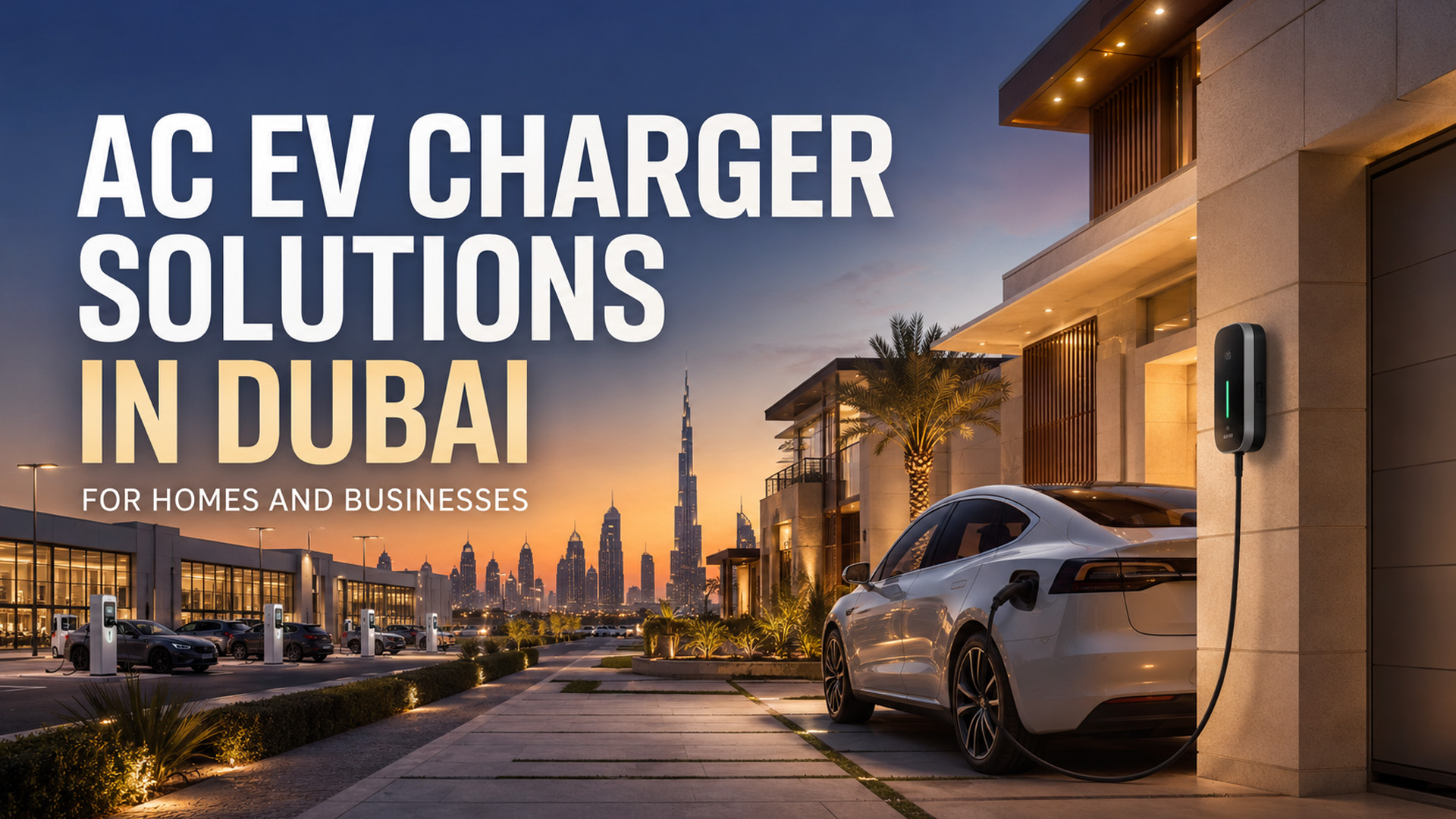
Choose the charging output around the vehicle, parking duration and electrical supply—not the largest number on the product label.
An AC charger is often the most practical way to support everyday electric-vehicle charging at homes, offices, hotels, residential buildings and commercial car parks. The difficult part is not deciding whether to install a charger; it is selecting a system that matches the vehicle, the property and the time available for charging.
An AC EV charger in Dubai is generally suitable where vehicles remain parked for several hours, including overnight residential parking and workplace charging. The appropriate output depends on the vehicle’s onboard charger, the available single-phase or three-phase supply, daily driving requirements and whether several chargers must share the property’s electrical capacity.
RBC Engineering evaluates these factors before recommending an AC charging configuration. Depending on the agreed project scope, the solution may include charger supply, electrical planning, load management, access controls, installation coordination, commissioning and operating support.
How an AC EV Charger Works
An AC charging station supplies alternating current to the electric vehicle. The vehicle’s onboard charger then converts that electricity into direct current for storage in the battery.
This distinction matters because the vehicle’s onboard charger can limit the actual charging rate. A vehicle designed to accept 7 kW AC charging will not charge at 22 kW simply because it is connected to a 22 kW station.
Charging performance can also be affected by:
- The available electrical supply
- Single-phase or three-phase connection
- The vehicle’s onboard charging limit
- Battery condition and state of charge
- Charging schedules and software settings
- Power shared with other chargers
- The building’s active electrical demand
The charger rating describes the equipment’s maximum capability. It does not guarantee that every vehicle or property can use that full output.
Choosing Between 7 kW, 11 kW and 22 kW AC Charging
Common AC charger ratings include 7 kW, 11 kW and 22 kW. The right option is the lowest practical rating that can deliver the required energy during the time the vehicle is normally parked.
| AC Charger Rating | Typical Electrical Requirement | Common Application | Important Consideration |
|---|---|---|---|
| 7 kW | Usually single-phase, subject to the property supply | Villas, private parking and overnight residential charging | Often sufficient when one vehicle remains parked for several hours |
| 11 kW | Usually three-phase | Homes with suitable supply, offices and shared residential parking | The vehicle must support the higher AC input to use the available output |
| 22 kW | Three-phase supply with suitable electrical capacity | Workplaces, hotels, commercial parking and higher-use AC applications | Many passenger vehicles cannot accept the full 22 kW through AC charging |
A larger charger can provide flexibility for compatible vehicles, but oversizing every charging point can increase electrical and infrastructure requirements without improving the actual user experience.
AC EV Chargers for Villas and Residential Parking
Residential charging works best when it becomes part of the driver’s normal parking routine. The vehicle is connected after the final journey of the day and receives the energy it needs before the next planned departure.
A home charging assessment should confirm:
- The vehicle model and maximum AC charging rate
- Average daily driving distance
- Available charging time
- Single-phase or three-phase property supply
- Distribution-board capacity
- Distance between the electrical source and parking bay
- Indoor or outdoor charger location
- Cable routing and protection
- Access control for shared parking
- Possible future ownership of a second electric vehicle
A dedicated charging circuit is normally more appropriate than relying on an ordinary socket for regular vehicle charging. The final electrical arrangement must be designed and installed according to the property and applicable local requirements.
Homeowners can review RBC Engineering’s home EV charging system guide for additional residential planning considerations.
Workplace EV Charging in Dubai
Offices are well suited to AC charging because employee vehicles may remain parked for much of the working day. This creates a longer charging window and can reduce the need for high-power equipment.
The project should still be designed around actual use. A workplace with ten charging bays does not necessarily need ten chargers operating at maximum output simultaneously.
Workplace Charging Decisions
- Will the chargers be reserved for employees or shared with visitors?
- Will charging be free, subsidised or billed?
- How many employees are expected to charge each day?
- Will users move their vehicles after charging is complete?
- Should particular users or fleet vehicles receive priority?
- How will electricity use be measured and reported?
- How many additional charging bays may be needed later?
Dynamic load management can distribute available capacity across several charging points, allowing the network to respond to the building’s demand and the number of connected vehicles.
Commercial AC Charging for Hotels, Retail and Managed Parking
AC chargers can add useful charging capacity at destinations where customers, guests or tenants remain parked for an extended period. These projects need more than electrical equipment; they also require a clear operating model.
Commercial operators should decide:
- Who is permitted to use the charging points
- Whether sessions are free, validated or paid
- How users begin and end a charging session
- Whether the system must integrate with parking or property software
- How charging bays will be monitored
- Who responds to user or equipment issues
- How usage and electricity consumption will be reported
Hotels may prioritise guest access and overnight charging, while retail sites may require shorter sessions and more active bay management. Offices may focus on employee authentication, and residential developments may need individual usage allocation.
For a broader property-level framework, review RBC Engineering’s guide to commercial EV charging stations.
What an AC EV Charger Site Assessment Should Check
The site assessment determines whether the proposed charger can be installed without creating avoidable safety, capacity or operational problems.
Electrical Review
- Incoming power supply
- Available single-phase or three-phase capacity
- Main and secondary distribution boards
- Existing and expected building demand
- Protection and isolation requirements
- Earthing arrangement
- Metering requirements
- Capacity for future charging points
Parking and Installation Review
- Parking-bay location
- Wall-mounted or pedestal installation
- Distance from the electrical supply
- Cable route and civil work
- Indoor or outdoor exposure
- Protection from vehicle impact
- Cable reach and storage
- Lighting, signage and accessibility
- Mobile, Wi-Fi or wired connectivity
The installation position should allow the cable to reach the vehicle inlet without creating a trip hazard or placing unnecessary tension on the connector.
RBC Engineering’s EV charging station design guide explains additional layout and future-expansion considerations.
Load Management for Multiple AC Chargers
Installing several AC chargers can create significant combined demand if every unit operates at its maximum rating at the same time. Load management allows the system to distribute available power according to defined rules.
A managed network may:
- Reduce charger output when building demand increases
- Share available capacity across connected vehicles
- Prioritise selected vehicles or users
- Schedule charging outside high-demand periods
- Increase output when capacity becomes available
- Monitor energy consumption by charger or user
Load management can reduce unnecessary pressure on the electrical supply, but it cannot compensate for a fundamentally undersized connection. The project still needs enough available energy to complete the required charging sessions within the normal parking period.
Smart AC Charger Features
Smart features can make an AC charging network easier to operate, particularly where several users share the same property.
Depending on the selected charger and management platform, available functions may include:
- RFID user authentication
- Mobile application control
- Remote start and stop
- Scheduled charging
- Energy-use reporting
- Charging-session records
- Fault notifications
- Dynamic load management
- Payment-system integration
- Remote software and configuration support
Not every project needs every feature. A private villa may require only scheduled charging and basic monitoring, while a commercial property may need user accounts, billing, reporting and system integration.
Read the guide to EV charging payments and access control when planning a shared or revenue-generating network.
Connector and Vehicle Compatibility
The connector must match the intended vehicles and the requirements of the project market. The charger specification should also identify whether the cable is permanently attached or the user must provide a separate charging cable.
Before procurement, confirm:
- The vehicle’s AC connector type
- The vehicle’s maximum onboard charging rate
- The required cable length
- Tethered or socketed charger preference
- Single-phase or three-phase compatibility
- Required communication protocol
- Access and payment functions
- Indoor or outdoor installation rating
Vehicle compatibility should be confirmed against the actual model and market specification rather than assumed from the brand name alone.
AC EV Charger Installation Process
- Requirement review: Confirm the vehicle, user type, parking duration and preferred charging output.
- Site assessment: Inspect the electrical supply, distribution board, parking position and cable route.
- Technical selection: Choose the charger, connector, mounting method and smart functions.
- Scope confirmation: Define equipment supply, electrical work, civil work, software and exclusions.
- Approval review: Confirm the permissions and documentation required for the property and project location.
- Installation: Complete the agreed circuit, protection, cable route, charger mounting and network connection.
- Configuration: Set charging limits, access rules, network settings and load-management controls.
- Testing and commissioning: Verify electrical safety, communication and successful vehicle charging.
- Handover: Provide the agreed operating guidance, documentation and warranty information.
Responsibilities should be clearly recorded where RBC Engineering supplies equipment but a separate electrical contractor or local partner performs the installation.
What Affects AC EV Charger Project Cost?
The charger is only one part of the total project cost. Two installations using the same equipment may have different budgets because of the electrical and physical work required.
Important cost factors include:
- Charger output and specification
- Single-phase or three-phase supply
- Distance from the distribution board
- Cable size and routing
- Electrical protection and metering
- Wall or pedestal mounting
- Civil work and reinstatement
- Network connectivity
- Load-management hardware
- Payment and access-control functions
- Number of charging points
- Testing, commissioning and maintenance scope
A technical assessment is more reliable than quoting a standard installation price without understanding the property.
Using Solar Power with an AC EV Charger
AC charging can be coordinated with on-site solar generation, particularly where vehicles are parked during daylight hours. The system must still balance solar production, building consumption and vehicle demand.
A solar-supported charging design should consider:
- Existing or proposed solar capacity
- Time of vehicle arrival and departure
- Building load during solar-production hours
- Available roof or carport area
- Charging schedules
- Grid import and export conditions
- Whether battery storage provides practical value
- Energy monitoring and control
Solar power does not guarantee that a charger will operate independently from the grid. The result depends on the available generation, the vehicle’s energy requirement and the building’s competing loads.
Explore RBC Engineering’s guide to solar-integrated EV charging for further planning information.
AC EV Charger Maintenance
AC chargers generally contain fewer high-power components than DC fast chargers, but they still require inspection and operational monitoring.
A maintenance plan may include:
- Visual checks of the enclosure and mounting
- Inspection of the cable, plug and socket
- Testing of protective devices
- Review of error logs and communications
- Software and configuration checks
- Cleaning of the charger and surrounding area
- Verification of signage and bay markings
- Review of charging-session records
- Replacement of damaged cables or connectors
Maintenance frequency should reflect the charger’s location and usage. A publicly accessible unit may require more frequent inspection than a private residential charger.
AC EV Charging Projects in the UAE, GCC and Africa
RBC Engineering can review AC charging enquiries from Dubai, other UAE emirates, GCC countries and selected African markets. Cross-border projects require a clearly defined delivery model.
The proposal should confirm equipment supply, shipping, local electrical work, approvals, commissioning, software support, warranty administration and spare-parts responsibilities. A charger suitable for one country should not automatically be presented as approved for another without reviewing the destination market’s requirements.
Request an AC EV Charger Proposal
Share the project location, vehicle model, parking duration, preferred number of charging points and available electrical supply. For shared or commercial sites, include any requirements for load management, user access, reporting, payments or future expansion.
Request an AC Charging Assessment
You can also review the broader EV charging solutions available through RBC Engineering.
Frequently Asked Questions
Is a 7 kW AC charger sufficient for home charging?
A 7 kW charger can be suitable when the vehicle remains parked for several hours and the daily energy requirement is moderate. The final decision should consider the vehicle’s onboard charger, daily driving distance and available property supply.
Will an 11 kW or 22 kW charger always charge faster?
No. The vehicle must support the higher AC input, and the property must provide the required electrical supply. A vehicle limited to a lower AC rate will not use the charger’s full output.
Can several AC chargers be installed in one car park?
Yes. Multiple chargers can be connected as a managed network, subject to the available electrical capacity. Dynamic load management can distribute power according to building demand and charging priorities.
What is the difference between an AC charger and a DC fast charger?
An AC charger sends alternating current through the vehicle’s onboard charger and is suited to longer parking periods. A DC fast charger supplies direct current to the battery and is intended for shorter, higher-power charging sessions.
Can an AC EV charger be used at an office or hotel?
Yes. AC charging is often suitable for offices, hotels and other destinations where vehicles remain parked for several hours. The project may require access control, usage reporting, billing or load management.
Can an AC charger work with solar panels?
Yes. Solar generation can contribute to vehicle charging when production and charging demand occur at the same time. The building’s other loads and any grid or battery requirements must also be considered.
What information is needed for an AC charger quotation?
Provide the project location, vehicle model, number of charging points, parking duration and available electrical supply. Details about cable routes, access control, load management, installation and future expansion will improve proposal accuracy.
Can RBC Engineering supply AC chargers outside Dubai?
RBC Engineering can assess enquiries from other UAE emirates, GCC countries and selected African markets. The final scope must define shipping, local installation, approvals, commissioning, warranty and maintenance responsibilities.