

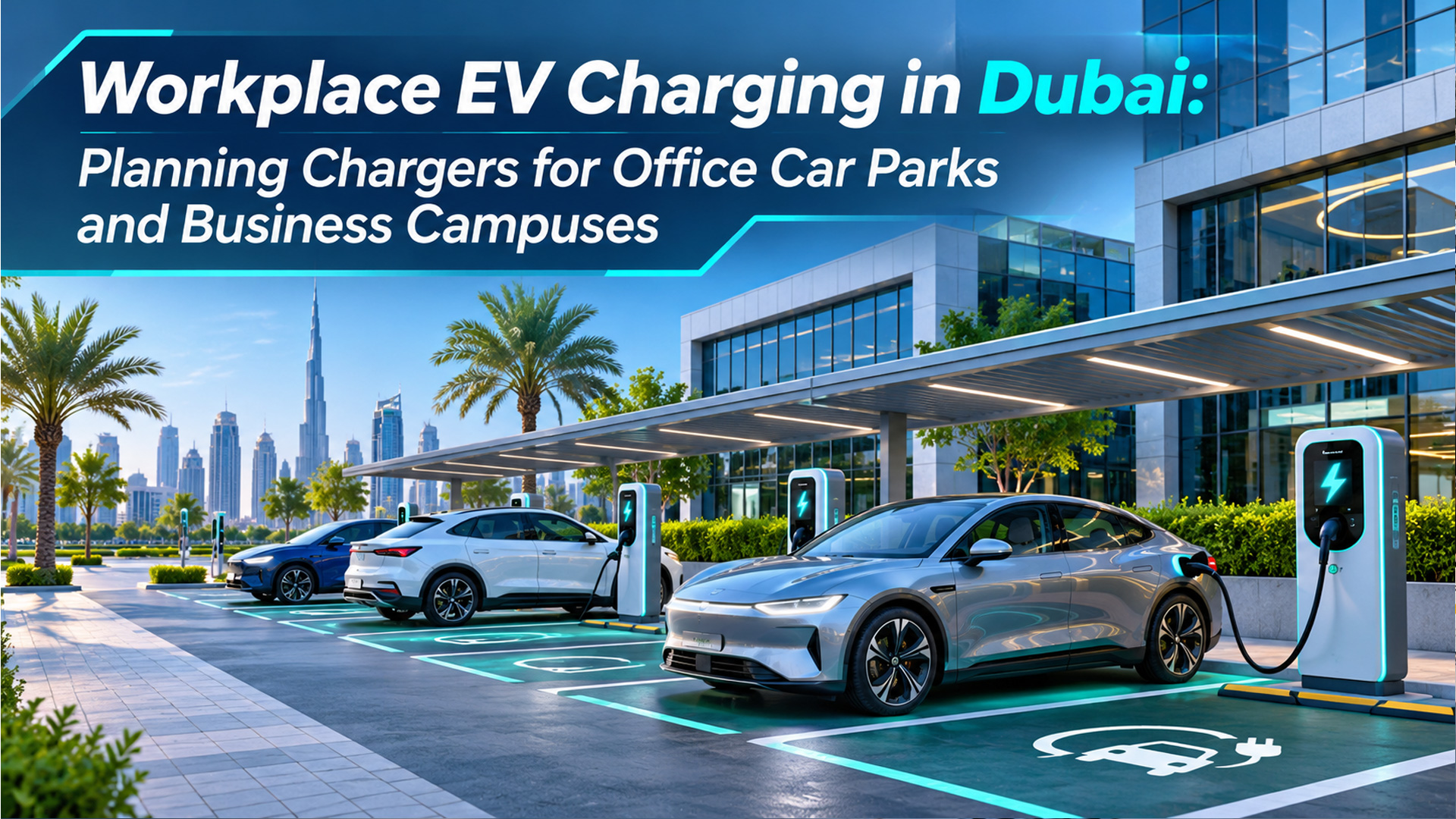
🔌 Employees park for eight hours. That makes the office car park one of the most practical places to charge an electric vehicle.
More employees, visitors and company fleets in Dubai are switching to electric vehicles, and many of them will ask the same question: can I charge at work? For building owners and employers, workplace EV charging in Dubai is becoming part of the tenant experience, the employee benefits package and the company’s sustainability story.
Workplace charging is different from public fast charging. Cars sit for long periods, so slower AC charging usually does the job at lower cost. The real planning challenges sit elsewhere: how much power the building can spare, who gets to charge, how usage is recorded and paid for, and how the system grows as demand increases.
Direct answer: Workplace EV charging is best planned around long parking times, available electrical capacity, the number of current and future EV users, access control and billing policy. AC chargers suit most office car parks, with smart load management sharing available power across chargers. Plan cabling for future expansion, choose networked chargers that support user authentication and data, and obtain the required approvals before installation.
Why Workplace Charging Is Different
- Long dwell time: employees park for most of the working day, so lower-power chargers can still deliver a full day’s driving range.
- Predictable users: staff, tenants and fleet vehicles are known, which simplifies access control.
- Shared electrical supply: chargers compete with the building’s cooling, lighting and other loads.
- Policy questions: who pays, how time is shared and what happens when demand exceeds chargers.
AC or DC for the Workplace?
| Charger type | Typical power | Best fit at workplaces |
| AC wall-mounted | Up to 22 kW depending on charger and vehicle | Staff parking with long dwell time |
| AC floor-mounted | Up to 22 kW per connector | Open car parks without walls |
| DC fast charger | Higher power for quick top-ups | Visitor bays, fleet turnaround, pool vehicles |
Most workplace sites start with AC chargers and add a limited number of DC units where vehicles need rapid turnaround. Our guide to EV charger types and power levels and our article on AC EV chargers in Dubai explain the options in detail.
Electrical Capacity and Load Management
The building’s available electrical capacity often decides how many chargers can be installed. Office buildings in Dubai have high daytime cooling loads, which coincide with working-hour charging.
Smart load management solves much of this. Instead of every charger drawing full power, the system shares available capacity dynamically, reducing charging power when building demand is high and increasing it when capacity frees up. Learn more in our article on the benefits of smart charging and load balancing.
Key insight: The question is rarely “how many chargers can we afford?” but “how much power can we spare?” Load management lets more chargers share the same supply safely.
Access, Authentication and Billing
Workplace chargers need rules. Common approaches include:
- RFID cards or app access so only authorized users can charge
- Free charging as a benefit, with usage tracked for reporting
- Cost recovery, where employees or tenants pay for energy used
- Fleet allocation, reserving chargers for company vehicles
- Time limits or rotation, encouraging users to move vehicles after charging
Networked chargers with management software make these policies workable and provide usage data. Our guide to integrating EV charging payments and access control covers the options.
Planning for Growth
EV adoption at a workplace often starts slowly and then accelerates. The cheapest time to prepare for that growth is during the first installation:
- Install cable containment and spare conduit for future bays
- Size distribution boards and cabling for later expansion where practical
- Choose chargers and software that scale without replacing the network
- Allocate future charging bays in the parking plan
For existing car parks, see our article on upgrading car parks with EV charging infrastructure.
Key insight: Build the cabling for the chargers you will need in five years, and install the chargers you need today. Retrofitting containment later costs far more than installing it once.
Approvals and Installation in Dubai
EV charger installations in Dubai require the appropriate approvals and connections through DEWA and, for multi-tenant buildings, coordination with the building owner or facility manager. Installation should be carried out by qualified contractors, with electrical protection, earthing and signage meeting the applicable requirements. Confirm current DEWA requirements for your site before procurement.
Operation and Maintenance
Workplace chargers are used daily, so availability matters. A maintenance plan should cover:
- Routine inspection of cables, connectors and enclosures
- Firmware and software updates
- Monitoring for faults and remote diagnostics
- Response times for repairs
- Cleaning and protection from heat and dust
Our guide to EV charger maintenance services in Dubai explains how to keep charging points reliable.
Fleets and Workplace Charging Together
Many workplaces combine employee charging with company fleet vehicles such as pool cars, sales vehicles or delivery vans. These users have different needs. Fleet vehicles may need guaranteed charge by a set time, while employee vehicles are more flexible.
Practical approaches include:
- Dedicated fleet bays with priority in the load management system
- Overnight fleet charging when employee demand and building load are low
- Scheduled charging so fleet vehicles are ready for morning departures
- Separate reporting to track fleet energy costs against operating budgets
A small number of DC chargers can support fleet vehicles that need quick turnaround during the day, while AC chargers serve employees parked for the full shift. Our guide to DC fast charger solutions in Dubai explains when higher-power charging makes sense for fleets.
Planning fleet and employee charging together avoids building two separate systems, and allows the same infrastructure, software and maintenance contract to serve both.
Common Mistakes in Workplace Charging Projects
- Installing chargers without checking building electrical capacity
- Choosing non-networked chargers that cannot manage access or billing
- No policy on who can charge and for how long
- Skipping containment for future expansion
- Placing chargers where cables cross walkways or block parking
- Ignoring maintenance until a charger fails
How RBC Engineering Supports Workplace EV Charging
RBC Engineering supplies EV charging systems, including AC wall-mounted and floor-mounted chargers and DC chargers, for commercial, fleet and residential sites in Dubai and the UAE. For a workplace charging enquiry, share the number of parking spaces, current and expected EV users, building electrical capacity, preferred access and billing approach and any fleet requirements. For broader commercial sites, see our guide to commercial EV charging stations.
Frequently Asked Questions
How many chargers does an office need?
Start with current EV users plus expected growth over the next few years, and use load management and shared charging rules to serve more users per charger.
Is AC charging enough for employees?
For most employees, yes. Long parking times allow AC chargers to deliver a meaningful charge during the working day.
Can the building’s power supply handle EV chargers?
It depends on spare capacity. A load assessment and smart load management allow chargers to share available power without overloading the supply.
Should employers charge employees for EV charging?
That is a policy choice. Some offer free charging as a benefit, while others recover costs. Networked chargers allow either approach.
Can workplace chargers be used by visitors?
Yes, if access control and payment options are set up for them. Some sites reserve specific bays for visitors.
What approvals are needed for workplace chargers in Dubai?
Installations require the relevant DEWA approvals and coordination with the building owner. Confirm the current requirements before purchasing equipment.
Make the Car Park Part of the Workplace Offer
Well-planned office EV charging gives employees and tenants a practical reason to choose electric vehicles and shows that the business is ready for the shift. Start with power capacity and policy, choose networked chargers, and build in room for growth.
Planning EV charging for an office car park or business campus in Dubai? Call RBC Engineering on +971 55 502 2471, email info@rbcengineering.ae, or share your site details to discuss charger options.