

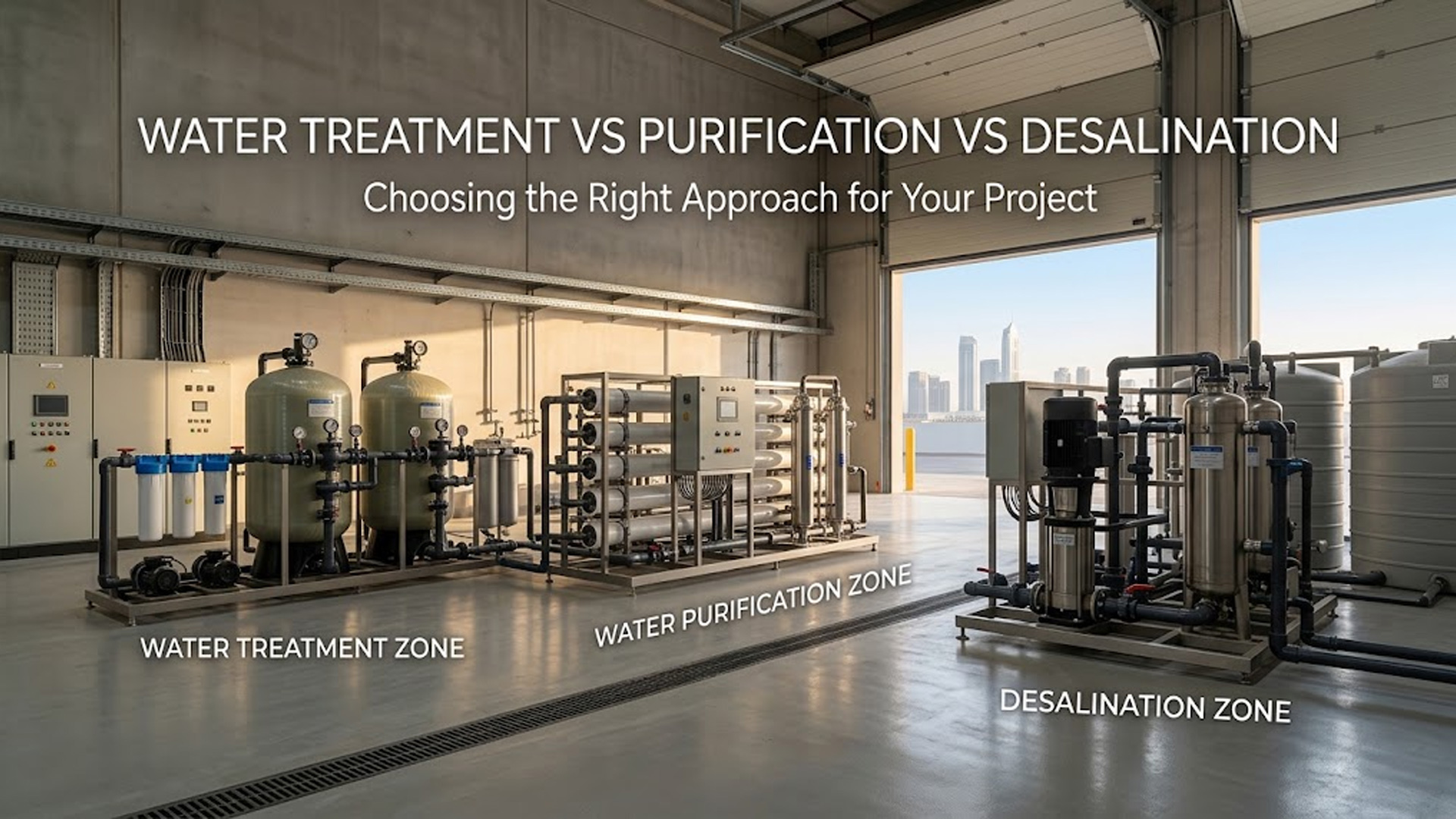
Water-treatment enquiries often begin with the name of a technology: filtration, reverse osmosis, purification or desalination. The more useful starting point is different. Buyers first need to understand the source water, what must be removed or controlled, how much treated water is required and what quality the finished water must achieve.
Water treatment is the broad process of changing water quality for a defined use, while water purification generally focuses on removing unwanted substances to achieve a higher-quality output. Desalination is a more specific treatment process used to reduce dissolved salts in seawater or brackish water. The correct approach depends on feedwater analysis, required output and the intended application.
The Difference in Simple Terms
The three terms are related, but they should not be treated as interchangeable.
| Category | Primary Purpose | Typical Starting Point |
| Water treatment | Changes water quality to make it suitable for a particular process or use. | Identify the water problem and required output. |
| Water purification | Removes or reduces selected contaminants to achieve a specified water quality. | Define what must be removed and the required final quality. |
| Desalination | Reduces dissolved salts in saline or brackish water. | Establish salinity, feedwater chemistry and freshwater requirement. |
A project can also involve more than one of these categories. For example, desalination is itself a form of water treatment, and a desalination plant normally requires pretreatment before the main salt-removal process.
What Is Water Treatment?
Water treatment is the broadest category. It describes the physical, chemical or membrane processes used to change water characteristics so the water is more suitable for a defined application.
Depending on the project, a treatment system may need to address:
- suspended particles and sediment;
- hardness;
- dissolved salts;
- specific dissolved substances;
- organic compounds;
- microbiological risks;
- pH or chemical balance;
- process-specific water-quality requirements; or
- a combination of several conditions.
The treatment train can therefore include filtration, softening, activated carbon, membrane processes, chemical conditioning, disinfection or other technologies selected for the actual water characteristics.
For broader commercial and industrial requirements, RBC Engineering provides information on water treatment equipment and related support for UAE projects.
What Is Water Purification?
Water purification generally describes treatment intended to achieve a defined level of contaminant removal or water quality. The required degree of purification depends on what the water will be used for.
A purification system might incorporate:
- sediment filtration;
- activated-carbon treatment;
- ultrafiltration (UF);
- reverse osmosis (RO);
- UV disinfection;
- ion exchange;
- chemical treatment; or
- multiple treatment stages working together.
The term “purifier” should not be treated as a technical specification by itself. Two systems described commercially as water purifiers can use completely different treatment methods and deliver very different output water.
Buyers evaluating filtration, membrane treatment or related purification options can review RBC Engineering’s water purification equipment category.
What Is Water Desalination?
Desalination has a more specific objective: reducing dissolved salts in saline water to produce water suitable for the intended downstream use.
Common source waters include:
- seawater;
- brackish groundwater; and
- other saline water sources requiring significant salt reduction.
Reverse osmosis is widely used for membrane desalination, while thermal technologies can also be applied to desalination at appropriate scales and applications.
What matters during procurement is not simply choosing “a desalination machine”. Feedwater salinity, water chemistry, required output, pretreatment, operating conditions, reject management, site utilities and finished-water requirements all influence the plant configuration.
Projects where dissolved-salt reduction is the main requirement can review RBC Engineering’s water desalination equipment information.
Engineering procurement insight: Reverse osmosis describes a treatment technology, while desalination describes an application. An RO system treating moderately mineralised process water and an RO plant treating seawater may share the same basic separation principle, but they should not be treated as equivalent systems.
Does Every Water Purification System Need RO?
No. Reverse osmosis is valuable when dissolved constituents need to be reduced to meet the required output specification, but not every water-quality problem requires that level of separation.
If the main problem is suspended sediment, an appropriate filtration process may be sufficient for that particular treatment stage. If hardness is the main concern, ion exchange or another hardness-management strategy may be relevant. If microbial control is required, disinfection must be considered as part of the treatment process.
Conversely, conventional particulate filtration alone does not provide the same dissolved-solids separation as RO.
The process should follow the water-quality requirement rather than forcing every application into one technology.
Why Feedwater Analysis Changes the Decision
Equipment selection should be based on what is actually present in the feedwater.
A useful water analysis can help project teams identify parameters that affect:
- filter selection;
- membrane suitability;
- scaling potential;
- fouling risk;
- chemical treatment requirements;
- disinfection strategy;
- materials selection;
- cleaning requirements; and
- the achievable treated-water specification.
The laboratory test programme should match the source water and intended application. A generic test that omits important project-specific parameters may still leave major design questions unanswered.
Why Required Water Quality Matters Just as Much
Knowing the feedwater tells the project team where treatment begins. The required output tells them where the treatment process needs to finish.
Statements such as “clean water”, “pure water” or “good-quality water” are not sufficient specifications for engineering procurement.
Instead, determine:
- what the treated water will be used for;
- which water-quality parameters matter to that process;
- whether a specific customer or process specification applies;
- whether the application is health-sensitive;
- whether downstream equipment imposes quality requirements; and
- how treated-water quality will be monitored or verified.
If the water is intended for drinking or another health-sensitive application, the applicable local water-quality requirements and verification regime should be established for the project. Dubai Municipality maintains current health and safety technical guidance, including guidance related to water quality and water systems.
Can Filtration, Purification and Desalination Be Used Together?
Yes. Real treatment plants often use several processes in sequence.
For example, a membrane desalination system may require upstream treatment to protect the membrane process from suspended material, fouling or scaling. After the main separation stage, additional conditioning or disinfection may be required depending on the intended use.
This is why equipment should be evaluated as a complete treatment train rather than as isolated machines.
How to Decide Which Category Your Project Falls Into
Start with the water source
Identify whether the source is municipal water, groundwater, borewell water, seawater, brackish water, process water, treated wastewater or another source.
Define the actual problem
Are you dealing with sediment, hardness, salinity, microbial risk, a process contaminant or a combination of issues?
Define the required output
Specify the required flow, daily production, operating hours and finished-water quality.
Define the end use
Water for industrial processes may have different requirements from water used for general utilities, cleaning, irrigation or drinking.
Consider the entire site
Space, electricity, drainage, storage, access, chemical handling, automation and maintenance requirements can all affect equipment selection.
RBC Engineering project insight: A well-written enquiry describes the problem before naming the solution. Providing feedwater data, required output and application details gives the project team a stronger basis for deciding whether the system needs filtration, membrane purification, desalination or a combined treatment train.
What to Compare When Reviewing Water-System Quotations
Two quotations should not be compared solely by plant capacity and purchase price.
| Comparison Item | Why It Matters |
| Feedwater design basis | Shows what water conditions the proposed equipment has been selected to handle. |
| Treated-water requirement | Defines what the proposed system is expected to produce. |
| Pretreatment | Can materially affect reliability of downstream membrane or treatment equipment. |
| Main treatment process | Determines how the required contaminants or water characteristics will be addressed. |
| Instrumentation and controls | Affects monitoring, operation and fault identification. |
| Waste or reject management | Determines how process waste streams will be handled. |
| Consumables and maintenance | Influences ongoing operating requirements and lifecycle planning. |
| Commissioning scope | Clarifies how system operation and initial performance will be established. |
What to Include in Your Project Enquiry
- project location;
- water source;
- recent water analysis where available;
- required flow rate;
- required daily treated-water output;
- operating hours;
- target water quality;
- intended application;
- existing treatment system, if applicable;
- available installation space;
- electrical and utility information;
- storage requirements;
- automation and monitoring requirements;
- known reject, drainage or discharge constraints; and
- installation, commissioning or maintenance support required.
Frequently Asked Questions
Is water purification the same as water treatment?
Water purification is generally part of the wider water-treatment field. Water treatment can include conditioning processes that do not necessarily aim for highly purified water, while purification normally focuses more directly on removing selected unwanted substances to achieve a defined output quality.
Is reverse osmosis the same as desalination?
No. Reverse osmosis is a membrane-separation technology. Desalination is an application focused on reducing salts from saline water, and RO is one of the technologies that can be used for that purpose.
Do I need a water analysis before requesting equipment?
A water analysis is highly valuable for final treatment selection because it identifies the characteristics the equipment must address. Early discussions can begin without complete data, but final system specification should not rely on flow rate alone.
Can normal filtration remove dissolved salts?
Conventional particulate filtration is mainly used for suspended material and does not provide the same dissolved-salt reduction as reverse osmosis. The appropriate process depends on what must be removed.
Can one plant combine filtration and RO?
Yes. Filtration or another pretreatment process is commonly used upstream of membrane treatment where feedwater conditions require it. The exact treatment sequence should be selected from project-specific water data.
How do I know whether my project needs desalination?
If the source water contains significant salinity that must be reduced for the intended use, desalination may be required. Feedwater analysis and target water quality are needed before determining the appropriate process.
Discuss Your Water Requirements
If your project requires water treatment, purification or desalination equipment, provide the available water analysis, source-water information, required output and intended application. Contact RBC Engineering to discuss the project requirements and the information needed to evaluate an appropriate treatment approach.