

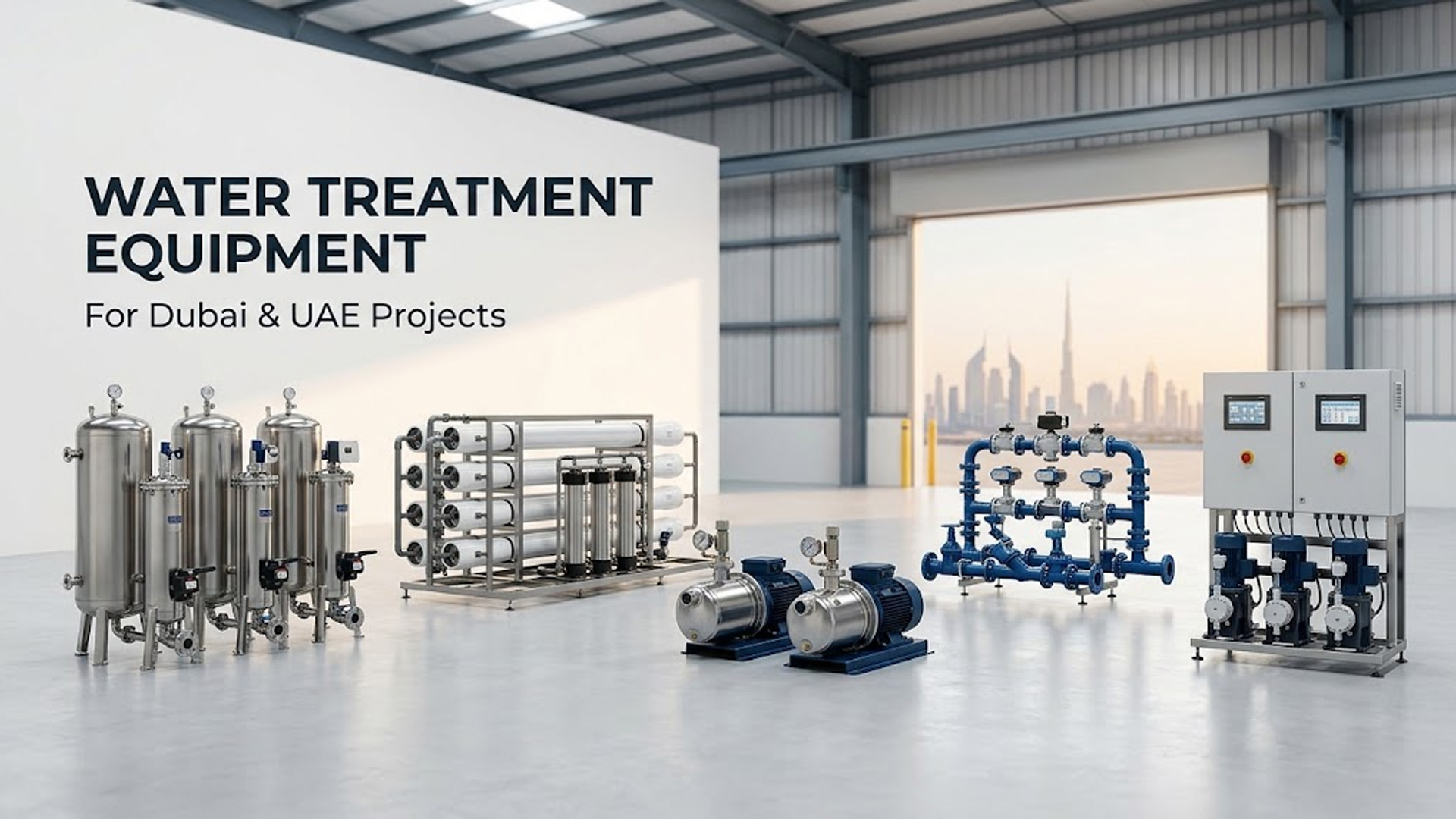
Selecting water treatment equipment should start with the water itself, not with a preferred machine or treatment technology. For commercial buildings, industrial facilities and infrastructure projects, the right system depends on the source-water characteristics, required flow, operating profile, target water quality, available utilities and what must happen to any waste or reject stream.
Water treatment equipment is used to remove, reduce or control unwanted substances in water so that it meets the requirements of a particular application. The correct treatment process can involve filtration, softening, membrane separation, disinfection, chemical conditioning or a combination of technologies selected from actual feedwater and output requirements.
Water Treatment Starts with the Water, Not the Equipment
A common procurement mistake is to begin by asking for a particular technology before defining the problem it needs to solve. Requests such as “we need an RO plant” or “we need a filtration system” may be understandable starting points, but they do not provide enough information to specify a reliable treatment system.
Two sites requiring the same daily volume of treated water can need very different equipment if their source water, contaminants, operating hours or final water-quality requirements are different. Even within the same facility, water used for process equipment may require a different treatment approach from water intended for washing, utilities or other building uses.
Before equipment selection, the project team should establish:
- the source of the incoming water;
- a recent water analysis where available;
- the required flow rate and daily output;
- operating hours and demand profile;
- the required treated-water quality;
- the intended application of the treated water;
- available storage capacity;
- electrical and other utility requirements;
- available installation footprint;
- automation and monitoring requirements; and
- how backwash, concentrate, sludge or other discharge streams will be managed where applicable.
Engineering procurement insight: A treatment plant cannot be selected reliably from flow rate alone. Feedwater chemistry and required output quality can change the treatment sequence, membrane requirements, chemical conditioning, operating pressure, instrumentation, maintenance requirements and waste-handling arrangements.
What Types of Water Treatment Equipment May Be Required?
Water treatment is rarely limited to one universal piece of equipment. Depending on the source water and the required result, a treatment train may combine several stages, with each stage performing a specific function.
| Technology or Equipment | Typical Function | Important Buyer Question |
| Sediment and media filtration | Reduces suspended particles and selected physical contaminants before downstream treatment or use. | What particle loading, turbidity and flow conditions must the filters handle? |
| Activated carbon treatment | Can be used to reduce selected organic compounds, taste or odour issues and certain chemicals depending on the application. | What contaminants are being targeted and what media replacement or monitoring regime will be required? |
| Water softening / ion exchange | Can be used where hardness or specific dissolved ions need to be controlled. | What is the feedwater hardness, required output and regeneration requirement? |
| Ultrafiltration (UF) | Uses membrane separation to remove suspended and particulate material while allowing much of the dissolved content to remain. | Is UF being used as the principal treatment stage or as pretreatment for another membrane process? |
| Reverse osmosis (RO) | Uses pressure-driven membrane separation to reduce dissolved salts and other dissolved constituents. | What are the feedwater chemistry, salinity, pretreatment requirements and required permeate quality? |
| UV disinfection | Uses ultraviolet treatment for microbial inactivation where appropriate to the application. | What upstream water quality and validated treatment performance are required? |
| Chemical dosing and conditioning | Can support pH control, coagulation, disinfection, scale control or other treatment objectives. | What chemical, dosing rate, storage, control and safety arrangements are required? |
| Monitoring and control equipment | Measures and controls relevant process conditions such as flow, pressure, conductivity or other water-quality parameters. | Which parameters must operators monitor, record or integrate with the site’s control system? |
The list above is not a design specification. A real project may require only some of these technologies or may require additional treatment stages depending on the water analysis, process and required output.
Water Treatment, Water Purification and Desalination Are Not the Same Thing
These terms are sometimes used interchangeably in procurement enquiries, but they describe different scopes. Defining the correct category helps buyers compare proposals on the same technical basis.
Water Treatment
Water treatment is the broadest term. It can include physical, chemical and membrane processes used to condition water for a defined application. A treatment system may address suspended solids, hardness, dissolved substances, microbiological risks or process-specific water-quality requirements.
Water Purification
Purification generally refers to treatment intended to achieve a higher degree of removal or control of unwanted constituents. Depending on the application, this may involve membrane treatment, filtration, activated carbon, disinfection or several stages working together.
Projects specifically evaluating RO, filtration, UV or related purification technologies can review RBC Engineering’s water purification equipment information separately.
Water Desalination
Desalination specifically addresses water containing significant dissolved salts, such as seawater or brackish water. Reverse osmosis can be used for desalination, but this does not mean every RO application is a desalination project or that every water-treatment project requires RO.
Where salinity reduction is the primary requirement, buyers can review RBC Engineering’s water desalination equipment category.
Why Reverse Osmosis Is Not Automatically the Right Answer
RO is an important water-treatment technology, but specifying it before understanding the water can result in an unnecessarily complicated system or an incomplete treatment train.
A project may primarily need suspended-solids control, hardness reduction, disinfection or another form of conditioning. Conversely, where dissolved salts or specific dissolved constituents must be reduced, conventional particulate filtration alone may not achieve the required result.
The question should therefore be:
What must the treatment system achieve?
Once that is known, engineers and suppliers can evaluate which combination of treatment processes is appropriate.
Why Pretreatment Matters in Membrane Systems
Membrane equipment operates as part of a treatment train. Feedwater conditions can affect fouling, scaling, pressure requirements, cleaning frequency and membrane performance, so upstream treatment should be considered during system design rather than added as an afterthought.
For an RO project, pretreatment may involve physical filtration, chemical conditioning, hardness or scale control, activated carbon, ultrafiltration or another process depending on the feedwater analysis. The exact combination cannot be determined responsibly without project data.
This is particularly important when comparing quotations. Two proposals with the same nominal output capacity are not necessarily technically equivalent if one includes the required pretreatment, instrumentation and discharge arrangements while another quotes only the primary treatment unit.
RBC Engineering project insight: When reviewing water-treatment quotations, compare the complete process scope rather than only the headline plant capacity. Pretreatment, pumps, instrumentation, controls, storage interfaces, consumables, maintenance access and reject or backwash management can materially affect how practical the final system is to operate.
Commercial and Industrial Water Treatment Requirements
Commercial and industrial buyers usually need to look beyond the initial equipment purchase. The treatment system has to fit into an operating facility and provide the required water consistently under the site’s actual working conditions.
Relevant applications can include:
- commercial buildings and facilities;
- hotels and hospitality properties;
- industrial process-water systems;
- manufacturing facilities;
- utility-water preparation;
- boiler or cooling-system water preparation where project-specific treatment is required;
- construction and infrastructure facilities;
- agricultural and irrigation applications where suitable;
- water reuse projects; and
- residential applications requiring dedicated treatment equipment.
Residential buyers looking for a household-focused treatment discussion can also review RBC Engineering’s residential water treatment systems resource.
Eight Questions to Answer Before Selecting Water Treatment Equipment
- Where does the feedwater come from?
Municipal water, borewell water, process water, groundwater, seawater and wastewater streams present different treatment challenges. Source identification should therefore come before technology selection.
- What does the water analysis show?
A laboratory analysis gives the project team a factual basis for identifying the substances or characteristics that require treatment. The parameters required depend on the source and intended application, so the test scope should also be relevant to the project.
- What water quality is required after treatment?
“Clean water” is not an engineering specification. The required quality should be defined against the intended use, process requirement or applicable standard.
- What flow rate and daily production are needed?
Peak flow and total daily output are different requirements. A system serving intermittent demand may be configured differently from one expected to operate continuously.
- How many hours per day will the system operate?
Operating hours affect equipment duty, storage requirements and the relationship between instantaneous production capacity and total daily demand.
- What space and utilities are available?
Equipment must fit the real site. Access for maintenance, electrical supply, drainage, chemical storage where applicable, ventilation, pipe routing and future component replacement should be considered before finalising the layout.
- What happens to the waste stream?
Backwash water, membrane concentrate, regeneration waste or sludge cannot simply be ignored during procurement. The project should identify how each relevant stream will be collected, discharged, treated or reused in accordance with the applicable site requirements.
- Who will operate and maintain the system?
A technically capable plant can still become difficult to operate if consumables, cleaning requirements, instrumentation and maintenance access were not considered during procurement. The operating model should therefore influence the system specification.
What Should Be Compared in Water Treatment Quotations?
Price comparison is useful only when suppliers are quoting comparable technical scopes. Before awarding an order, buyers should understand what is included and excluded.
- design or rated flow conditions;
- stated feedwater basis;
- required treated-water specification;
- pretreatment stages;
- main treatment technology;
- pumps and pressure requirements;
- filter or membrane configuration where relevant;
- instrumentation and process controls;
- chemical dosing equipment where required;
- storage or tank interfaces;
- electrical and control requirements;
- automation and alarm functions;
- backwash or reject arrangements;
- consumables and routine replacement items;
- commissioning scope;
- operator requirements;
- maintenance scope; and
- availability of spare and replacement components.
A lower initial quotation can become a poor procurement decision if important process stages or operating requirements have simply been excluded from the quoted scope.
Plan for Operation and Maintenance Before Installation
Water-treatment performance depends on more than the original equipment selection. Filters require inspection or replacement, membranes may require cleaning, chemical dosing systems need replenishment and control, instrumentation must remain reliable, and pumps and valves require normal mechanical maintenance.
Maintenance planning should therefore consider:
- filter and media replacement requirements;
- membrane monitoring and cleaning where applicable;
- chemical consumption and storage;
- pump, valve and seal maintenance;
- instrument inspection and calibration requirements;
- sampling and water-quality verification;
- critical spare parts;
- safe equipment access; and
- records of operating conditions and maintenance activities.
The objective is not to prescribe a generic maintenance interval. Service requirements should follow the selected equipment, feedwater conditions, operating duty and manufacturer instructions.
Potable Water Requires More Than an Equipment Claim
If treated water is intended for drinking or another health-sensitive application, the project must identify the applicable water-quality requirements and verify the finished water against those requirements. Installing a filter, UV unit or RO system does not by itself prove that the resulting water is suitable for drinking.
For Dubai projects, current authority requirements should be checked for the specific application. Dubai Municipality’s technical guidelines provide a current starting point for relevant municipal guidance, while project teams should confirm which standards and approvals apply to their particular facility and intended water use.
Testing, commissioning and ongoing monitoring should be defined according to the project requirement rather than replaced by generic claims such as “100% pure” or “guaranteed potable”.
What to Include in Your Water Treatment Project Enquiry
A more complete enquiry allows the technical discussion to begin with useful project information instead of assumptions. Where available, provide:
- project location;
- facility or application type;
- source of the feedwater;
- recent laboratory water analysis;
- required flow rate;
- required daily output;
- expected operating hours;
- required treated-water quality;
- intended use of the treated water;
- available storage capacity;
- available electrical supply and utilities;
- installation footprint and access restrictions;
- automation or monitoring requirements;
- existing treatment equipment, if this is an upgrade;
- known discharge or reject-water requirements; and
- installation, commissioning or maintenance support required.
If some of these details are not yet available, the enquiry should clearly identify what is known and what still needs to be established. It is better to define missing information early than to base an equipment order on assumptions.
How RBC Engineering Supports Water Treatment Projects
RBC Engineering provides water-treatment equipment support within its broader engineering services portfolio in Dubai. Current service information covers water-treatment equipment supply and support activities including installation, maintenance and system optimisation.
The practical starting point is to discuss the project requirement rather than select a technology from a product name alone. Feedwater conditions, required output, treatment objective, site constraints and operating requirements can then be reviewed to establish the appropriate equipment scope.
For projects involving several engineering systems, water treatment should also be coordinated with the facility’s electrical supply, controls, plant access, drainage, storage and other infrastructure requirements rather than treated as an isolated package.
Frequently Asked Questions
What is the best water treatment system for an industrial facility?
There is no single best system for every industrial site. Selection depends on feedwater analysis, flow and operating requirements, the process using the treated water and the quality that process requires. A treatment train should be developed from those inputs rather than from the facility type alone.
Does every water treatment system need reverse osmosis?
No. RO is appropriate when the required treatment objective calls for membrane separation of dissolved constituents, but other projects may primarily require filtration, softening, disinfection, chemical conditioning or another process. Water analysis and the required output determine whether RO is necessary.
What is the difference between water filtration and water treatment?
Filtration is one form of water treatment. Water treatment is the broader process and may include filtration together with softening, membrane separation, disinfection, chemical conditioning and other stages.
Can a water treatment system be sized without a water analysis?
Flow and demand information can support early planning, but they are not sufficient for a reliable final treatment specification. Feedwater characteristics influence the technology, pretreatment and operating requirements, so appropriate water-quality data should be obtained before final equipment selection.
How do I compare two water treatment equipment quotations?
Compare the design basis and complete treatment scope, not only capacity and price. Check the assumed feedwater, required output quality, pretreatment, pumps, membranes or filters, instrumentation, controls, reject management, commissioning, consumables and maintenance requirements.
Does installing an RO or UV system automatically make water potable?
No. Potable suitability depends on the complete treatment process, source-water risks, applicable water-quality requirements and verification of the treated water. An individual technology name should not be treated as proof of drinking-water compliance.
What information should I send when requesting water treatment equipment?
Provide the project location, source water, water analysis where available, required flow and daily output, target water quality, intended application, operating hours, utilities, site constraints and any discharge or automation requirements. This gives the project team a much stronger basis for discussing the equipment scope.
Discuss Your Water Treatment Requirements
If you are planning a new water-treatment system, replacing existing equipment or reviewing a treatment requirement for a commercial or industrial facility, provide RBC Engineering with the available feedwater information, required output and site conditions. Contact RBC Engineering to discuss the project requirements and the information needed for an appropriate equipment assessment.