

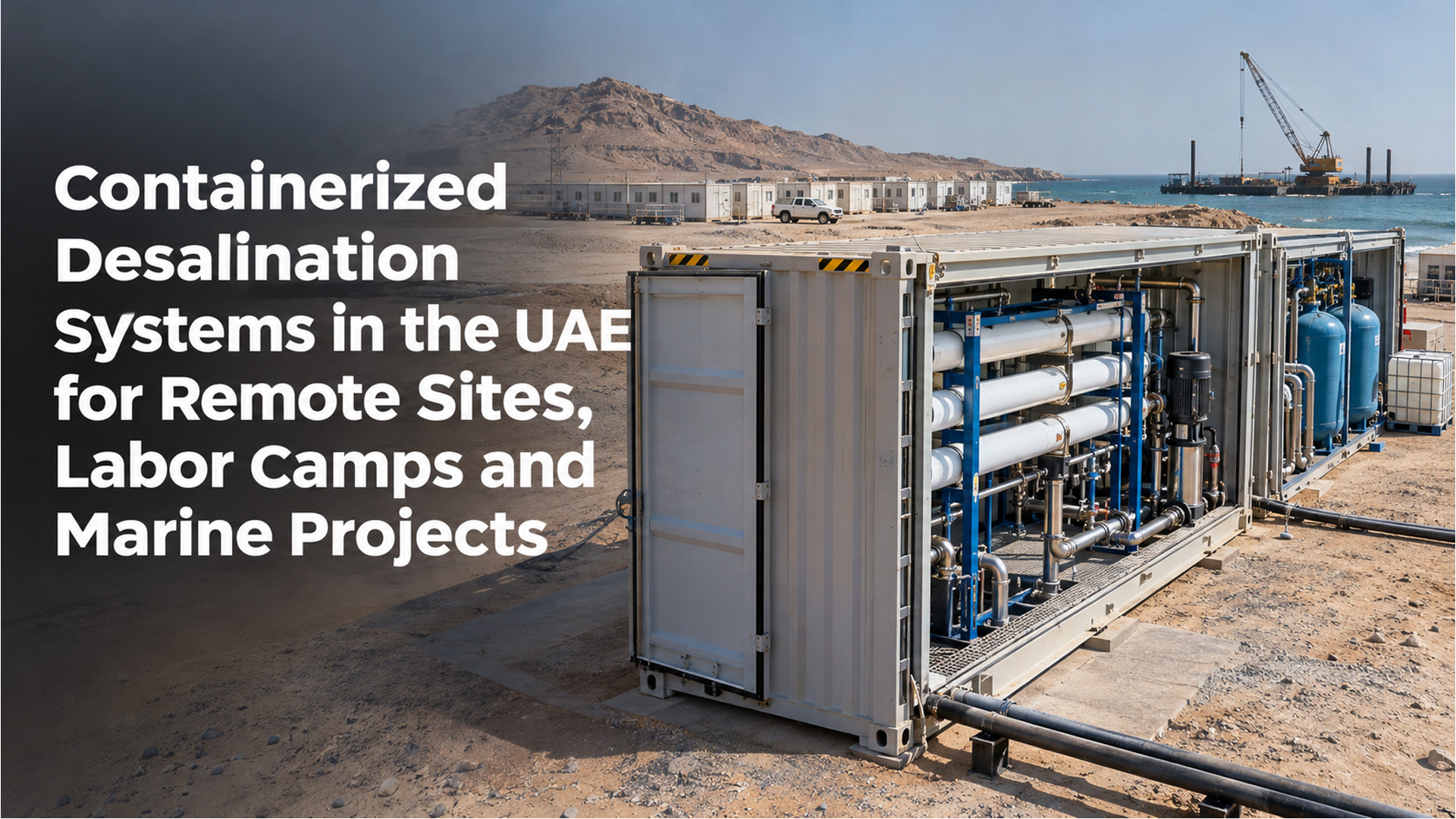
🚚 When the nearest water network is kilometers away, a well-planned mobile desalination unit can turn seawater or brackish groundwater into a dependable on-site supply.
A containerized desalination system in the UAE usually enters the conversation for a practical reason: the project needs water where tankers are expensive, slow or unreliable. Desert construction sites, island developments, labor accommodation, coastal resorts under construction and marine facilities all face the same question. Should water keep arriving by truck, or should it be produced on site?
A containerized or skid-mounted plant packs pretreatment, reverse osmosis, controls and often post-treatment into a transportable footprint. That makes it attractive for temporary or remote work. It also creates design questions that a permanent plant room never has to answer, from how the intake survives a shifting shoreline to how the unit copes with 50 °C ambient air inside a steel box.
Direct answer: A containerized desalination system should be selected from the raw-water source (seawater or brackish well water), its analysis, the daily and peak demand, the required product-water quality, the available power supply and the route for the concentrate. Mobility adds further checks: transport limits, site foundations, intake and outfall arrangements, container cooling, remote monitoring and how quickly consumables and service support can reach the site.
When a Mobile Desalination Unit Makes Sense
Containerized plants are not a replacement for every permanent system, but they fit several common UAE situations well:
- Construction sites and labor camps that need water for months or a few years before permanent utilities arrive
- Island, coastal and desert developments where network connection is distant or delayed
- Marine terminals, ports and offshore support bases
- Emergency or temporary capacity while a permanent plant is upgraded or repaired
- Agricultural or remote facilities drawing brackish groundwater
The decision often starts with a simple cost comparison against water tankering. A fair comparison includes energy, membranes, chemicals, operator time, concentrate handling and the cost of a supply interruption, not just the purchase or rental price of the unit.
Seawater or Brackish Water: The First Design Fork
The raw-water source changes almost everything about a portable desalination system.
| Source | Typical design implications | Practical notes for remote sites |
| Seawater (open intake or beach well) | High-pressure pumps, seawater-rated membranes, energy recovery devices, corrosion-resistant materials | Intake protection and marine growth control are critical |
| Brackish groundwater | Lower pressure, higher recovery possible, scaling and metals control | Well yield and water quality can change over time |
| Variable or unknown source | Conservative design and broader operating envelope | Test before committing to a fixed configuration |
For seawater, a beach well can deliver naturally pre-filtered water with fewer suspended solids than an open intake, but it depends on suitable geology. Open intakes need screening, protection against debris and a plan for biological growth. For brackish wells, the analysis should be repeated where possible, because pumping can change salinity over time.
Our comparison of water treatment vs water purification vs desalination explains where desalination becomes necessary rather than optional.
What Goes Inside the Container
A typical containerized RO desalination unit includes:
- Intake pump connection and coarse screening
- Media filtration or ultrafiltration
- Chemical dosing for antiscalant, dechlorination or pH correction as required
- Cartridge filters ahead of the high-pressure pump
- High-pressure pump and, for seawater, an energy recovery device
- Membrane pressure vessels
- Clean-in-place (CIP) tank and pump
- Post-treatment such as remineralization and disinfection where water will be used for drinking or domestic purposes
- Control panel, instrumentation and, ideally, remote monitoring
Not everything has to fit in one container. Splitting pretreatment and RO into separate modules, or placing product-water storage outside, can improve access and make the system easier to expand.
Key insight: The container is only the enclosure. Ask which equipment sits inside, which sits outside, and how a technician will reach the membranes, pumps and filters for routine work in a confined space.
Power, Heat and Energy Use on Remote Sites
Seawater desalination is energy intensive, and the high-pressure pump is the largest load. On a remote site, the power source becomes a design input:
- Grid or temporary site supply: confirm voltage, capacity and reliability.
- Diesel generators: fuel logistics and running cost often dominate the economics.
- Hybrid supply with solar: daytime production supported by off-grid solar power can reduce fuel use, with storage tanks absorbing the difference between production hours and demand.
Heat is the other UAE-specific concern. A sealed steel container in summer can exceed the temperature limits of control panels, drives and instruments. Insulation, ventilation or dedicated air conditioning for the electrical compartment should be part of the specification. Feed water heated by sun-exposed pipes or tanks also changes membrane performance, so shading matters.
Water Quality, Storage and Distribution
Desalinated water is very low in minerals and can be corrosive to distribution pipework. If the water will be used for drinking, cooking or showers, post-treatment should be specified, along with disinfection and storage designed to prevent recontamination. Our guide to drinking water treatment systems covers those downstream steps in more detail.
Storage also protects against downtime. Sizing product-water tanks for at least the period needed to carry out membrane cleaning or a pump repair keeps the site running while the unit is offline.
Concentrate and Site Approvals
Every desalination unit produces a concentrate stream. On the coast, discharge arrangements need to satisfy the relevant environmental authority. Inland, brackish concentrate disposal can be harder, as evaporation ponds, tankering or discharge to an approved network each carry cost and approval requirements. Settle this early, because it can decide whether a site is feasible at all.
Labor camps and remote developments often need wastewater treatment as well. Pairing water production with a packaged wastewater treatment plant helps the project plan both ends of the water cycle together.
Buying, Renting or Relocating a Unit
Projects with a fixed end date may prefer short-term arrangements. Longer or repeat programs often justify ownership, especially if the unit can move from one site to the next. Before relocating a plant, check whether the new source water falls within the unit’s design envelope. A plant built for brackish water cannot simply be moved to the seashore.
Key insight: Mobility is valuable only if the design envelope travels with it. Specify a unit for the range of sources and capacities you realistically expect over its life, not only for the first site.
Common Mistakes With Containerized Desalination
- Choosing the unit before testing the raw water
- Ignoring container cooling and dust ingress
- Underestimating fuel or power costs on generator-fed sites
- Leaving no space for membrane removal and CIP
- Skipping post-treatment when the water is used for domestic purposes
- Treating concentrate disposal as a later problem
- Having no plan for consumables, spare membranes and remote support
How RBC Engineering Supports Remote Water Projects
RBC Engineering supplies water desalination equipment and related water treatment equipment for commercial and industrial projects in Dubai and across the UAE. For a containerized system enquiry, share the source type and analysis, daily and peak demand, intended water use, available power, site access and the expected project duration. That information allows suitable configurations to be discussed against your actual conditions.
For larger fixed installations such as hotels and permanent facilities, see our commercial water desalination buyer’s guide for the UAE.
Frequently Asked Questions
What is a containerized desalination system?
It is a desalination plant, usually based on reverse osmosis, built into a shipping container or skid so it can be transported and installed quickly. It typically includes pretreatment, membranes, pumps, controls and cleaning equipment.
Can a portable desalination unit produce drinking water?
Yes, if it is designed for it. Drinking-water use normally requires suitable post-treatment, disinfection, protected storage and testing against the applicable standards for the site.
How much power does a seawater desalination unit need?
It depends on capacity, recovery and whether an energy recovery device is used. Seawater systems need far more energy per cubic meter than brackish-water systems, so the power source should be confirmed early.
Can the same unit treat seawater and brackish water?
Only if it has been designed and rated for both. Seawater operation requires higher pressure ratings and suitable membranes and materials.
How long does it take to install a containerized plant?
Installation is usually much faster than building a permanent plant, but intake, outfall, power, foundations and approvals still take time. These should be planned in parallel with equipment delivery.
What maintenance does a mobile desalination unit need?
Routine filter changes, chemical replenishment, performance logging and periodic membrane cleaning. Remote monitoring helps identify problems before production falls.
Plan the Site Before the Container Arrives
A mobile desalination unit can give a remote project independence from water tankers, but only when the source, power, heat, concentrate and maintenance plan are worked out before delivery. Treat the container as a complete small water utility, and it will behave like one.
Need on-site water production for a remote UAE project? Call RBC Engineering on +971 55 502 2471, email info@rbcengineering.ae, or send your site and water details to discuss a suitable desalination setup.