

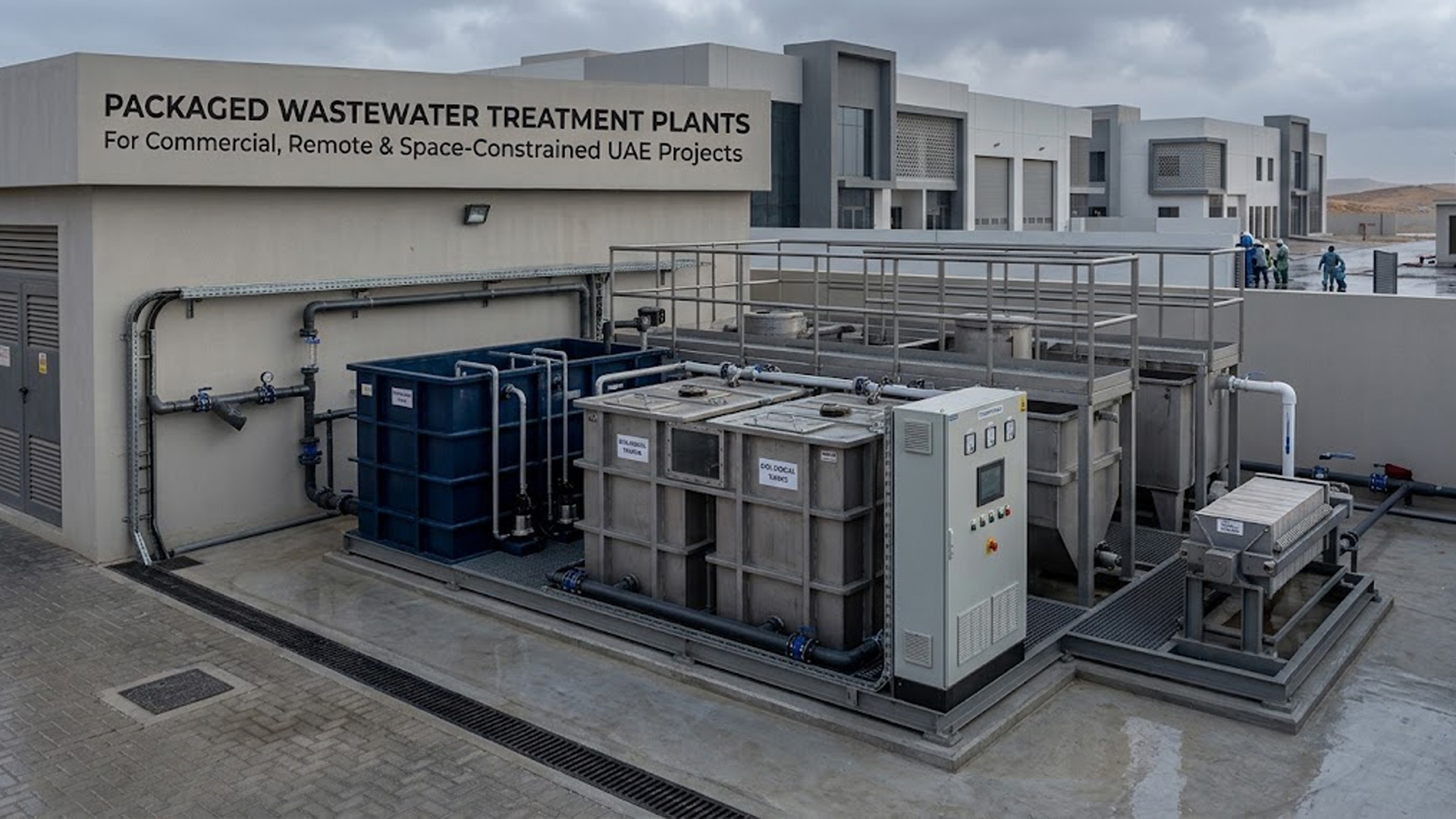
A packaged plant can simplify project delivery, but only when its process, hydraulic capacity and operating requirements genuinely match the wastewater.
A packaged wastewater treatment plant in the UAE can be a practical option when a project needs a compact, modular or comparatively self-contained treatment arrangement. Remote facilities, construction-related developments, commercial compounds and sites with limited plant space may all investigate packaged treatment rather than developing every treatment component through extensive site-built civil works.
The word “packaged,” however, should not be mistaken for “one size fits all.” Wastewater characteristics, daily flow, peak demand, required treated-water quality, sludge production, available utilities and operator capability still determine whether a packaged configuration is technically suitable.
Direct answer: A packaged wastewater treatment plant combines major treatment functions into a compact or modular system, but it must still be selected around influent quality, average and peak flow, treatment objectives, footprint, maintenance access and treated-water destination. Capacity alone is not enough to determine whether a packaged plant will perform reliably.
What Is a Packaged Wastewater Treatment Plant?
A packaged plant brings selected wastewater-treatment stages together in a pre-engineered or modular arrangement. Depending on the actual process, the system may incorporate preliminary treatment, equalisation, biological treatment, solids separation, filtration, disinfection and controls.
The exact arrangement varies considerably between technologies and suppliers. Buyers should therefore evaluate the process inside the package rather than selecting equipment purely because it is described as compact or modular.
When a Packaged Treatment Plant May Make Sense
Packaged systems can be considered where project conditions favour a smaller footprint, modular delivery or reduced dependence on extensive site-built treatment infrastructure.
Potential applications can include:
- Commercial developments
- Staff accommodation
- Remote project sites
- Construction camps
- Hospitality facilities
- Community buildings
- Industrial support facilities
- Temporary or phased developments where the treatment strategy allows
The application does not determine the technology by itself. Actual wastewater characteristics still need to be understood.
Packaged Does Not Mean Plug-and-Play
Even a compact treatment system requires proper integration with the site.
The project may still need:
- Incoming wastewater piping
- Screening or preliminary treatment
- Equalisation capacity
- Concrete foundations
- Interconnecting pipework
- Electrical supply
- Control cabling
- Ventilation
- Drainage
- Treated-water storage
- Sludge storage or removal arrangements
- Access for maintenance
These requirements should be included in the project scope before a packaged unit is ordered.
Start With Influent Wastewater Characteristics
The most important design information comes from the wastewater entering the plant.
A useful project basis may include:
- Wastewater source
- Average daily flow
- Peak hourly flow
- Minimum flow
- Suspended solids
- Organic loading
- pH
- Oil and grease where relevant
- Nutrients where relevant
- Salinity or process chemicals for industrial applications
A plant developed for predominantly domestic sewage should not automatically be used for industrial effluent simply because both projects have the same daily flow.
Projects with wider wastewater requirements should begin with RBC Engineering’s wastewater treatment plant solutions before narrowing the process to a packaged configuration.
Average Flow and Peak Flow Must Be Considered Separately
A 100-cubic-metre-per-day requirement does not mean wastewater arrives evenly over 24 hours.
Hotels, accommodation facilities and commercial buildings can produce significant hourly variations. If the package cannot accept the peak hydraulic load directly, equalisation may be needed before treatment.
Important questions include:
- When does the highest wastewater flow occur?
- How long does the peak continue?
- Is the development occupied continuously?
- Will future phases increase wastewater volume?
- Can equalisation smooth the incoming load?
Choosing the Treatment Process Inside the Package
Different packaged systems may use different biological and separation processes. The appropriate choice depends on the wastewater, required output, footprint and level of operation the client can support.
| Selection Factor | Why It Matters |
| Influent strength | Determines the treatment load the biological and physical stages must handle |
| Required effluent quality | Determines whether additional clarification, filtration or polishing is required |
| Footprint | Influences process configuration and equipment arrangement |
| Flow variation | May require equalisation or additional hydraulic capacity |
| Operator availability | Influences automation and process-complexity decisions |
| Sludge management | Determines storage, removal and possible dewatering requirements |
| Future expansion | Influences whether modular treatment trains should be considered |
Packaged Sewage Treatment Versus Industrial Effluent Treatment
Domestic-type sewage and industrial effluent should remain separate engineering intents.
Predominantly domestic wastewater can contain organic material, solids and nutrients that may be suitable for a biological sewage-treatment process. Industrial effluent can introduce chemicals, oils, extreme pH, salinity or contaminants that change the treatment concept substantially.
An industrial project should therefore evaluate the characteristics of each process wastewater stream before choosing a packaged system.
Footprint Is More Than the Equipment Dimensions
A compact equipment footprint can be attractive on constrained sites, but the project also needs operating space.
Allow for:
- Access around pumps and blowers
- Removal of filters and components
- Chemical storage where required
- Sludge handling
- Control-panel access
- Safe sampling points
- Replacement of major equipment
- Operator movement
A package that physically fits into a plant area but cannot be serviced properly is not a good space-saving solution.
Odour and Ventilation Planning
Where a treatment plant sits near occupied areas, odour control should be addressed during design.
Relevant considerations may include:
- Covered tanks
- Ventilation routes
- Air extraction
- Screenings storage
- Sludge holding
- Process stability
- Location relative to occupied spaces
Wastewater Reuse Changes the Treatment Target
If the project intends to reuse treated wastewater, that objective should be identified before equipment selection.
Reuse may require additional:
- Filtration
- Disinfection
- Monitoring
- Storage
- Dedicated distribution
- Operational controls
The required quality depends on the specific reuse application and applicable project requirements.
Incoming water and reuse requirements can also be coordinated through RBC Engineering’s broader water treatment solutions.
Controls and Automation
A packaged plant should provide operators with enough information to understand process condition and equipment status.
Depending on the system, controls may cover:
- Tank levels
- Pumps
- Blowers
- Dosing equipment
- High- or low-level alarms
- Equipment faults
- Selected process measurements
Automation should simplify stable operation without creating a system that becomes difficult to maintain locally.
Sludge Is Still Part of a Packaged Plant
Compact treatment does not eliminate sludge.
The plant design should establish:
- Expected sludge production
- Holding volume
- Removal frequency
- Access for collection
- Whether dewatering is required
Ignoring sludge requirements can undermine an otherwise well-designed installation.
Questions to Ask Before Selecting a Packaged Plant
- What wastewater is being treated?
- What are the average and peak flows?
- Is representative laboratory data available?
- What final treated-water quality is required?
- Will treated water be discharged or reused?
- How much plant space is available?
- What electrical supply is available?
- Who will operate the system?
- How will sludge be handled?
- Is future expansion expected?
- What site-built civil works remain necessary?
How a Packaged Wastewater Project Should Progress
- Characterise the wastewater source.
- Confirm average and peak flows.
- Define the treated-water objective.
- Evaluate the appropriate treatment process.
- Confirm whether a packaged configuration suits the project.
- Review footprint and civil requirements.
- Define utilities and controls.
- Plan sludge and residual management.
- Complete installation integration.
- Commission under representative site conditions.
- Establish operation and maintenance responsibilities.
Projects requiring higher-grade polishing can also review appropriate water purification equipment after the main wastewater treatment process.
Assess Whether a Packaged Plant Fits Your Project
Provide RBC Engineering with the project location, wastewater source, available analysis, average and peak flow, required treated-water destination, available footprint and expected installation scope. This information helps determine whether a packaged configuration is appropriate before specific equipment is selected.
Discuss a Packaged Wastewater Requirement
Frequently Asked Questions
What is a packaged wastewater treatment plant?
It is a compact or modular arrangement that integrates selected wastewater-treatment stages into a pre-engineered system while still requiring project-specific sizing and site integration.
Is a packaged wastewater plant suitable for industrial wastewater?
It can be suitable only when the selected treatment process matches the actual industrial effluent. Industrial wastewater should be characterised before a packaged system is specified.
Do packaged plants require civil works?
Often yes. Foundations, tanks, piping, drainage, electrical connections and other site works may still be required depending on the plant configuration.
Can a packaged plant treat wastewater for reuse?
Potentially, but the treatment and polishing stages must be designed around the specific reuse-quality requirement.
How should packaged wastewater capacity be selected?
Selection should consider average flow, peak flow, influent quality, operating pattern, required output quality and future demand.
Does a packaged plant still produce sludge?
Yes. Sludge and other residual materials remain part of wastewater treatment and require appropriate storage and management.
What information should be provided before requesting a packaged plant?
Provide wastewater analysis where available, average and peak flow, project type, required effluent quality, footprint, utilities and the intended discharge or reuse route.