

Desalination Should Be Selected Because the Water Requires It — Not Because It Sounds Like the Most Advanced Treatment Option
Interest in Water Desalination Systems UAE projects can come from hotels, commercial facilities, industrial operations and other sites that need to reduce dissolved salts in their water supply.
However, desalination is not a universal replacement for conventional water treatment.
Some projects may require sediment filtration, softening or other conditioning. Others may genuinely need a membrane-based desalination process because salinity is central to the water-quality problem.
The first procurement decision should therefore be whether desalination is actually the correct treatment approach.
What Is a Commercial Water Desalination System?
A commercial desalination system reduces dissolved salts from a saline or mineralised water source to produce water that meets a defined quality requirement.
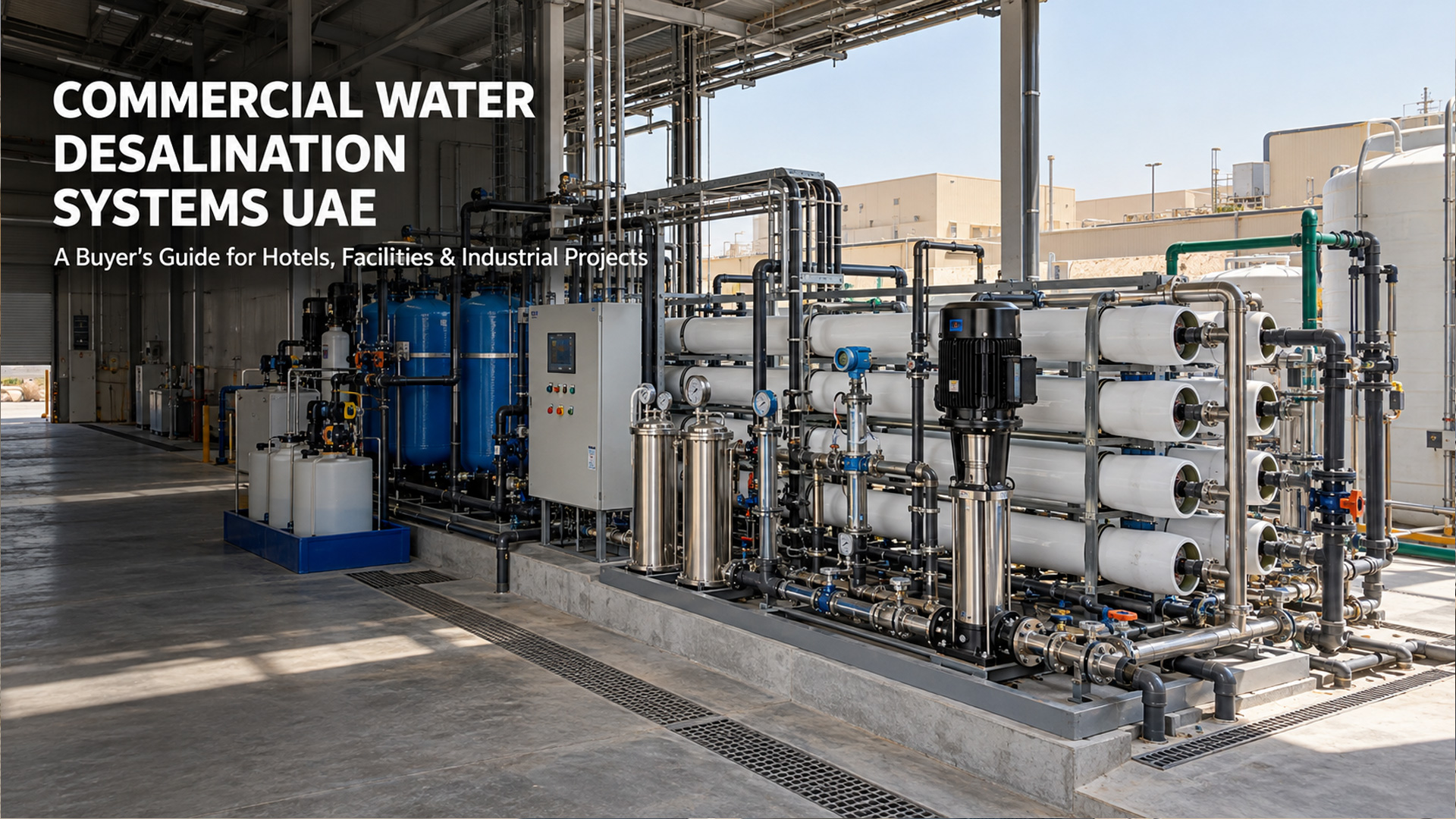
Depending on the source and application, a complete system can include:
- Feed-water pumping
- Pretreatment
- Filtration
- Chemical conditioning
- High-pressure pumping
- RO membranes
- Instrumentation
- Automatic controls
- Product-water storage
- Post-treatment
- Reject-water management
The desalination unit should therefore be evaluated as a complete treatment train rather than simply as an RO membrane package.
When Does Desalination Make Sense?
Desalination is generally evaluated when reducing dissolved salts is a major treatment objective.
Projects should first establish:
- Feed-water salinity
- Required final water quality
- Daily consumption
- Required production rate
- Operating schedule
- Recovery expectations
- Reject-water arrangements
If the principal issue is suspended sediment rather than dissolved salts, a conventional filtration system may be more appropriate.
RBC Engineering’s comparison of water treatment, purification and desalination provides additional guidance on distinguishing these approaches.
Feed-Water Analysis Comes First
The performance of a commercial desalination system UAE depends heavily on incoming-water conditions.
A water analysis may need to consider salinity, hardness, suspended solids, pH, temperature and other characteristics relevant to membrane performance and pretreatment.
The purpose is to understand both what must be removed and what could affect downstream equipment.
Pretreatment Is Part of the Desalination System
Membranes operate best when unsuitable contaminants are controlled before the water reaches them.
Depending on feed-water conditions, pretreatment may involve:
- Sediment filtration
- Multimedia filtration
- Activated carbon
- Softening
- Cartridge filtration
- Chemical dosing
The correct combination depends on the water.
A generic pretreatment package should not be applied to every installation without technical justification.
Recovery Has a Direct Effect on the Water Balance
A desalination plant produces treated water and reject water.
Recovery describes the relationship between incoming feed water and the treated-water output.
This means buyers should understand more than the headline product-water capacity.
Ask:
- How much feed water is needed?
- How much product water will be produced?
- How much reject water will leave the system?
- What recovery is expected under the proposed conditions?
Reject Water Needs a Plan
Reject-water handling should be discussed before procurement is complete.
The project team needs to understand the expected reject volume and the intended discharge or appropriate reuse arrangement.
This becomes part of the overall water-management strategy.
Capacity Should Match the Building or Process
Hotels, commercial facilities and industrial plants can have very different water-consumption patterns.
Rather than selecting equipment from daily demand alone, buyers should consider:
- Average daily consumption
- Peak demand
- Hours of operation
- Storage capacity
- Maintenance periods
- Future expansion
Storage can often help separate treatment production from short periods of high demand.
Commercial Facilities Need Practical Operation
In a hotel or large commercial property, the treatment plant may need to operate with limited daily attention.
Useful features may therefore include clear system-status indication, automatic tank-level control, alarms and appropriate conductivity or pressure monitoring.
Automation should support reliability while remaining understandable for the site team.
Industrial Projects May Need More Detailed Integration
Industrial users may require desalinated water as part of a wider process.
That can introduce additional considerations such as:
- Tighter output specifications
- Continuous production
- Redundancy
- Integration with process equipment
- Additional polishing stages
- Process controls
Materials Must Match Pressure and Water Conditions
Desalination systems can involve elevated pressure and water with challenging chemistry.
Suitable material selection is therefore important for pumps, housings, piping, valves and other wetted components.
Material choice should reflect the actual design conditions rather than a one-size-fits-all specification.
Energy Consumption Should Be Discussed Early
High-pressure pumping can represent an important part of desalination operating cost.
Buyers should understand expected electrical requirements before approving equipment.
Energy discussions should be based on the proposed capacity and operating conditions rather than generic efficiency claims.
Consumables Are Part of the Lifecycle Cost
Long-term requirements may include:
- Filter cartridges
- Membranes
- Chemicals
- Cleaning
- Pump servicing
- Instrumentation
- Replacement components
The plant should be evaluated over its operating life rather than only by purchase price.
Maintenance Access Matters
A desalination skid may appear compact, but adequate service clearance is essential.
Technicians should be able to remove membranes, replace filters, inspect pumps, access dosing systems and work on electrical panels without unnecessary dismantling.
Compare Desalination Quotations on Equal Technical Scope
Before comparing price, compare:
Feed-Water Basis + Product-Water Quality + Capacity + Pretreatment + Recovery + Membranes + Pumps + Materials + Controls + Instrumentation + Reject Handling + Storage + Commissioning + Consumables
A low headline price can be misleading if key components are outside the supplier’s scope.
Water Desalination vs Conventional Water Treatment
The decision should come back to the water-quality problem.
If the project needs suspended-solids removal, filtration may be enough.
If hardness is the main concern, softening may be appropriate.
If dissolved salts must be reduced substantially, desalination may become the correct treatment route.
For further comparison, review RBC Engineering’s guide to water filtration vs reverse osmosis.
Frequently Asked Questions
When should a UAE project consider desalination?
Desalination should be considered where dissolved salts are a significant water-quality problem and the required final water quality justifies membrane treatment.
Is desalination the same as water filtration?
No. Filtration generally targets suspended contaminants, while desalination focuses on dissolved salts.
What determines desalination-system capacity?
Capacity should reflect water demand, operating hours, storage, required output quality, recovery and future expansion.
Why is pretreatment important?
Pretreatment helps prepare incoming water for the membrane process and can reduce conditions that may affect downstream performance.
What should buyers ask about reject water?
Ask about expected reject volume, recovery, discharge arrangements and any appropriate reuse options within the project.
Discuss Your UAE Desalination Requirement With RBC Engineering
RBC Engineering supports commercial and industrial water-treatment, purification and desalination requirements.
Share your water source, available analysis, required treated-water quality and expected demand to begin a project-specific discussion.
Choose desalination because the water analysis requires it — not simply because it appears to be the most advanced treatment technology.