

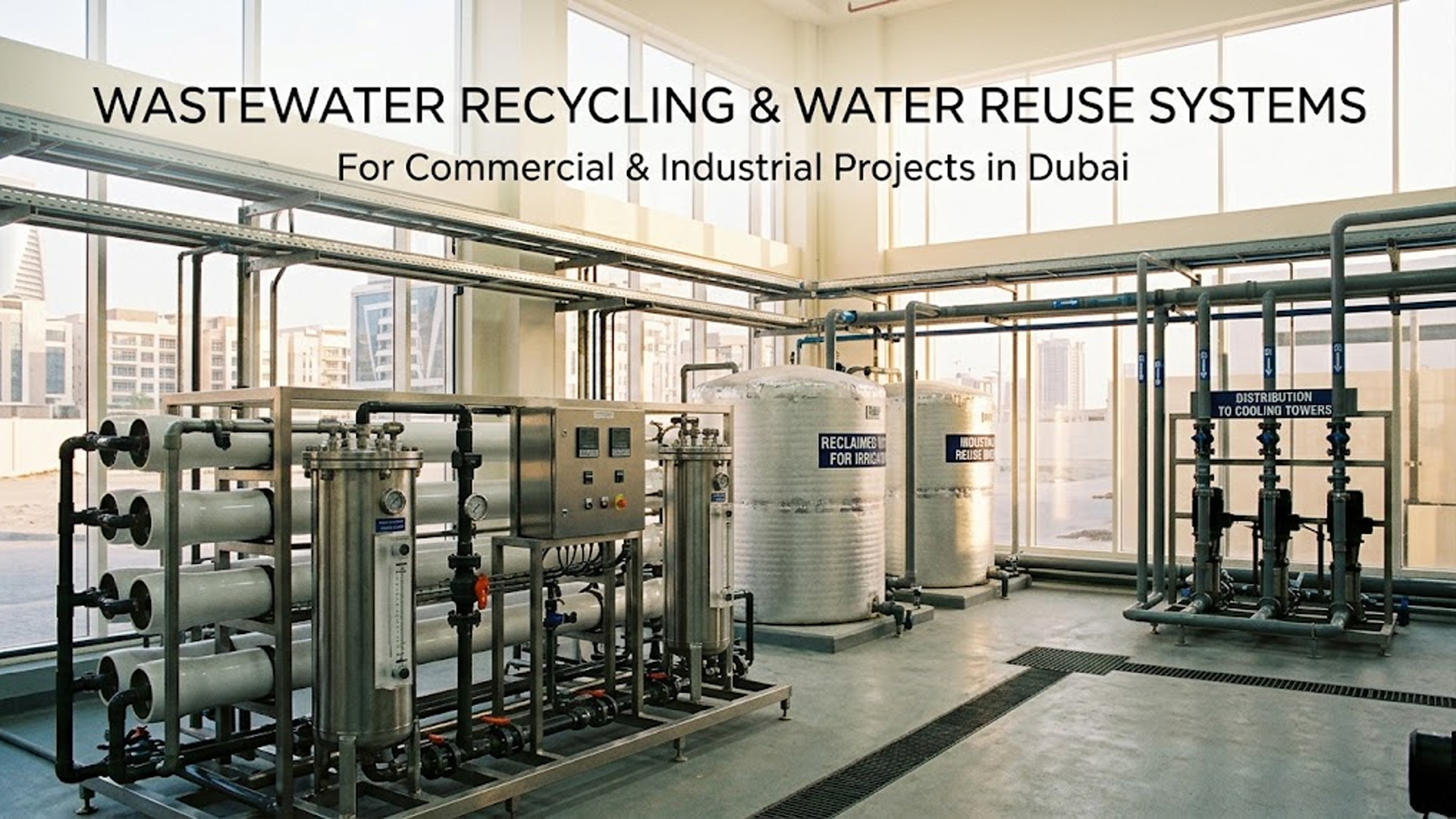
Water reuse should be designed backwards from the intended application, because irrigation, flushing, cooling and process reuse do not necessarily require the same treatment quality.
A wastewater recycling system in Dubai should not begin with the assumption that every treated wastewater stream must reach one universal quality level. The more useful approach is to identify where the recovered water will be used, determine the quality required for that application and then design the treatment and monitoring stages around that target.
This can help commercial and industrial projects avoid both under-treatment and unnecessary treatment complexity.
Direct answer: Wastewater recycling converts a suitable wastewater stream into treated water for a defined reuse application. The required process may include biological treatment, clarification, filtration, membrane treatment, disinfection, storage and monitoring. The exact treatment level depends on the wastewater source and the intended reuse.
Wastewater Treatment and Water Reuse Are Different Objectives
A wastewater treatment plant may be designed to achieve a defined discharge requirement. A water-reuse system may require additional treatment because the recovered water will return to an active building, irrigation network, cooling process or industrial operation.
The project should therefore define:
- Wastewater source
- Existing treatment process
- Current treated-water quality
- Proposed reuse application
- Required reuse quality
- Daily reuse demand
- Peak reuse demand
- Storage requirement
- Distribution arrangement
RBC Engineering’s broader wastewater treatment plant solutions should remain the parent service for the core wastewater-treatment process.
Potential Water Reuse Applications
Reuse opportunities depend on project requirements and the quality achieved by the treatment system.
Potential non-potable applications may include:
- Landscape irrigation
- Toilet flushing
- Selected cleaning duties
- Cooling-related applications
- Industrial wash water
- Selected process-water reuse
These applications are not interchangeable. A water-quality specification suitable for one reuse route may not be appropriate for another.
Start With the Reuse Quality Target
Before adding filters or membranes, define what the recovered water must achieve.
| Reuse Question | Why It Matters |
| Where will the water be used? | Defines the required treatment objective |
| Will people come into contact with it? | Can influence microbiological-control requirements |
| Will it enter equipment? | May introduce hardness, salinity or fouling limits |
| Will it be stored? | Introduces turnover and water-quality considerations |
| How variable is demand? | Affects storage and treatment capacity |
| How will quality be monitored? | Determines sampling and instrumentation requirements |
Source Wastewater Determines the Starting Point
Treated sewage, commercial wastewater and industrial effluent can require very different reuse-treatment strategies.
For example, an industrial stream may contain elevated dissolved salts even after its main pollutants have been treated. If the reuse application is sensitive to salinity, additional membrane treatment may be necessary.
By contrast, another project may primarily need additional filtration and disinfection after biological treatment.
Filtration for Wastewater Reuse
Filtration can remove residual suspended material before water enters a reuse network or a more advanced treatment stage.
Depending on the project, treatment may incorporate:
- Media filtration
- Fine filtration
- Cartridge filtration
- Membrane filtration where appropriate
The required filtration level should be selected according to the downstream application and existing treated-water quality.
When Reverse Osmosis May Be Required
Reverse osmosis becomes relevant when dissolved-salt reduction is required for the intended reuse.
RO should not be included merely because recycled water is involved. The decision should consider:
- Feed-water salinity
- Required reuse quality
- Scaling potential
- Pretreatment
- Recovery
- Reject-water management
- Operating cost
Projects requiring dedicated membrane treatment can review water purification equipment as part of the wider treatment strategy.
Disinfection and Reuse Storage
Where microbiological control is required, disinfection should be coordinated with treated-water storage and the distribution network.
Design considerations may include:
- Storage duration
- Tank turnover
- Protection from contamination
- Distribution-pipe segregation
- Sampling points
- Monitoring
- Maintenance
Water can leave a treatment process in acceptable condition and still deteriorate if storage and distribution are poorly managed.
Reuse for Irrigation
Irrigation is one possible application for treated wastewater, but the design should account for both water quality and irrigation equipment.
Considerations may include:
- Suspended solids
- Salinity
- Emitter blockage
- Storage
- Seasonal irrigation demand
- Distribution pressure
Reuse for Flushing
Building flushing applications can require a dedicated non-potable distribution system and sufficient storage to balance wastewater treatment output with building demand.
The hydraulic design should account for peak consumption, pump operation and clear segregation from drinking-water systems.
Cooling and Industrial Reuse
Cooling and industrial applications are more equipment-sensitive.
The reuse-water quality may affect:
- Scaling
- Corrosion
- Fouling
- Heat-transfer performance
- Process consistency
The equipment or process receiving the water should therefore define the required quality.
Water Balance Should Be Calculated Before Plant Expansion
A useful reuse project compares how much wastewater is available with how much reusable water the facility actually needs.
The water balance should consider:
- Wastewater generated each day
- Treatment recovery
- Reuse demand
- Seasonal variation
- Storage capacity
- Periods when reuse demand is low
There is limited value in increasing treatment capacity if the site has no practical use for the additional recovered water.
Reuse Can Be Part of a Wider Water Strategy
Projects considering wastewater recovery should also examine incoming water demand.
RBC Engineering’s water treatment solutions can help separate the quality requirements of incoming water, process water and reusable treated wastewater.
For saline source-water applications, dedicated water desalination equipment should remain a separate treatment owner.
A Practical Wastewater Recycling Process
- Identify the wastewater available for recovery.
- Review existing treated-water quality.
- Define the exact reuse application.
- Establish the required reuse quality.
- Calculate daily and peak reuse demand.
- Select additional filtration or polishing.
- Define disinfection where required.
- Plan treated-water storage.
- Design dedicated distribution.
- Establish monitoring and sampling.
- Commission the system against the reuse objective.
Operational Limitations Matter
A reuse system depends on both wastewater supply and reuse demand.
Potential operational limitations can include:
- Insufficient wastewater during low occupancy
- Low irrigation demand during particular periods
- Variable industrial production
- Storage constraints
- Changing influent quality
- High maintenance requirements for advanced polishing
These limitations should be considered before projected reuse volumes are treated as guaranteed savings.
Assess a Wastewater Recycling Opportunity
Provide RBC Engineering with the wastewater source, existing treatment process, available water-quality results, daily treated-water production, intended reuse application, required daily reuse volume and available storage. This allows the reuse concept to be evaluated around a real water balance.
Frequently Asked Questions
What is a wastewater recycling system?
It is a treatment and distribution arrangement that prepares suitable wastewater for a defined reuse application rather than disposing of all treated water after the primary treatment process.
Can treated wastewater be reused for irrigation?
Potentially, when the treatment process achieves the quality required for the specific irrigation application and relevant project requirements are met.
Does wastewater reuse always require reverse osmosis?
No. RO is useful where dissolved-salt reduction is necessary. Other applications may require filtration and disinfection without RO.
Can recycled water be used for cooling systems?
It may be possible when water chemistry is compatible with the cooling equipment and the treatment process addresses scaling, corrosion, fouling and other relevant requirements.
Why is treated-water storage important?
Wastewater production and reuse demand do not always occur at the same time, so storage can help balance production with consumption.
What should be tested before planning water reuse?
The required testing depends on the wastewater source and reuse application. The objective is to compare actual treated-water quality with the quality required by the intended use.
How is water-reuse capacity selected?
Capacity should consider available wastewater, treatment recovery, actual reuse demand, peak demand, storage and seasonal variation.