

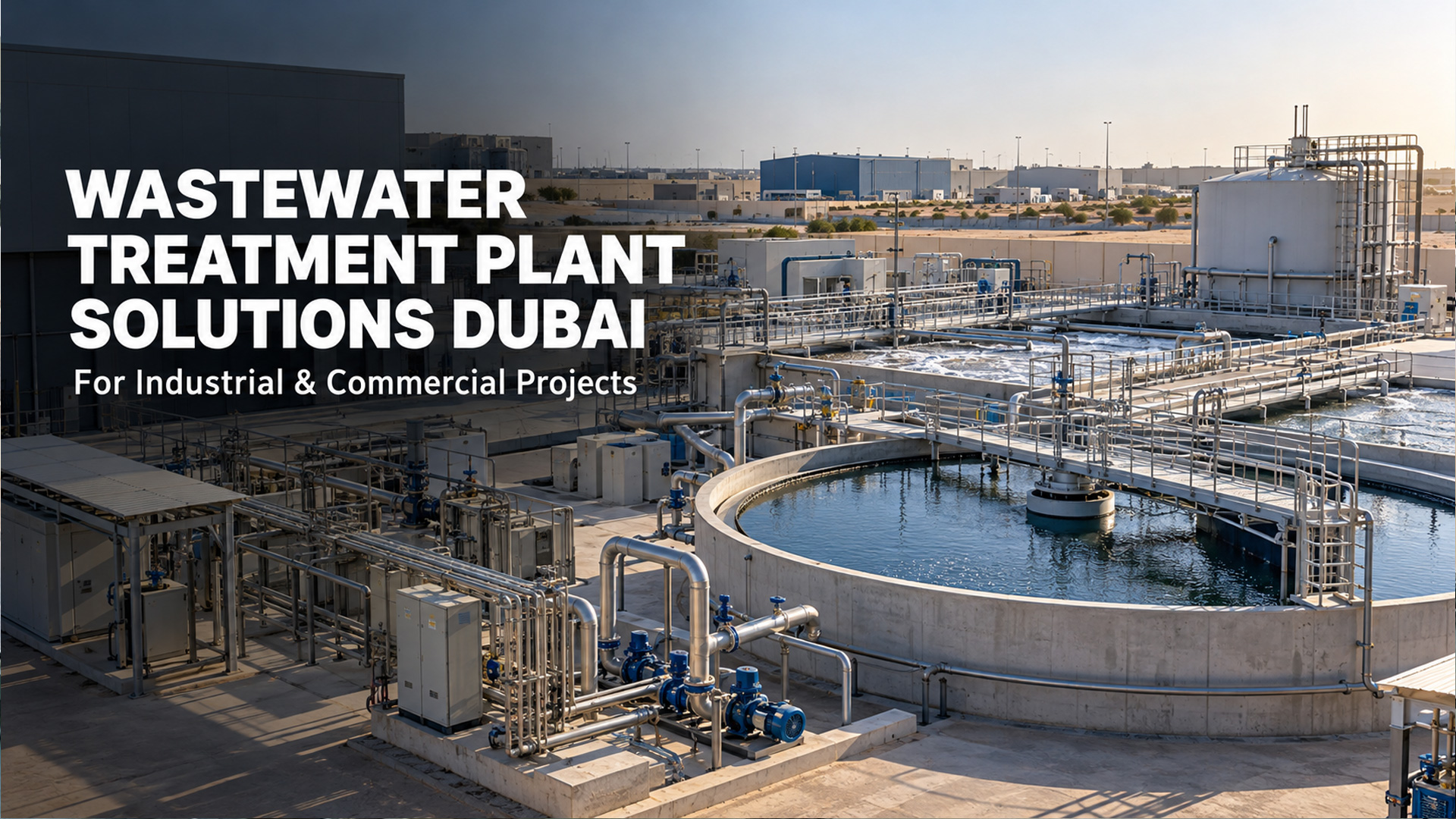
Design the treatment process around wastewater characteristics, flow variation and the required discharge or reuse quality—not a generic plant package.
A wastewater treatment plant solution in Dubai should begin with one fundamental question: what exactly is entering the plant?
Wastewater from a commercial development, staff accommodation, hospitality facility or industrial process can differ significantly in organic load, suspended solids, oils, chemicals, salinity, nutrients, flow variation and operating pattern. Those differences determine the treatment process, tank volumes, equipment selection, sludge production, operating requirements and whether treated water can be considered for reuse.
Direct answer: Wastewater treatment should be designed from influent characteristics, average and peak flow, discharge or reuse target, site conditions and operating requirements. A treatment train may include screening, equalisation, physical or chemical pretreatment, biological treatment, clarification, filtration, disinfection and sludge handling. Industrial effluent and domestic sewage should not automatically be treated as the same wastewater stream.
Wastewater Treatment Starts With Characterisation
Nominal daily flow is only one design input. The composition of the wastewater and the way the flow changes through the day can have an equal or greater effect on plant performance.
A project assessment may require information on:
- Wastewater source
- Average daily flow
- Peak hourly flow
- Operating schedule
- Expected variation in influent quality
- Suspended solids
- Organic loading
- Oil and grease where relevant
- pH
- Nutrients
- Salinity or dissolved solids where relevant
- Process chemicals that may affect treatment
- Required treated-water quality
- Discharge or reuse destination
- Available land and civil constraints
Representative wastewater testing is especially important for industrial projects because the process generating the effluent can change the treatment requirement substantially.
Wastewater, Sewage and Industrial Effluent Are Different Design Problems
The terms are sometimes used interchangeably in general marketing content, but they should not be treated as identical engineering requirements.
| Waste Stream | Typical Source | Main Design Consideration |
| Domestic sewage | Residential, commercial and community sanitation flows | Organic loading, solids, nutrients, peak flow and biological treatment |
| Commercial wastewater | Hotels, kitchens, laundries and mixed-use facilities | Variable flow and specific pretreatment needs such as grease management |
| Industrial effluent | Manufacturing and process facilities | Process-specific contaminants, pH, chemicals and treatability |
| Reuse stream | Treated wastewater intended for a defined secondary use | Additional polishing, disinfection, storage and monitoring requirements |
This is why a broad wastewater page should explain the overall treatment framework while dedicated sewage-treatment and effluent-treatment pages can later address those buyer intents in more depth.
Main Stages in a Wastewater Treatment Plant
Not every project requires every stage, and the exact arrangement depends on the wastewater characteristics. However, a commercial or industrial plant may include several of the following treatment functions.
Screening and preliminary treatment
Screening removes larger solids that could interfere with pumps, piping or downstream equipment. Depending on the wastewater source, preliminary treatment may also address grit, oil, grease or other materials before the main process.
Flow equalisation
Wastewater rarely arrives at a perfectly constant rate. Equalisation can help manage variations in flow and concentration, allowing downstream stages to operate under more stable conditions.
Physical and chemical pretreatment
Some wastewater requires pH adjustment, coagulation, flocculation, precipitation, oil separation or another specialised pretreatment stage before biological or membrane treatment.
Biological treatment
Where biodegradable organic matter is a major part of the wastewater load, a biological process may be used to reduce that load. The correct process depends on influent characteristics, required effluent quality, footprint, operating expertise and other project conditions.
Solid-liquid separation
Clarification, filtration or membrane separation may be used to separate treated water from solids depending on the selected process.
Polishing and disinfection
Further filtration and an appropriate disinfection stage may be required where the treated water has a more demanding discharge or reuse target.
Sludge handling
Treatment transfers part of the wastewater load into sludge or other residual streams. Sludge volume, storage, dewatering and disposal responsibilities should therefore be considered during design rather than after commissioning.
Sewage Treatment for Commercial and Community Projects
Domestic sewage from developments, hospitality facilities, staff accommodation and community buildings typically contains biodegradable organic matter, suspended solids and nutrients, although the exact characteristics still vary by project.
Important design factors can include:
- Actual occupancy
- Daily and peak flow
- Variation between occupied and low-demand periods
- Kitchen or commercial inputs connected to the system
- Required effluent quality
- Odour-management requirements
- Equipment redundancy
- Available footprint
- Operator capability
- Reuse requirements where applicable
A dedicated sewage-treatment design should not simply be copied from an industrial effluent plant because the wastewater characteristics and process risks differ.
Industrial Effluent Treatment Requires Process-Specific Information
Industrial wastewater should be traced back to the manufacturing or process operation that produces it.
A facility may have multiple effluent streams with different characteristics. Mixing those streams before understanding them can make treatment more difficult. In some projects it may be beneficial to segregate particular wastewater streams for pretreatment or recovery before they enter the main treatment plant.
Useful information can include:
- Production process
- Raw materials used
- Cleaning chemicals
- Batch or continuous operation
- Expected pH range
- Organic and inorganic loading
- Oils or emulsions
- Metals or process-specific substances where relevant
- Temperature
- Flow variation
That data allows the treatment concept to be developed around actual wastewater behaviour rather than around a standard ETP label.
Wastewater Recycling and Reuse
Wastewater treatment and water reuse are related, but they are not the same design objective.
A plant may be capable of reducing pollutants sufficiently for one discharge route without producing water suitable for another reuse application. If treated water will be reused, the intended use should be defined during the design stage.
Potential non-potable reuse applications may include, subject to the required quality and project approvals:
- Irrigation
- Flushing
- Selected cleaning applications
- Cooling-related applications
- Industrial process reuse
Reuse can introduce additional requirements for polishing, disinfection, treated-water storage, monitoring and dedicated distribution piping.
Packaged Wastewater Treatment Plants
A packaged plant can be useful when a project requires a compact treatment arrangement, shorter site installation activity or a modular approach. However, “packaged” does not mean that the same configuration will suit every wastewater stream.
Before selecting a packaged system, confirm:
- Design flow
- Peak flow
- Influent quality
- Required output quality
- Number of operating trains
- Tank and equipment footprint
- Access for maintenance
- Ventilation and odour considerations
- Sludge handling
- Power availability
- Drainage
- Future expansion requirement
Modularity is valuable only when the treatment process itself is suitable for the wastewater.
How Wastewater Treatment Connects With the Wider Water Strategy
A facility should consider both incoming and outgoing water streams.
The incoming supply may require water treatment solutions before use. Process operations may then produce wastewater requiring a separate treatment train. If reuse is planned, the treated wastewater may require additional polishing before returning to a selected application.
Where higher-grade filtration or polishing is required, suitable water purification equipment can be assessed according to the specific water-quality target.
A Practical Wastewater Project Process
- Map every wastewater source
Identify sanitation flows, process wastewater, kitchen discharges, washdown water and other relevant streams.
- Measure the flow profile
Establish average, peak and low-flow conditions rather than using one daily number.
- Characterise the wastewater
Use representative analysis and process information to identify the parameters that drive treatment selection.
- Define the treated-water destination
Confirm whether the objective is discharge, reuse or another clearly defined application.
- Develop the process concept
Select preliminary, physical, chemical, biological and polishing stages as required.
- Confirm civil and site requirements
Review excavation, tank location, equipment rooms, ventilation, drainage, access and future maintenance requirements.
- Define instrumentation and controls
Identify measurements, alarms, dosing controls, level controls and plant protection functions required for stable operation.
- Plan sludge and residual management
Determine how sludge, screenings and other residual materials will be stored and handled.
- Commission under actual operating conditions
Commissioning should assess equipment operation, process stability and treated-water performance against the agreed project criteria.
Why Operator Requirements Matter
Treatment plants are not static pieces of equipment. Their performance depends on operation, monitoring and maintenance.
A design should reflect the level of operator involvement available at the site. Highly complex equipment can create unnecessary operational risk where there is no suitable maintenance structure. Conversely, a process with insufficient monitoring or control may not respond adequately to changing influent conditions.
Operational planning can include:
- Routine sampling
- Process checks
- Cleaning schedules
- Blower and pump maintenance
- Chemical-dosing checks where applicable
- Sludge removal
- Instrument calibration
- Filter or membrane maintenance
- Spare-part planning
- Operating records
Compliance Must Be Defined Project by Project
No wastewater supplier should promise universal compliance without first knowing the project location, wastewater characteristics, discharge destination, reuse requirement and applicable authority conditions.
The responsible project team should establish the applicable discharge, reuse, permitting, monitoring and operating requirements for the site. The treatment process can then be designed against those defined criteria.
This is more reliable than adding a general “compliant” label to a treatment package without reference to the actual project.
Prepare a More Useful Wastewater Treatment Enquiry
Send RBC Engineering the project location, wastewater source, available laboratory analysis, average and peak flow, operating schedule, required treated-water destination, available footprint and expected equipment or project scope. Industrial projects should also include information about the process that generates the effluent.
Discuss a Wastewater Treatment Project
Frequently Asked Questions
What information is needed to design a wastewater treatment plant?
Key inputs include wastewater source, representative analysis, average and peak flow, operating pattern, required treated-water quality, discharge or reuse destination, site space and operator requirements.
Is sewage treatment the same as industrial effluent treatment?
No. Domestic sewage and industrial effluent can have very different characteristics. Industrial treatment should account for the specific manufacturing process, chemicals and wastewater streams involved.
What is the purpose of an equalisation tank?
Equalisation helps reduce short-term variations in flow and wastewater concentration so downstream treatment stages can operate under more stable conditions.
Can treated wastewater be reused?
Potentially, when the treatment process and final quality are suitable for a clearly defined reuse application and the relevant project requirements are satisfied.
Is a packaged wastewater plant suitable for every site?
No. A packaged arrangement can reduce footprint or simplify installation, but the process must still be matched to the influent quality, flow pattern and required treated-water quality.
Why is sludge handling important?
Wastewater treatment creates residual solids that must be stored, removed or further treated. Ignoring sludge handling can create operational, space and maintenance problems.
How should wastewater treatment capacity be selected?
Capacity should account for average flow, peak flow, variability, future loading where relevant and the operating characteristics of the selected treatment process.
Can wastewater compliance be guaranteed before analysing the project?
No. Applicable requirements depend on the location, wastewater characteristics, discharge or reuse route and project-specific authority conditions. Those criteria should be confirmed before the treatment process is finalised.