

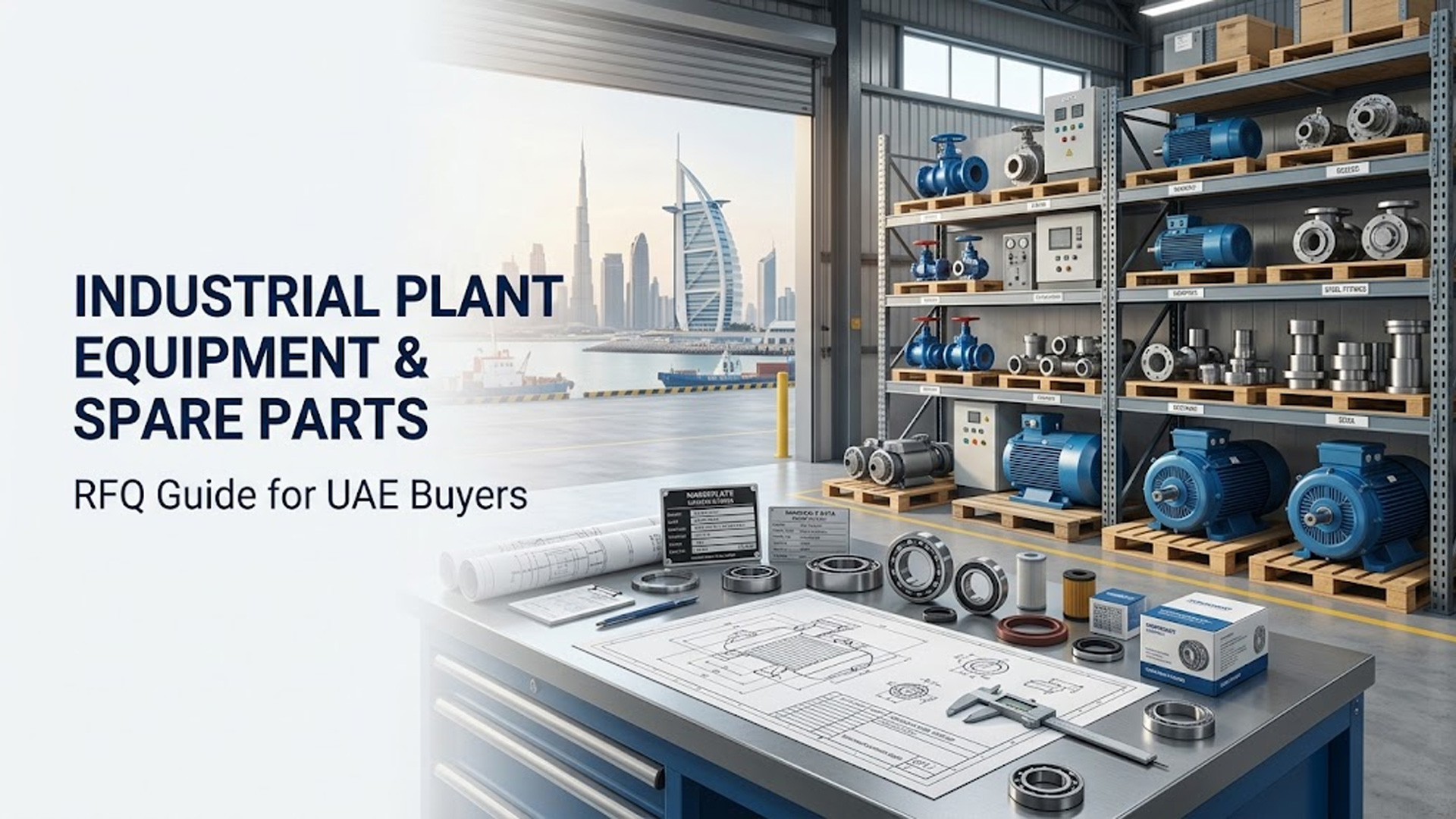
Industrial procurement becomes difficult when an RFQ identifies a machine or spare part without explaining the application, duty, operating conditions or compatibility requirement. A clearer enquiry helps suppliers understand whether the buyer needs new equipment, a replacement unit, an OEM spare, a technically acceptable alternative or support for an existing plant.
An industrial plant equipment RFQ should define the application, capacity or duty, operating hours, utilities, environmental conditions, site constraints and required support scope. For spare parts, include the OEM, equipment model, serial number, existing part number, quantity and available drawings or photographs so compatibility can be checked before supply.
Start with the Application, Not the Product Name
The same general equipment category can be used for very different duties.
Before requesting a quotation, explain:
- what process or plant function the equipment supports;
- what material, fluid or load it handles where relevant;
- required capacity or performance;
- normal operating conditions;
- operating hours;
- duty cycle;
- available utilities;
- installation environment;
- space or access constraints; and
- whether the requirement is new, replacement, expansion or standby equipment.
This information helps prevent a common procurement problem: selecting equipment that appears suitable from a catalogue description but is poorly matched to the actual duty.
Define Whether You Need Equipment, a Replacement or a Spare
Industrial enquiries generally fall into several different categories.
| Requirement | What the Buyer Should Clarify |
| New equipment | Application, duty, capacity, utilities, environment and integration requirements. |
| Replacement equipment | Existing model, reason for replacement, connection requirements and whether performance must change. |
| OEM spare part | Manufacturer, model, serial number and original part reference. |
| Alternative/replacement spare | All original identification plus dimensions, material, performance and compatibility requirements. |
| Used equipment | Required application plus acceptable condition, inspection, documentation and service-history requirements. |
RBC Engineering’s current business information confirms that the company trades in industrial plant equipment and spare parts while supporting plant-equipment service requirements.
What to Include When Requesting New Plant Equipment
A useful RFQ for new industrial equipment should describe the required outcome rather than relying on a broad equipment name.
Application
Explain the process the equipment will serve and its role within the wider plant.
Required capacity
Provide the required capacity or process duty in appropriate engineering units. Do not select a larger size “for safety” without understanding how oversizing affects operation.
Duty cycle
State whether the equipment operates intermittently, for defined shifts or continuously.
Operating conditions
Provide relevant temperatures, pressures, materials, loads, fluid properties or other process conditions where they affect selection.
Utilities
Identify the available electrical supply, compressed air, fuel, water, drainage or other utilities required by the equipment category.
Environment
State whether installation is indoors or outdoors and identify relevant dust, heat, moisture, corrosive or washdown conditions.
Space and access
Plant-room dimensions, doorways, lifting access, service clearances and maintenance routes can influence which equipment is practical to install.
Engineering procurement insight: The equipment that fits the process is not always the equipment that fits the plant room. Delivery access, service clearances, lifting requirements and future component replacement should be considered before a purchase order is placed.
How to Identify Industrial Spare Parts Correctly
Spare-part enquiries need accurate identification because visually similar components may have different materials, tolerances, ratings or interfaces.
Where available, provide:
- equipment manufacturer or OEM;
- machine or equipment model;
- serial number;
- original part number;
- part description;
- quantity required;
- equipment nameplate information;
- assembly drawing or exploded view;
- item number from the OEM drawing;
- clear photographs;
- dimensions where relevant;
- material specification where known;
- electrical or performance rating where applicable; and
- details of any superseded or previously substituted part.
A photograph can help identify a component, but it should not automatically be treated as proof of technical compatibility.
OEM Part or Equivalent Replacement?
Buyers may sometimes consider an equivalent component when an original spare is unavailable, has a long lead time or no longer meets the commercial requirement.
However, “same size” does not necessarily mean interchangeable.
Compatibility can depend on:
- material;
- dimensions and tolerances;
- pressure or temperature rating;
- electrical characteristics;
- mechanical connection;
- speed;
- load;
- chemical compatibility;
- software or control compatibility;
- certification requirements; and
- the consequences of component failure.
For critical equipment, any alternative should be technically checked for the actual application before use.
Do Not Treat Critical and Routine Spares the Same Way
A practical spare-parts strategy normally distinguishes between different levels of operational importance.
Routine consumables
These are items used predictably during normal servicing or operation.
Wear parts
These components deteriorate through operating duty and may need planned replacement.
Critical spares
These are components whose failure or long replacement lead time could cause significant operational disruption.
Insurance or strategic spares
Some facilities hold selected high-impact items even when failure is infrequent because sourcing them after a breakdown could take too long.
The correct strategy depends on equipment criticality, supplier lead time, redundancy, maintenance capability and the cost of downtime.
Why Spare-Part Lead Time Should Be Reviewed Before Equipment Purchase
Spare support is not only a maintenance issue. It is part of the original equipment-selection decision.
Before purchasing industrial equipment, ask:
- which consumables are routinely required;
- which components are considered normal wear items;
- where replacement parts are sourced;
- typical availability of common components;
- whether specialised parts require import lead time;
- whether equivalent components are permitted;
- what maintenance skills are needed; and
- which parts would create the greatest operational risk if unavailable.
These questions can be especially important for facilities where production depends on equipment that has little or no installed redundancy.
How to Request Used Industrial Equipment
If the project allows used equipment, state the acceptable condition clearly rather than simply asking for the lowest-cost machine available.
A used-equipment RFQ may need information on:
- acceptable year or generation where relevant;
- operating-hour information if available;
- maintenance history;
- known repairs;
- major component condition;
- functional testing;
- inspection requirements;
- included accessories;
- documentation;
- spare-part support;
- delivery condition; and
- commissioning requirements.
Buyers considering this procurement route can review RBC Engineering’s existing guide to used construction equipment in Dubai.
Low Purchase Price Does Not Replace Technical Fit
Budget matters, but the lowest quotation can become expensive if equipment is unsuitable for the duty, difficult to maintain or dependent on unavailable spare parts.
When price is a major project constraint, compare:
- technical suitability;
- expected operating duty;
- maintenance complexity;
- spare availability;
- consumable cost;
- energy and utility requirements;
- installation requirements;
- downtime risk; and
- expected service life for the intended duty.
RBC Engineering’s low-cost industrial plant equipment guide addresses this wider value-versus-purchase-price decision.
RBC Engineering project insight: Spare-parts planning should begin before equipment is ordered. A technically suitable machine can still become difficult to operate if routine wear components, critical spares or specialist service support are not available when the plant needs them.
Define the Supply Scope Clearly
An industrial-equipment RFQ should state whether the requirement is limited to supply or includes other project activities.
Potential scope items include:
- equipment supply;
- spare parts;
- accessories;
- delivery;
- installation;
- alignment or connection;
- commissioning;
- testing;
- operator familiarisation;
- maintenance support;
- recommended spare-parts list;
- technical documentation; and
- future service requirements.
RBC Engineering’s current service portfolio identifies installation, maintenance and repair support for industrial plant equipment.
What Documentation Should Buyers Request?
The documentation requirement should match the equipment and project, but useful information can include:
- technical data sheet;
- general arrangement information;
- utility requirements;
- operation instructions;
- maintenance instructions;
- recommended consumables;
- spare-parts list;
- electrical documentation where applicable;
- commissioning information;
- equipment identification details; and
- available manufacturer documentation.
If a project requires specific certification, conformity documentation or authority acceptance, identify that requirement in the RFQ rather than assuming every equipment category carries the same approvals.
Industrial Plant Equipment RFQ Checklist
| RFQ Area | Information to Include |
| Application | Process, equipment function and required result. |
| Performance | Capacity, duty, operating hours and process conditions. |
| Environment | Indoor/outdoor conditions, heat, dust, moisture and access. |
| Utilities | Electrical, water, air, fuel or other available services. |
| Existing equipment | OEM, model and interface details for replacements. |
| Spare parts | Part number, serial number, drawing and quantity. |
| Support | Installation, commissioning, maintenance and training requirements. |
| Documentation | Datasheets, manuals, drawings and required handover information. |
What to Include in Your Project Enquiry
- project location;
- industry or plant type;
- exact process or application;
- required equipment category;
- capacity or duty;
- operating hours;
- environmental conditions;
- available utilities;
- installation footprint;
- existing equipment information;
- preferred OEM where applicable;
- new or used equipment requirement;
- spare-parts requirements;
- required quantity;
- available part numbers or drawings;
- installation requirements;
- commissioning requirements;
- maintenance expectations; and
- required delivery timeline.
Frequently Asked Questions
What information should be included in an industrial equipment RFQ?
Define the application, capacity, duty cycle, operating conditions, utilities, site constraints and required supply scope. For replacement equipment, also provide information about the existing installation and interfaces.
What information is needed to identify a spare part?
Provide the OEM, equipment model, serial number, original part number and quantity where available. Drawings, nameplate information and clear photographs can also help establish the correct component.
Can an equivalent spare part replace an OEM part?
Possibly, but compatibility must be technically checked. Dimensions alone may not confirm suitability because materials, ratings, tolerances and operating conditions can also matter.
Should spare parts be considered before purchasing new equipment?
Yes. Routine consumables, critical spares, lead times and serviceability can materially affect the practical lifecycle of industrial equipment.
What should I check when buying used industrial equipment?
Review the equipment condition, maintenance history where available, operating suitability, included accessories, spare-part support and inspection requirements. Never assume condition solely from age or appearance.
Does RBC Engineering manufacture industrial plant equipment?
RBC Engineering’s current website describes the company as trading in industrial plant equipment and spare parts and providing related technical support. Equipment-manufacturer status should be confirmed for the specific product rather than assumed from the broader service category.
Discuss Your Industrial Equipment Requirements
If you need industrial plant equipment, replacement machinery or spare parts for a UAE project, prepare the available application, equipment and identification information before requesting a final quotation. Contact RBC Engineering to discuss your equipment requirements and sourcing information.