

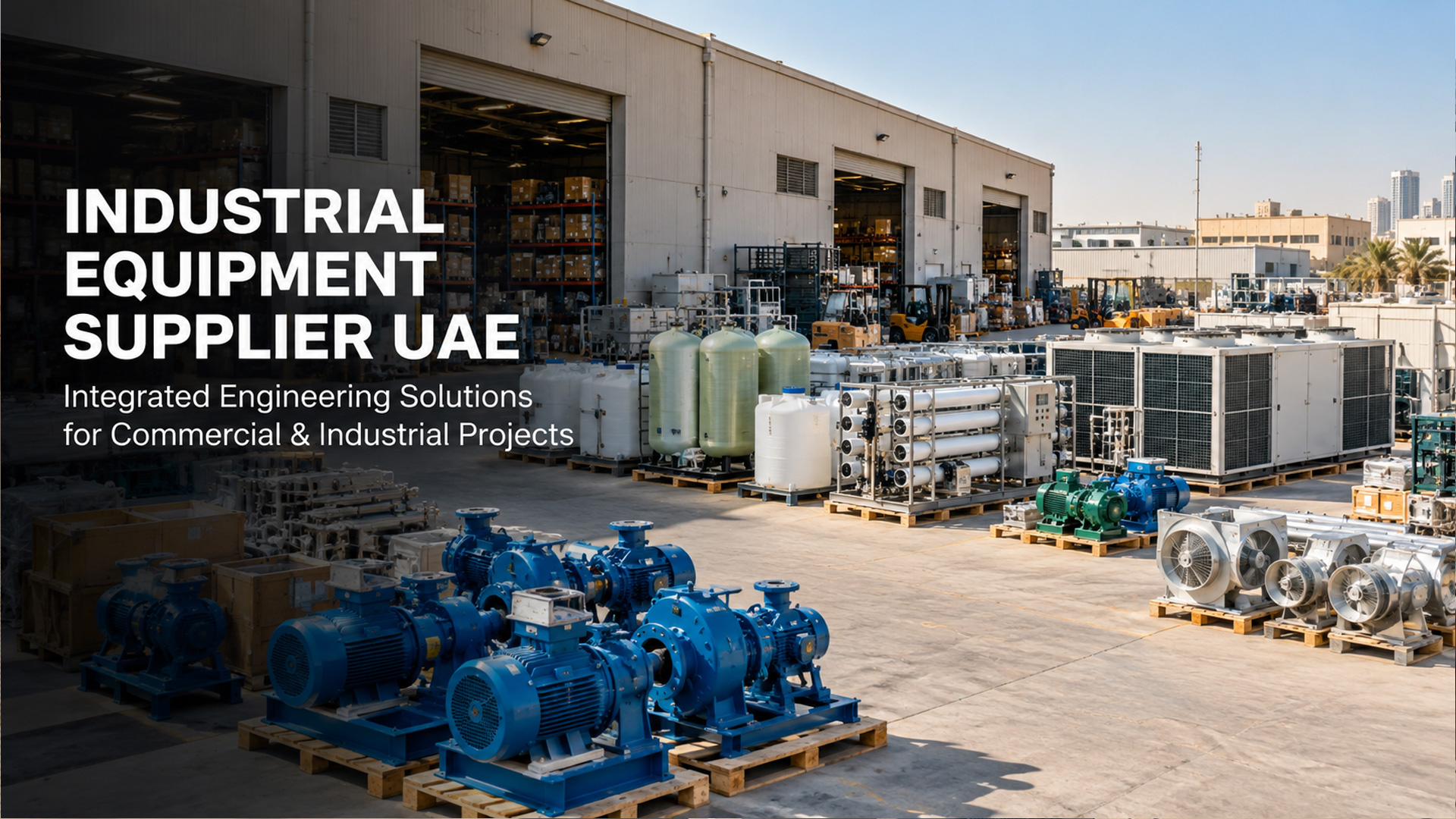
A Strong Industrial Supplier Should Help You Connect the Systems — Not Just Supply Individual Products
Choosing an Industrial Equipment Supplier UAE project teams can rely on becomes more complex when a facility requires several engineering systems rather than one isolated machine.
A factory may need process equipment, cooling, water treatment and industrial cleaning machinery. A commercial development may require chillers, solar systems, EV charging and water-treatment equipment. Contractors may need several technical packages with different utilities, controls and installation requirements.
Working with multiple specialist suppliers can be appropriate, but it also increases the importance of coordination.
For buyers, the key question is therefore not simply how many products a supplier offers.
The more important question is whether the supplier understands how different equipment packages fit into the wider project.
What Does an Industrial Equipment Supplier Cover?
The phrase industrial equipment UAE can cover many product and system categories.
Depending on the project, requirements may include:
- Industrial plant equipment
- Pumps
- Chillers
- Process cooling systems
- Water-treatment equipment
- Desalination systems
- Cleaning equipment
- Solar-energy systems
- EV charging systems
- Telecommunications equipment
- Water cooling and heating equipment
- Controls and related accessories
A multi-system engineering partner should not treat these as unrelated catalogue items.
Start With Project Scope
Before requesting quotations, buyers should define which systems are required and where supplier responsibilities begin and end.
This may include:
- Equipment supply
- Accessories
- Controls
- Interface requirements
- Installation support
- Commissioning
- Documentation
- Spare parts
Clearly defining scope makes proposals easier to compare.
Technical Coordination Matters When Several Systems Share Utilities
Different equipment packages may depend on the same electrical supply, water system, plant room, controls or operating team.
For example:
- Chillers and pumps need coordinated electrical and hydraulic requirements.
- Water-treatment systems may supply water to cooling or process applications.
- Solar systems can interact with a facility’s broader electrical strategy.
- EV charging may add significant electrical demand.
When these systems are planned independently, interface problems can appear later.
Compare Suppliers on Engineering Understanding — Not Product Count
A long product list does not automatically make a company the right engineering equipment supplier UAE.
Project buyers should evaluate whether the supplier can understand:
- Application requirements
- Capacity
- Operating conditions
- Utilities
- Equipment interfaces
- Controls
- Maintenance requirements
- Future expansion
Capacity Must Be Considered Across the Complete Project
Individual systems can affect one another.
Adding production equipment may increase cooling demand. Additional water treatment may require larger storage or transfer pumps. New EV charging infrastructure may change electrical demand.
This is why project capacity should be reviewed across connected systems rather than equipment by equipment.
Review Electrical Requirements Early
Electrical demand is one of the most important coordination areas.
Large chillers, pumps, treatment systems, industrial machinery and EV chargers can all contribute substantial connected load.
Before procurement, teams should verify:
- Available supply
- Voltage
- Phase
- Equipment load
- Starting requirements
- Control interfaces
- Future expansion
Equipment Footprint Is More Than a Dimension on a Datasheet
Plant-room planning should account for equipment size plus maintenance access.
Buyers should consider:
- Installation clearance
- Service clearance
- Ventilation
- Airflow
- Drainage
- Replacement routes
- Operator access
An equipment item may physically fit into a room but still be impossible to maintain properly.
Industrial Plant Equipment Requires Long-Term Support Planning
RBC Engineering already covers industrial plant equipment and spare parts within its UAE content ecosystem.
For multi-system projects, spare-parts planning should extend across all critical equipment.
Project teams should identify:
- Routine consumables
- Critical spare parts
- Wear components
- Recommended service intervals
- Operationally critical accessories
Cooling Systems Should Be Evaluated as Complete Systems
A chiller is one part of a cooling solution.
Pumps, controls, water quality, piping, heat rejection and the actual process load also affect performance.
Buyers evaluating cooling requirements can review RBC Engineering’s existing cooling systems supplier guide and industrial chiller guidance.
Water Treatment Should Connect With the Wider Facility
Water-treatment systems may serve production, cooling, washing, hospitality or other facility requirements.
The treatment equipment should therefore be selected around water analysis and the final use of the treated water.
RBC Engineering also provides guidance on water treatment equipment for UAE projects.
Solar and EV Charging Add an Electrical-Planning Dimension
Solar-energy and EV-charging systems should be considered within the building or facility’s wider electrical strategy.
For businesses adding several engineering systems at once, early coordination can help project teams understand how electrical generation, consumption and charging demand fit together.
Relevant RBC Engineering resources include its solar energy solutions and EV charging systems.
Documentation Should Be Part of Procurement
Industrial procurement is easier to manage when equipment is accompanied by appropriate technical documentation.
Depending on the project, useful documentation may include:
- Datasheets
- Equipment schedules
- Connection requirements
- Electrical requirements
- Operating information
- Maintenance guidance
- Recommended spare parts
Documentation becomes particularly important when multiple contractors and consultants are involved.
Compare Scope Before Comparing Supplier Price
Two industrial equipment supplier UAE proposals can appear similar financially while covering different responsibilities.
Before comparing totals, review:
Equipment + Accessories + Controls + Interfaces + Utilities + Documentation + Installation Requirements + Commissioning + Spares + Maintenance Requirements
Lifecycle Cost Should Be Considered Across Every System
The lowest combined equipment price does not necessarily create the lowest long-term operating cost.
Lifecycle expenses can include:
- Electricity
- Water
- Consumables
- Cleaning
- Service
- Spare parts
- Labour
- Downtime
When several systems operate within one facility, these costs can become significant.
When Does a Multi-System Supplier Make Sense?
A multi-system engineering supplier can be useful when a project needs coordination across related equipment categories.
This can help reduce fragmented communication and make it easier to understand how separate equipment packages affect one another.
However, the supplier should still demonstrate technical understanding in each relevant category rather than relying only on broad product availability.
What Should UAE Project Buyers Ask a Supplier?
- What information do you need before recommending equipment?
- What is included and excluded from your scope?
- How will the equipment integrate with existing systems?
- What utilities are required?
- What controls are included?
- What space and access are required?
- What consumables and spare parts are needed?
- What documentation is provided?
- What commissioning requirements should be planned?
- How can future expansion be accommodated?
Working With RBC Engineering
RBC Engineering’s commercial and industrial equipment ecosystem covers several technical categories, including industrial plant equipment, chillers, water treatment, desalination, solar energy, EV charging, telecommunications equipment, cleaning equipment and water cooling/heating systems.
For project buyers, the advantage of discussing several requirements together is that equipment can be considered as part of the wider facility rather than isolated purchasing decisions.
Frequently Asked Questions
What should I look for in an industrial equipment supplier in the UAE?
Look beyond product availability. Evaluate technical understanding, equipment compatibility, documentation, utilities, controls, spare parts, maintenance requirements and the supplier’s ability to understand the complete project scope.
Can one supplier support multiple engineering systems?
Potentially, yes. The important consideration is whether the supplier can provide appropriate technical support across each relevant equipment category and coordinate system interfaces properly.
Why should equipment interfaces be reviewed during procurement?
Industrial systems often share utilities, plant space, controls and operating resources. Interface problems discovered after delivery can create delays and additional costs.
Should lifecycle cost be compared across suppliers?
Yes. Electricity, consumables, maintenance, spares, labour and downtime can influence total ownership cost well beyond the initial purchase price.
Why is future expansion important?
Factories and commercial facilities often change over time. Considering expansion during initial design can reduce the cost and complexity of adding new equipment later.
Discuss Your UAE Industrial Equipment Requirements With RBC Engineering
Whether your project requires one system or several connected engineering packages, share your technical requirements, operating conditions and project scope with RBC Engineering.
The strongest industrial-equipment decision is not simply choosing the right product — it is making sure every system works properly within the complete project.