

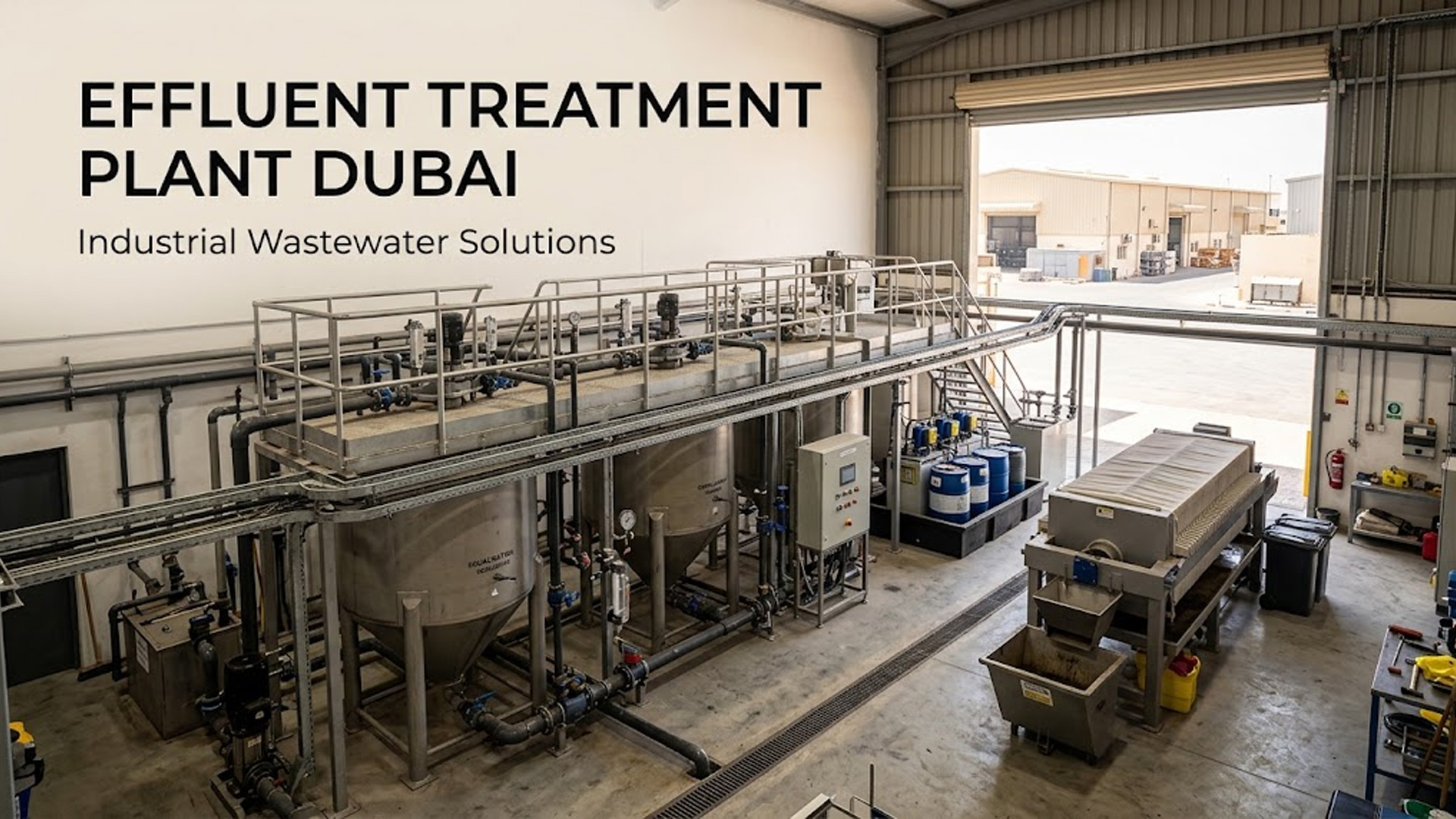
Industrial wastewater treatment starts with the manufacturing process that creates the effluent—not with a standard ETP equipment package.
An effluent treatment plant in Dubai should be designed around the industrial process generating the wastewater. A food-processing facility, workshop, manufacturing plant and chemical operation can produce wastewater with completely different pH, organic loading, solids, oils, salts and process chemicals.
That is why industrial effluent should be characterised before selecting treatment equipment. The same nominal flow rate can require very different physical, chemical, biological or membrane processes depending on what is present in the wastewater.
Direct answer: An industrial effluent treatment plant should be developed from wastewater analysis, process information, average and peak flow, contaminant loading and required treated-water destination. Depending on the effluent, treatment may involve equalisation, oil separation, pH adjustment, coagulation, flocculation, clarification, biological treatment, filtration, membranes, disinfection and sludge handling.
Start With the Industrial Process
The most useful ETP discussion begins upstream of the wastewater plant.
Project teams should identify:
- Which processes produce wastewater
- What raw materials are used
- Which cleaning chemicals enter drains
- Whether production is batch or continuous
- How often equipment is washed
- Whether different effluent streams are mixed
- Whether stormwater or sanitary sewage enters the same network
This mapping can identify opportunities to segregate difficult streams before they enter the main ETP.
Industrial Effluent Is Not the Same as Sewage
Domestic sewage normally contains predictable categories of biodegradable organic matter, solids and nutrients.
Industrial effluent may contain:
- Extreme pH
- Oil and grease
- High organic loading
- Suspended solids
- Salts
- Process chemicals
- Metals where relevant
- Cleaning agents
- Temperature variations
- Low-biodegradability compounds
Therefore an industrial ETP should not simply copy a sewage-treatment process.
Representative Wastewater Analysis
Laboratory data helps identify which treatment mechanisms are likely to be required.
Parameters can include, depending on the industrial process:
- pH
- Suspended solids
- Organic load indicators
- Oil and grease
- Total dissolved solids
- Conductivity
- Nutrients
- Metals where relevant
- Temperature
- Process-specific constituents
A single sample taken at a convenient time may not represent a highly variable industrial operation. Sampling strategy should reflect production cycles where variation is significant.
Flow Equalisation for Industrial Wastewater
Many industrial sites discharge wastewater in batches rather than continuously.
An equalisation tank can help:
- Buffer peak flow
- Mix different wastewater batches
- Reduce sudden concentration changes
- Stabilise downstream dosing
- Protect biological treatment from sudden shocks
Equalisation does not treat the wastewater by itself, but it can make subsequent treatment significantly easier to control.
pH Adjustment
Industrial wastewater can be acidic or alkaline depending on manufacturing and cleaning processes.
pH may need to be controlled before:
- Chemical precipitation
- Coagulation
- Biological treatment
- Membrane treatment
- Final discharge or reuse
Dosing systems should be selected around actual wastewater chemistry, flow and control requirements.
Oil and Grease Separation
Workshops, food production, equipment washing and selected industrial processes can introduce oil or grease.
Where relevant, separation should occur before processes that can be disrupted by floating oils or emulsions.
The appropriate technology depends on whether the contaminant is free oil, dispersed oil or chemically emulsified material.
Coagulation, Flocculation and Clarification
Some industrial effluents contain fine suspended or colloidal material that does not settle easily on its own.
Chemical treatment may be considered to destabilise those particles so they can form larger flocs and be separated.
Successful chemical treatment depends on:
- Wastewater characteristics
- Chemical selection
- Dose
- Mixing
- Reaction time
- Settling or flotation arrangement
- Sludge management
When Biological Treatment Is Appropriate
Biological treatment can be useful where a significant portion of the wastewater load is biodegradable and the operating conditions support biological activity.
However, process chemicals, extreme pH, high salinity or toxic compounds can inhibit biological treatment.
Treatability should therefore be assessed rather than assuming every high-organic-load wastewater stream can be treated biologically.
Advanced Filtration and Membrane Treatment
Where the required treated-water quality is more demanding, additional treatment may include:
- Media filtration
- Activated carbon
- Ultrafiltration where appropriate
- Reverse osmosis where dissolved-solids reduction is required
- Other project-specific polishing processes
Membrane systems normally require stable feed conditions and suitable pretreatment.
Projects requiring dedicated membrane treatment for incoming process water can also review water purification equipment.
ETP Sludge Management
Physical and chemical treatment can create significant sludge.
The plant design should address:
- Sludge quantity
- Sludge characteristics
- Thickening
- Storage
- Dewatering where appropriate
- Removal responsibility
A treatment process that removes contaminants from the water simply transfers part of the pollution load into another residual stream. That stream must still be managed.
Industrial Effluent Recycling and Reuse
Some projects investigate whether suitably treated effluent can be reused for a defined application.
Potential uses may include:
- Selected washing processes
- Cooling-related applications
- Irrigation where suitable
- Flushing
- Specific process reuse
The treatment target must be developed specifically for the proposed reuse.
Segregating Wastewater Streams Can Improve Treatment
One of the most useful industrial-water decisions can happen before the ETP.
If a facility mixes a small, highly contaminated stream with a much larger volume of relatively simple wash water, the entire plant may need to be designed around the difficult stream.
Stream segregation may allow:
- Targeted pretreatment
- Recovery of selected materials
- Reduced chemical consumption
- More stable biological treatment
- Smaller downstream equipment
The benefit depends on the actual process and should be assessed case by case.
ETP Applications
Industrial effluent treatment systems may be considered for sectors such as:
- Manufacturing
- Food and beverage processing
- Workshops
- Industrial cleaning operations
- Warehouses with process activities
- Production facilities
- Other industries generating process wastewater
The treatment system should always be developed around the specific industrial operation rather than the sector name alone.
Effluent Treatment Within the Wider Wastewater Strategy
An ETP should remain a child service under the broader wastewater treatment solutions architecture.
This keeps clear ownership between:
- General wastewater treatment
- Domestic sewage treatment
- Industrial effluent treatment
- Water purification
- Incoming industrial water treatment
Facilities requiring treatment before water enters production can review RBC Engineering’s industrial water treatment solutions.
A Practical ETP Design Process
- Map the manufacturing process.
- Identify every wastewater stream.
- Measure average and peak flows.
- Obtain representative wastewater analysis.
- Identify streams that may require segregation.
- Define the treated-water destination.
- Develop physical and chemical pretreatment.
- Assess biological treatability where relevant.
- Select polishing or membrane treatment if required.
- Plan sludge handling.
- Define instrumentation and automation.
- Commission under representative production conditions.
ETP Automation and Monitoring
Industrial wastewater can change rapidly, making monitoring particularly valuable.
Depending on the plant, instruments may monitor:
- Flow
- Tank levels
- pH
- Conductivity
- Pressure
- Dosing-system operation
- Selected process parameters
Automation should support stable treatment without removing the need for appropriate operator oversight.
Operation and Maintenance
Industrial plants need maintenance plans that reflect the contaminants they handle.
Possible requirements include:
- Tank cleaning
- Pump servicing
- Dosing-system maintenance
- Instrument calibration
- Sludge removal
- Filter maintenance
- Membrane cleaning where used
- Chemical inventory management
- Routine wastewater sampling
Information to Provide for an ETP Assessment
- Project location
- Industrial process description
- Wastewater-generating operations
- Average and peak flow
- Wastewater analysis
- Chemicals used in production or cleaning
- Operating schedule
- Required discharge or reuse route
- Available space
- Utility availability
- Expected installation scope
Discuss Your Industrial Effluent Before Selecting Treatment Equipment
Provide RBC Engineering with the industrial process, wastewater sources, representative analysis, average and peak flows, operating schedule and required treated-water destination. These details allow the treatment concept to respond to the actual effluent instead of relying on a generic ETP package.
Request an Industrial Effluent Treatment Review
Frequently Asked Questions
What is an effluent treatment plant?
An ETP is a treatment system designed to manage wastewater generated by industrial or process operations before its defined discharge or reuse route.
What is the difference between an ETP and STP?
An ETP treats industrial process wastewater, while an STP mainly treats domestic-type sewage. Their contaminant profiles and treatment requirements can differ substantially.
Does industrial wastewater always need biological treatment?
No. The appropriate process depends on wastewater composition and biodegradability. Some effluents require mainly physical or chemical treatment, while others can benefit from biological stages.
Why is pH important in an ETP?
pH affects chemical reactions, biological treatment, membrane performance and final treated-water quality, making it an important process-control parameter.
Can industrial wastewater be recycled?
Potentially, where the treatment system can achieve the quality required for a clearly defined reuse application.
Why should different wastewater streams be separated?
Segregation can prevent a small difficult stream from increasing the complexity of the entire treatment plant and may allow more targeted treatment.
What information is needed before designing an ETP?
Useful information includes process details, wastewater analysis, average and peak flow, chemicals used, operating schedule and the required treated-water destination.