

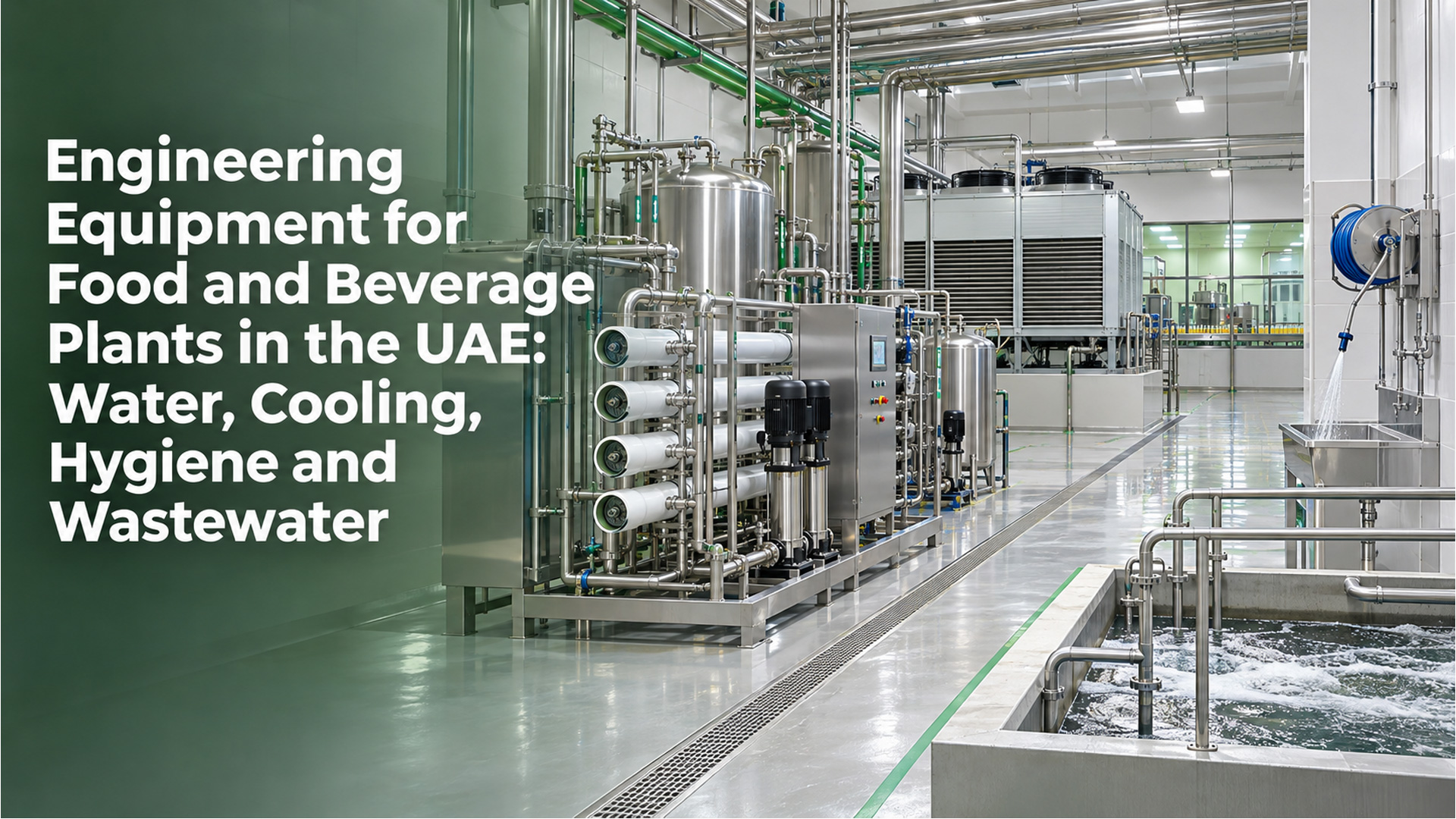
🏭 Product quality in a food plant depends on more than the production line. Water, cooling, cleaning and wastewater systems decide whether it runs safely and efficiently.
Food and beverage manufacturers in the UAE operate under demanding conditions. Production must meet strict hygiene expectations, cooling loads are heavy in a hot climate, water is a valuable resource, and wastewater from processing can be difficult to treat. Selecting the right food processing plant equipment in the UAE therefore extends well beyond mixers, fillers and packaging lines. The utility systems behind them are just as important.
This guide looks at the engineering equipment that supports food and beverage operations: process water, cooling, hygiene and cleaning, wastewater, and the spare parts that keep everything running. It is written for plant managers, engineers and procurement teams planning a new facility, an expansion or an upgrade.
Direct answer: A food and beverage plant relies on several supporting systems: water treatment to produce consistent process and ingredient water, cooling and refrigeration to control product and process temperatures, cleaning equipment and hygienic design to meet food safety standards, wastewater treatment to manage high-strength effluent, and a spare-parts strategy to protect uptime. Each should be specified from the plant’s products, processes and production volumes, and coordinated rather than purchased in isolation.
Process and Ingredient Water
Water may be an ingredient, a cleaning medium, a boiler feed or a cooling medium, and each use has different quality requirements. Beverage, dairy and bakery operations often need water with consistent mineral content and taste, while boiler feed and certain rinses need low dissolved solids.
A typical water treatment train can include filtration, activated carbon, softening, reverse osmosis and disinfection. For plants needing low-dissolved-solids water, our guide to the industrial RO plant in Dubai explains how to size reverse osmosis systems for process use, and our overview of water treatment equipment covers the wider options.
Key insight: Define water quality by use point. A single treatment standard for the whole plant either overtreats water for cleaning or undertreats water for product.
Process Cooling and Refrigeration
Food plants need cooling for product chilling, fermentation, mixing, cold storage and equipment such as compressors and molding machines. In the UAE, high ambient temperatures make cooling one of the largest energy loads.
Chilled water systems
Chillers supply chilled water to process heat exchangers, jacketed vessels and air handling units. Correct sizing, redundancy and part-load efficiency matter because production cannot stop for a chiller failure. See our guide to process cooling systems in the UAE for selection criteria.
Cooling towers and condenser water
Water-cooled chillers and process equipment rely on cooling towers, which need careful water treatment to control scale, corrosion and biological growth. Our article on cooling tower water treatment in Dubai explains the essentials.
Industrial water cooling
Some processes need dedicated closed-loop cooling or industrial water cooling systems to protect sensitive equipment from contamination.
Hygiene and Cleaning Equipment
Cleaning in food plants protects product safety and supports audits. Equipment choices include:
- Floor scrubber dryers and sweepers for production and warehouse floors
- Pressure washers for equipment exteriors, drains and loading bays where suitable
- Wet and dry vacuums for spills and dust
- Hygienic tools color-coded by zone to prevent cross-contamination
Cleaning equipment should suit floor finishes, drainage, chemicals used and food safety rules for each zone. Our guide to industrial floor cleaning machines in Dubai explains machine selection for large facilities.
Clean-in-place systems for production equipment are a separate specialist area, usually specified with the process line supplier.
Wastewater From Food Processing
Food and beverage wastewater often contains high organic loads, fats, oils, sugars, suspended solids and variable pH from cleaning chemicals. Discharging it without suitable pretreatment can breach authority requirements and overload downstream treatment.
Typical treatment stages may include screening, grease and oil separation, equalization, pH correction, dissolved air flotation and biological treatment, depending on the effluent. Our guide to effluent treatment plant solutions in Dubai explains how industrial wastewater is characterized and treated.
Key insight: Segregate high-strength streams, such as product losses and first rinses, from lighter wastewater where possible. Treating everything mixed together is usually harder and more expensive.
Spare Parts and Equipment Reliability
Downtime in a food plant can mean lost product as well as lost production time. A spare-parts strategy should identify critical items for pumps, chillers, compressors, filters, dosing systems and cleaning machines, and confirm lead times. Our guide on industrial plant equipment and spare parts covers how to build an RFQ that addresses long-term support.
Coordinating Utilities in New Projects and Expansions
When a food plant expands, the utilities often become the constraint before the production line does. A new line may need more process water, more cooling and more wastewater capacity. Planning these together avoids discovering, late in the project, that one system cannot keep up.
- Map current and future water, cooling and wastewater loads
- Identify shared constraints such as electrical capacity and plant room space
- Plan redundancy for critical utilities
- Coordinate cleaning chemicals with wastewater treatment design
- Consider heat recovery between cooling and hot-water systems
A Practical Example of Utility Planning
Consider a hypothetical juice and dairy facility in an industrial area of Dubai planning a second production line. The new line will increase daily production by around half. On paper, the production equipment is the main investment. In practice, the plant team discovers that the existing RO system already runs close to its capacity during peak shifts, that one of the two chillers carries most of the load in summer, and that wastewater from cleaning cycles has started to exceed what the existing pretreatment can handle.
If those constraints are discovered after the new line is ordered, the project faces delays and rushed utility upgrades. If they are reviewed at the planning stage, the team can size an additional RO train, add chiller capacity with redundancy, segregate high-strength rinse water, and plan equipment deliveries in the right sequence. The production line then starts on schedule, supported by utilities designed for the new load.
The same review also highlights quick wins, such as recovering heat from refrigeration to preheat cleaning water, or reusing final rinse water for floor washing where hygiene rules allow.
Common Mistakes in Food Plant Utility Planning
- Sizing utilities for current production without expansion margin
- Treating all water to the same standard
- Choosing cleaning chemicals without considering wastewater impact
- No redundancy for chillers or critical pumps
- Ignoring spare-parts lead times
- Purchasing utility equipment from separate suppliers without coordination
How RBC Engineering Supports Food and Beverage Facilities
RBC Engineering supplies industrial plant equipment, chillers and cooling systems, water and wastewater treatment equipment and building cleaning equipment for industrial facilities in Dubai and across the UAE. For a food and beverage project, share the products and processes, production volumes, current utility systems, water analysis, cooling loads, wastewater characteristics and expansion plans. That information allows each utility to be discussed as part of a coordinated plant.
Frequently Asked Questions
What water treatment does a food factory need?
It depends on how water is used. Ingredient and product water may need filtration, carbon, reverse osmosis and disinfection, while cleaning water may need less treatment. Define quality by use point.
Why is cooling so important for food plants in the UAE?
High ambient temperatures increase cooling loads for product chilling, storage and equipment. Reliable, efficient cooling protects product quality and controls energy cost.
Can food factory wastewater go to the sewer?
Only if it meets the requirements of the relevant authority. Many food plants need pretreatment for fats, oils, solids and pH before discharge.
What cleaning equipment suits food production areas?
Floor scrubber dryers, suitable pressure washers, wet and dry vacuums and color-coded hygienic tools are common, chosen to suit floors, chemicals and food safety zones.
How can a food plant reduce water use?
Options include segregating streams, reusing suitable rinse water, optimizing cleaning procedures and treating wastewater for reuse where approved.
Should utilities be planned together during expansion?
Yes. New production lines usually increase water, cooling and wastewater demand at the same time, so coordinated planning avoids bottlenecks.
Build the Plant Around Reliable Utilities
A successful food factory water treatment, cooling, hygiene and wastewater setup lets the production line do its job without interruption. Specify each system from real process needs, plan them together and protect them with the right spares.
Planning a new food or beverage facility or expanding an existing plant in the UAE? Call RBC Engineering on +971 55 502 2471, email info@rbcengineering.ae, or share your plant requirements to discuss the supporting equipment.