

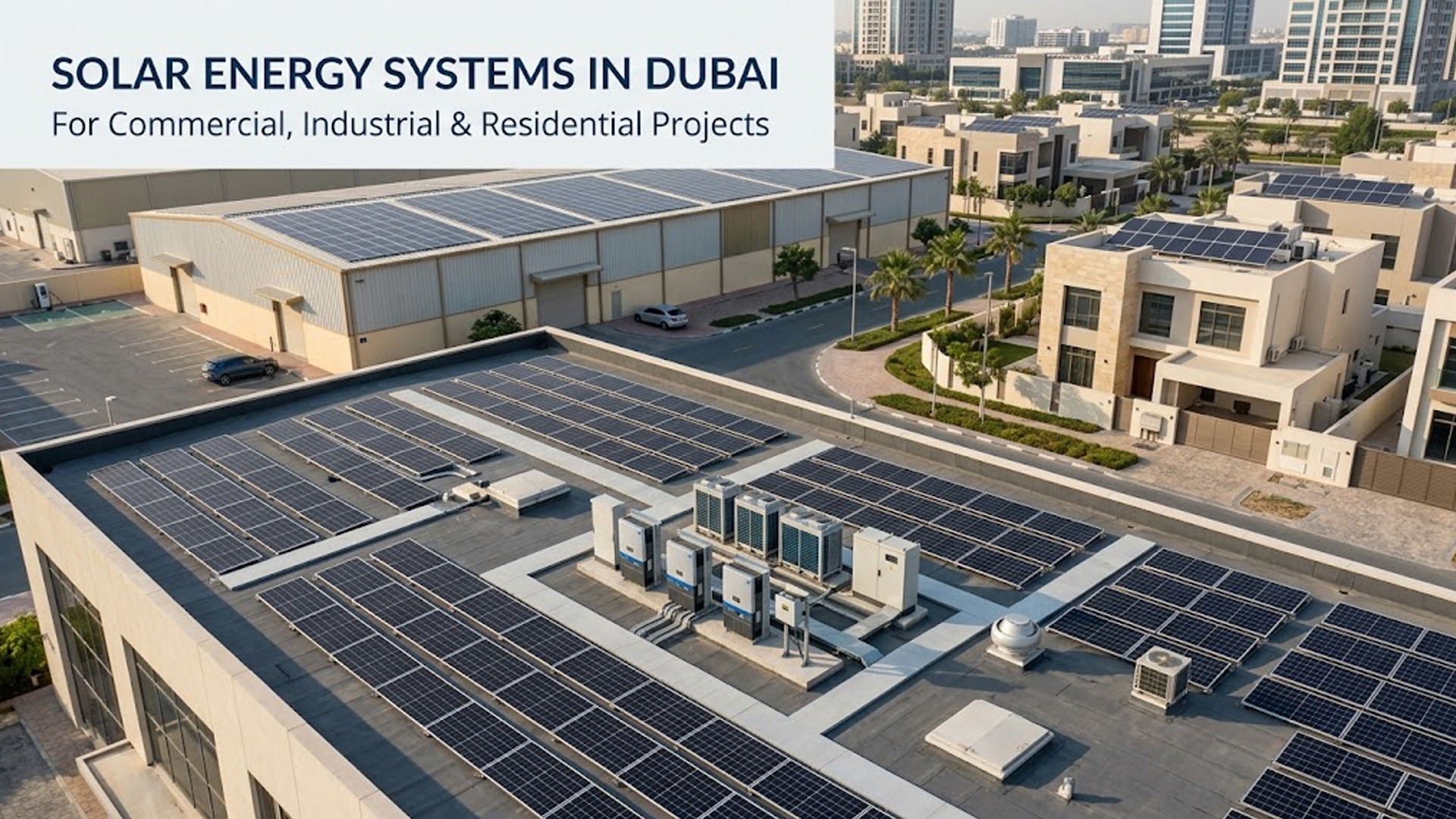
The right solar system starts with the site’s electricity profile, usable installation area and operating priorities—not a standard number of panels.
Planning solar energy systems in Dubai requires more than estimating how many photovoltaic panels will fit on a roof. The useful question is how much of the site’s electricity demand can realistically be supported by solar generation while respecting the building layout, electrical infrastructure, operating hours and applicable connection requirements.
A warehouse with strong daytime demand may need a different design from a villa seeking lower grid consumption, while an industrial site with critical loads may need to assess solar together with battery storage or other backup arrangements.
Direct answer: Solar-system selection should be based on electricity-consumption data, daytime load, usable roof or ground area, shading, structural conditions, electrical capacity and the required operating model. Grid-tied, hybrid and off-grid solar systems solve different problems, so the correct architecture should be selected before equipment is specified.
Start With the Electricity Load, Not the Solar Panel Count
Historical electricity consumption provides the starting point for solar sizing, but monthly totals alone do not tell the whole story.
A useful assessment considers:
- Monthly electricity consumption
- Daytime versus night-time demand
- Maximum site demand
- Operating hours
- Seasonal variations
- Major electrical loads
- Future equipment additions
- Potential EV charging
- Critical loads requiring backup
Solar generation is produced during daylight hours. Facilities that consume substantial electricity during the same period can often use a higher portion of that production directly.
Three Main Solar System Architectures
| System Type | Grid Connection | Battery Storage | Typical Project Objective |
| Grid-tied solar | Yes | Usually not required for basic configuration | Offset suitable daytime grid consumption |
| Hybrid solar | Typically yes | Included according to project requirements | Combine solar generation with selected storage or backup capability |
| Off-grid solar | No normal grid dependence | Generally required | Serve remote or standalone loads |
Grid-Tied Solar Systems for Dubai Properties
A grid-tied solar system in Dubai operates alongside the electrical grid and is commonly considered where the project objective is to offset suitable on-site electricity demand.
Grid-connected projects need to be developed around the applicable Dubai utility connection, design, equipment, inspection and commissioning requirements.
Important engineering considerations include:
- Available connection capacity
- Main distribution arrangement
- Existing electrical load
- Inverter configuration
- Protection requirements
- Metering arrangement
- Roof or mounting structure
- Cable routes
- Isolation and maintenance access
Grid-tied solar should not be described as automatic backup power. Its behaviour during a grid outage depends on system architecture and protection requirements.
Hybrid Solar Systems and Battery Storage
Hybrid solar systems combine solar generation with energy storage and control equipment.
A hybrid design can be considered when the client wants to:
- Store selected solar generation
- Support defined loads during specific operating conditions
- Manage energy use across different periods
- Increase flexibility for sites with changing load profiles
Battery capacity should not be chosen only from the solar-array size. It should be based on the loads that need support, required duration, charging strategy, usable battery capacity and expected operating cycle.
Off-Grid Solar Systems
Off-grid solar systems require closer coordination between generation, storage and demand because there is no normal grid supply available to absorb system imbalances.
Important inputs include:
- Daily energy consumption
- Peak load
- Starting currents
- Required autonomy
- Battery capacity
- Solar resource
- Seasonal demand
- Backup-generation strategy where applicable
Oversizing every component is not a substitute for good load analysis. The objective is to create a balanced system that can support the required loads under realistic operating conditions.
Commercial Solar Energy Systems
Commercial solar energy systems in Dubai are commonly evaluated for warehouses, offices, retail properties, hospitality facilities, schools and other properties with substantial daytime electricity consumption.
Commercial planning should consider:
- Roof ownership and access
- Daytime demand
- Tenant versus landlord electrical arrangements
- Future building loads
- Roof penetrations and existing services
- Fire and access routes
- Maintenance pathways
- Electrical shutdown coordination
For a commercial facility, the most important system may not be the one with the largest possible array. It is the one that fits the site’s usable area, electrical limits and consumption pattern.
Industrial Solar Projects
Industrial facilities often have larger electricity demand but can also present more complex integration conditions.
An industrial assessment may need to review:
- Production schedules
- Large motors and machinery
- Process continuity requirements
- Harmonic considerations
- Existing transformers and distribution boards
- Industrial roof construction
- Dust or site contamination
- Future expansion
- Cooling and utility loads
The solar design should be coordinated with the wider electrical system rather than treated as an independent rooftop installation.
Residential Solar Systems
Residential properties typically have a different consumption pattern from commercial facilities. Villas may have significant cooling demand but can also consume more electricity outside peak solar-production hours.
Residential planning should review:
- Available roof space
- Shading
- Household daytime occupancy
- Cooling demand
- Water heating
- EV charging plans
- Future battery-storage interest
This helps establish whether a grid-tied, hybrid or another configuration fits the household’s actual objectives.
Solar Panel Layout and Roof Assessment
A roof can appear large while offering much less usable solar area after practical restrictions are considered.
Layout planning needs to account for:
- Roof orientation
- Shading
- Parapets
- Mechanical equipment
- Water tanks
- Access routes
- Maintenance clearances
- Structural conditions
- Existing waterproofing
Panel quantity should therefore follow usable area rather than gross roof dimensions.
Solar System Sizing
Good sizing balances available generation with real electricity demand.
A practical sizing exercise may include:
- Collect historical electricity data.
- Separate daytime and night-time consumption where possible.
- Identify major loads and operating schedules.
- Survey the usable solar-installation area.
- Estimate achievable PV capacity.
- Model expected generation under site conditions.
- Compare generation with the site’s load profile.
- Review electrical and utility constraints.
- Consider future changes in demand.
Guaranteed savings or universal payback periods should not be quoted without project-specific energy, tariff, equipment and financial data.
Solar Inverters and Electrical Integration
The inverter connects solar generation to the electrical system and has an important role in conversion, monitoring and protection.
Selection should consider:
- Array configuration
- DC input requirements
- AC output
- Electrical architecture
- Monitoring capabilities
- Environmental conditions
- Protection and isolation
- Equipment eligibility for the relevant project
Inverter selection should be coordinated with panel strings, distribution equipment and applicable connection requirements.
Monitoring Should Help Operators Understand Performance
A monitoring platform should make system operation visible rather than simply display an impressive dashboard.
Useful information can include:
- Current solar output
- Daily production
- Historical generation
- Inverter status
- Fault notifications
- Comparison between expected and actual performance
For larger facilities, solar monitoring can also be considered alongside building-energy and EV-charging data.
Solar and EV Charging Integration
Solar generation can be coordinated with EV charging when both systems are planned around the site’s electrical capacity and operating profile.
The key is timing. Vehicles charging during solar-production hours may use a greater proportion of on-site solar energy than vehicles charged only after business hours.
Facilities considering both technologies can review RBC Engineering’s solar and EV charging integration guidance.
What a Solar Installation Process Should Cover
A proper solar energy system installation should move through defined stages rather than directly from quotation to panel mounting.
- Energy and site assessment
- Roof or ground survey
- Electrical review
- System architecture selection
- PV layout and production assessment
- Equipment selection
- Applicable approvals and submissions
- Installation
- Electrical testing
- Commissioning
- Monitoring setup
- Handover and maintenance planning
Maintenance and Long-Term Access
Solar equipment needs to remain accessible after commissioning.
Maintenance planning can include:
- Visual inspection
- Module condition checks
- Cleaning according to actual site conditions
- Electrical-connection inspection
- Inverter review
- Monitoring-data checks
- Mounting-system inspection
- Fault investigation
The required maintenance frequency depends on the site, equipment and operating conditions.
Information to Prepare Before Requesting a Solar Proposal
- Project location
- Recent electricity bills
- Operating hours
- Main electrical loads
- Roof or available installation area
- Existing electrical single-line information where available
- Future EV-charging plans
- Backup or battery-storage objectives
- Target project schedule
Plan a Solar System Around Your Real Electricity Demand
Provide RBC Engineering with the project location, available electricity-consumption data, daytime operating profile, usable installation area, electrical information and future energy requirements. These inputs allow the solar concept to be developed around the site rather than a generic panel package.
Discuss a Solar Energy Project
Frequently Asked Questions
What type of solar energy system is suitable for a Dubai commercial property?
It depends on the site’s electricity profile and operational objectives. Many projects evaluate grid-tied systems first, while hybrid configurations may be considered where defined energy-storage requirements exist.
What is the difference between grid-tied and hybrid solar?
A grid-tied system primarily operates alongside the grid, while a hybrid system combines solar with battery storage and additional energy-management functionality.
How should a solar system be sized?
Sizing should consider actual electricity consumption, daytime load, usable installation area, expected generation and electrical constraints.
Does installing more solar panels always provide better results?
No. The useful system size depends on site consumption, usable space, electrical conditions and the project’s operating model.
Can solar energy support EV charging?
Yes. Solar and EV charging can be coordinated where charging schedules, site loads, electrical capacity and solar generation are considered together.
Do all solar systems provide backup during a grid outage?
No. Backup capability depends on the system architecture, storage, switching and protection design. A standard grid-tied installation should not be assumed to provide backup power.
What information is needed before requesting a solar quotation?
Useful information includes electricity bills, operating hours, project location, roof or ground area, electrical details and any battery or EV-charging requirements.