

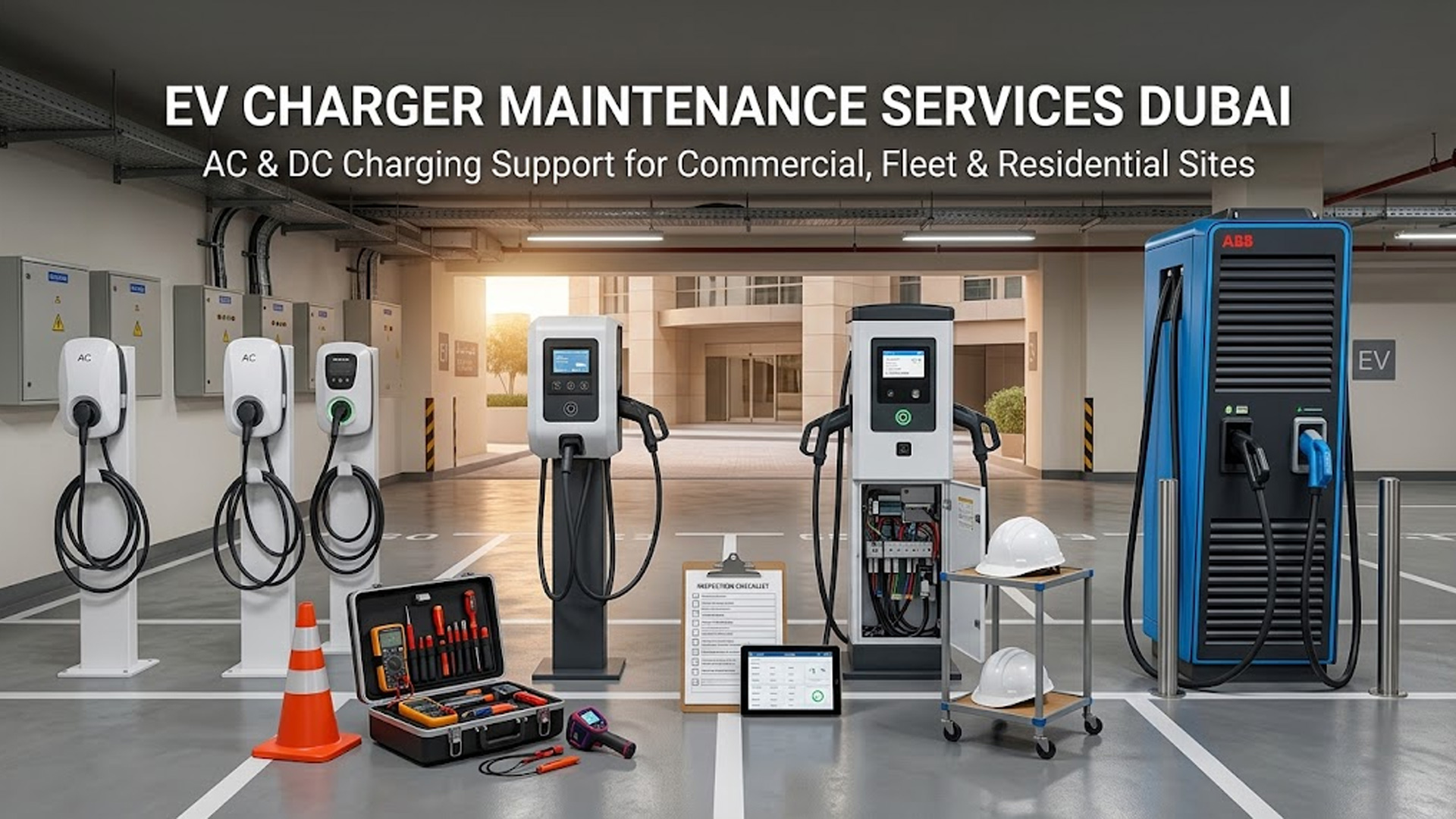
EV charger maintenance should protect availability, electrical condition and user experience—not consist only of cleaning the enclosure when something looks wrong.
EV charger maintenance services in Dubai should be planned around charger type, utilisation, environment and business importance. A charger serving one residential vehicle has a very different operating profile from equipment used throughout the day at a fleet depot, workplace or commercial parking facility.
A useful maintenance strategy combines routine inspection, electrical checks, connector and cable condition, software monitoring, fault review, cleaning and timely replacement of worn components.
Direct answer: EV charger maintenance should include planned visual inspection, cable and connector checks, enclosure inspection, electrical verification, fault-log review, cleaning, communications checks and functional testing as appropriate to the equipment. Maintenance frequency should reflect utilisation, environment and manufacturer requirements rather than one fixed interval for every charger.
Why Charger Maintenance Should Be Planned Before Failure
Waiting for a charger to stop working before investigating it can create avoidable disruption.
Preventive maintenance can help identify:
- Damaged cables
- Worn connectors
- Loose or damaged mounting
- Blocked ventilation
- Water or dust ingress concerns
- Error messages
- Communication faults
- Abnormal operating behaviour
The objective is not to promise zero downtime. It is to identify deterioration before it develops into a larger operating issue where practical.
AC and DC Chargers Have Different Maintenance Profiles
An AC EV charger generally contains a different power architecture from a high-power DC fast charger.
| Maintenance Area | AC Charging | DC Fast Charging |
| Cables and connectors | Important | Important, often under heavier use |
| Power electronics | Typically simpler charger architecture | More substantial internal power-conversion equipment |
| Cooling | Depends on model | Can be a more significant maintenance consideration |
| Communications | Relevant for managed units | Often critical for commercial operation |
| Utilisation | Ranges from low residential use to busy workplaces | Often associated with higher-turnover charging requirements |
The maintenance programme should follow the actual charger model and manufacturer documentation.
Visual Inspection
A visual inspection can identify many problems without opening the equipment.
Check:
- Enclosure condition
- Mounting and pedestal
- Charging cables
- Connector condition
- Display
- Emergency controls where provided
- Labels
- Physical impact damage
- Evidence of overheating
- Water or dust exposure
Cable and Connector Condition
Charging cables are handled repeatedly and are among the most exposed parts of a charging station.
Inspect for:
- Cuts
- Abrasion
- Cracking
- Damaged strain relief
- Connector wear
- Contamination
- Poor cable storage
A damaged charging cable should not remain in normal service simply because the charger still energises.
Cleaning and Environmental Exposure
Outdoor chargers can be exposed to dust, sand and other environmental conditions. Cleaning should follow equipment-manufacturer instructions and should not introduce water or chemicals into areas that are not designed for them.
Maintenance should also keep:
- Cooling paths clear
- Connector areas clean
- Displays readable
- Ventilation openings unobstructed
- Charging bays free from conditions that can damage cables
Electrical Maintenance
Electrical inspection should be performed according to the equipment, installation and applicable maintenance scope.
Areas may include:
- Protective devices
- Isolation
- Visible connection condition
- Earthing arrangement
- Signs of overheating
- Abnormal tripping
Repeated protection trips should be investigated rather than treated as a routine reset task.
Software, Network and Communications Checks
Modern charging sites can depend heavily on communications.
A charger may be electrically functional but commercially unavailable if it cannot communicate with the charging-management platform.
Checks can include:
- Network status
- Backend connectivity
- Authentication
- Session reporting
- Remote status
- Firmware status where applicable
- Fault logs
Sites using billing or controlled access should also review RBC Engineering’s EV charging payments and access-control guidance.
Fault Logs Are Useful Maintenance Data
Repeated faults can reveal patterns that are not obvious during a site visit.
Maintenance teams should consider:
- Fault frequency
- Time of occurrence
- Vehicle involved
- Connector used
- Ambient conditions
- Whether the fault clears automatically
- Whether the same error returns
This helps distinguish an isolated user issue from a recurring charger or infrastructure problem.
Commercial EV Charger Maintenance
Commercial sites may need a more structured maintenance programme because charger availability affects employees, tenants, visitors or paying users.
The strategy can include:
- Routine inspections
- Remote monitoring
- Fault escalation
- Spare-parts planning
- Usage review
- Planned maintenance windows
- Service records
The main EV charging solutions page should remain the parent owner for complete commercial charging infrastructure.
Fleet Charging Maintenance
A charger outage can have greater operational consequences when vehicles depend on charging before a scheduled route or shift.
Fleet maintenance planning should therefore consider:
- Charger redundancy
- Vehicle scheduling
- Critical charging windows
- Fault escalation
- Remote monitoring
- Availability of alternative chargers
- Critical replacement components
Residential Charger Maintenance
Home chargers generally experience a simpler operating environment, but they should still be checked periodically.
Home users should pay attention to:
- Cable condition
- Connector damage
- Mounting
- Error lights
- Abnormal heat
- Repeated charging interruptions
Residential buyers can review the dedicated home EV charging system guidance for equipment-selection considerations.
Maintenance Frequency Should Reflect Utilisation
A fixed schedule copied across every charger is not ideal.
Maintenance frequency may be influenced by:
- Charging sessions per day
- Public versus private use
- Outdoor exposure
- Charger power
- Cable handling
- Manufacturer requirements
- Historical faults
Spare-Parts Planning for Commercial Charging
Operators should identify components that may affect charger availability and understand the replacement process for their specific equipment.
This may involve:
- Charging cables
- Connectors
- Displays
- Communication components
- Cooling components where applicable
- Manufacturer-specific internal parts
The actual spare-parts list should come from the selected charger design and manufacturer documentation.
Build Maintenance Into EV Charging Design
Maintenance becomes easier when the original charging layout includes adequate equipment access, cable management, isolation and service space.
RBC Engineering’s EV charging station design resource addresses these wider planning decisions.
A Practical Charger Maintenance Checklist
- Inspect the charger enclosure.
- Check cables and connectors.
- Review visible mounting and impact damage.
- Check ventilation and cleanliness.
- Review current alarms.
- Review historical fault logs.
- Confirm network connectivity.
- Test charging functionality.
- Verify payment or access functions where relevant.
- Record maintenance findings.
- Escalate electrical or internal equipment faults appropriately.
Plan EV Charger Maintenance Around Your Site
Provide RBC Engineering with the charger models, quantity, location, AC or DC classification, utilisation pattern, current faults and charging-management setup. This helps define a more useful maintenance review for the actual charging infrastructure.
Discuss EV Charger Maintenance
Frequently Asked Questions
How often should an EV charger be maintained?
The appropriate interval depends on manufacturer requirements, charger utilisation, environment, equipment type and fault history rather than one universal schedule.
What does EV charger maintenance include?
It can include inspection, cleaning, cable and connector checks, electrical review, fault-log analysis, communications checks and functional testing.
Do DC fast chargers require more maintenance than home chargers?
The maintenance profile is different because DC equipment can contain more substantial power electronics and may operate at higher utilisation. Requirements should follow the specific charger design.
Can EV chargers be monitored remotely?
Many managed chargers support remote status and fault information when appropriate communications and management platforms are configured.
Why does a charger show offline even when it has power?
A charger can lose network or backend communication while remaining electrically energised. Communications and platform connectivity should therefore be checked separately.
Should a damaged charging cable still be used?
Visible damage should be assessed before continued use. Electrical charging equipment should not remain in normal operation when its safety or integrity is uncertain.
Why are maintenance records important?
Records help identify repeated faults, component trends and the maintenance history of individual chargers across larger sites.