

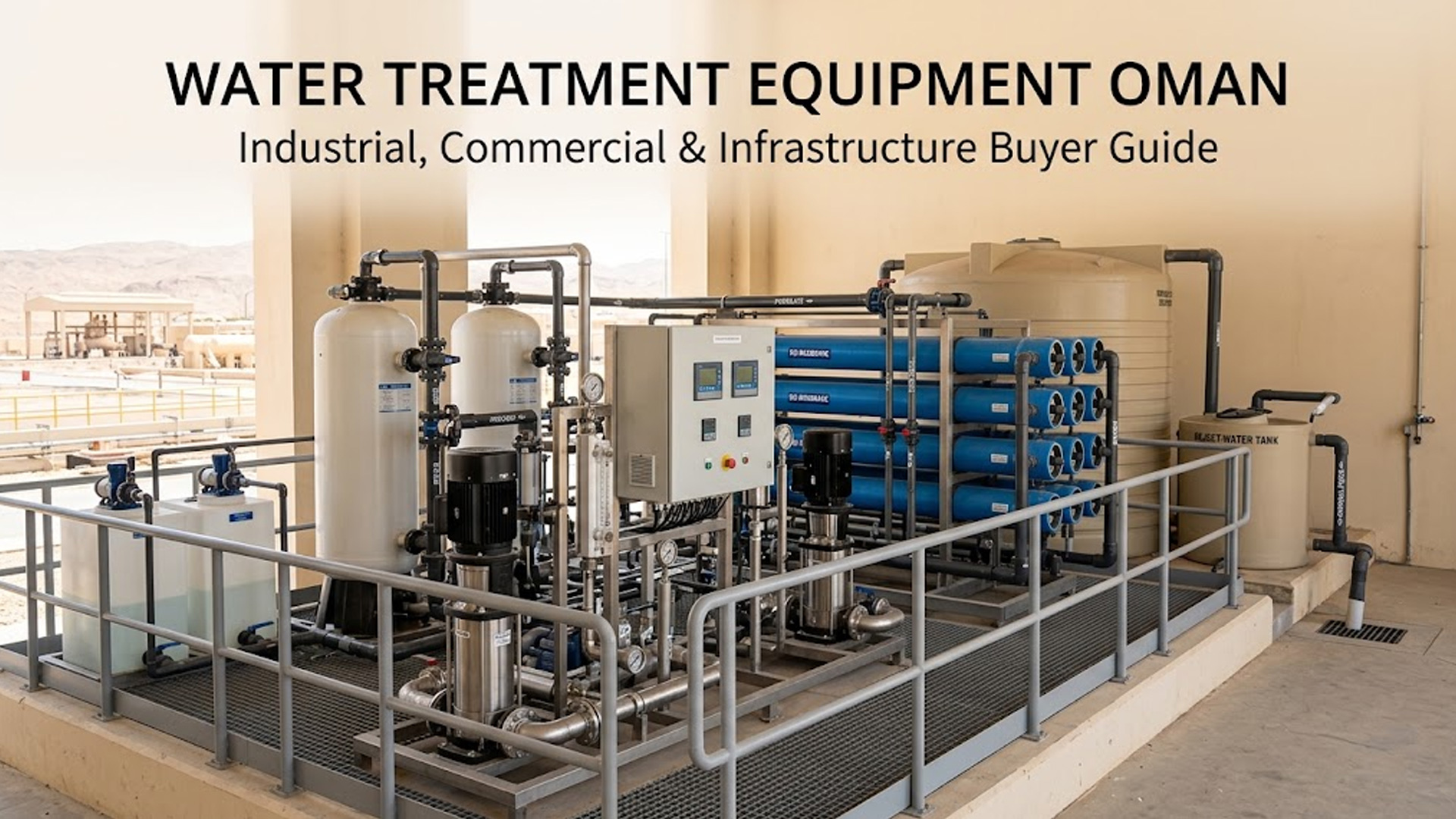
Choosing Water Treatment Equipment Starts With the Water Source — Not the Equipment Catalogue
Businesses searching for Water Treatment Equipment Oman can find everything from basic filtration units to complete reverse-osmosis, purification and desalination systems. The harder part is deciding which equipment actually belongs in the project.
Industrial plants, hotels, commercial facilities, infrastructure developments and other projects may all need treated water, but that does not mean they need the same treatment process.
The incoming water source, required final water quality, consumption pattern, operating hours and intended application should determine the system.
For procurement teams, this creates an important principle:
Do not begin by selecting equipment. Begin by defining what the water-treatment system needs to achieve.
Why Water Source Matters
The characteristics of incoming water can differ significantly from one project to another.
A system dealing primarily with suspended material has a different job from a system designed to reduce hardness or dissolved salts.
Before requesting final quotations, project teams should provide available feed-water information to the supplier.
Depending on the application, the assessment may consider parameters such as salinity, hardness, turbidity, suspended material, pH, iron, dissolved constituents or microbiological concerns.
The exact testing scope should reflect the intended application.
Better feed-water information allows a supplier to design water treatment systems Oman projects around measurable conditions rather than assumptions.
Define the Required Treated-Water Quality
After understanding the incoming water, the next question is what quality the project needs after treatment.
The answer depends on how the water will be used.
Applications may include:
- Industrial processes
- Commercial facilities
- Hotels and hospitality operations
- Washing and cleaning
- Equipment feed water
- Cooling systems
- Boiler-related requirements
- Irrigation
- Manufacturing
- Infrastructure applications
The treatment target should be clearly defined before selecting technology.
Water Filtration, Purification, RO and Desalination Are Different
The language around water treatment can create confusion during procurement.
Terms such as filtration, purification, reverse osmosis and desalination are sometimes used interchangeably even though they address different treatment requirements.
Filtration
Filtration can remove suspended material or selected contaminants using appropriate media or filter technologies.
Water Softening
Softening is generally considered where reducing water hardness is part of the treatment objective.
Reverse Osmosis
Reverse osmosis uses membrane separation and can be appropriate when the project needs to reduce dissolved substances.
Desalination
Desalination specifically addresses water in which dissolved salts are a principal treatment challenge.
Disinfection
Where microbiological control forms part of the requirement, an appropriate disinfection stage may be considered within the overall treatment process.
The correct combination depends on the project.
Do Not Specify RO Automatically
Reverse osmosis is an important technology, but not every industrial water treatment Oman project needs it.
If the primary challenge is sediment, suspended material or another condition that can be addressed through filtration or conditioning, installing RO without a clear treatment reason may make the plant unnecessarily complex.
Likewise, conventional filtration may be insufficient where significant dissolved-salt reduction is required.
The technology should follow the water analysis and output target.
Pretreatment Can Protect Downstream Equipment
Membranes and other treatment components perform best when the water reaching them is suitable for the process.
Pretreatment may therefore be required to control conditions that could affect downstream performance.
Depending on the feed water, possible stages can include sediment filtration, multimedia filtration, activated carbon, softening, cartridge filtration or chemical conditioning.
The treatment train should contain the stages that are technically justified — not every option available in a supplier catalogue.
Size the System Around Daily and Peak Demand
Capacity should be based on how the facility actually consumes water.
A nominal daily quantity alone may not tell the whole story.
Projects should consider:
- Average daily consumption
- Peak demand periods
- Required production rate
- Plant operating hours
- Available treated-water storage
- Maintenance downtime
- Potential future expansion
Storage can sometimes allow a treatment system to produce water steadily while the facility consumes water unevenly throughout the day.
This relationship between production and storage should be considered before finalising equipment capacity.
Commercial and Industrial Projects Need Different Priorities
Commercial properties may place significant value on compact equipment, straightforward controls, predictable maintenance and integration with existing building services.
Industrial facilities can have additional priorities, including continuous production, tighter process-water requirements, variable loads, redundancy, instrumentation and integration with production equipment.
For this reason, a water treatment supplier Oman project proposal should reflect the operating environment rather than offering exactly the same package to every type of customer.
Evaluate the Complete RO Package
When RO is technically appropriate, buyers should evaluate the complete plant rather than concentrating on membrane capacity alone.
An RO system may involve feed pumping, pretreatment, high-pressure pumping, membranes, instrumentation, controls, chemical conditioning, storage and reject-water handling.
Maintenance access also matters.
There should be adequate space to inspect and service pumps, filters, membranes, valves and instruments without unnecessarily dismantling other equipment.
Understand Recovery and Reject Water
Membrane systems separate incoming water into a treated-water stream and a reject stream.
Project teams should therefore understand expected recovery before approving the equipment.
Ask:
- How much feed water is required?
- How much treated water will be produced?
- How much reject water is expected?
- Where will the reject stream go?
- Is any appropriate reuse strategy being considered?
Reject-water planning should form part of the project water balance from the beginning.
Materials Should Suit Water and Site Conditions
The suitability of tanks, piping, valves, pumps, vessels and membrane housings depends partly on the water and operating environment.
The objective should not be to specify the highest-cost material everywhere.
The objective is to choose appropriate materials for pressure, water chemistry, environmental exposure and expected service life.
Automation Should Make Operation Easier
Automatic controls can simplify day-to-day plant operation when they are selected for a clear operational purpose.
Depending on the installation, monitoring may include pressure, flow, tank levels, conductivity, alarms or dosing functions.
Projects with limited technical staffing may particularly benefit from clear controls and straightforward system-status indication.
However, adding unnecessary control complexity can also make troubleshooting more difficult.
Operating Cost Should Be Considered Before Purchase
The purchase price of water purification equipment Oman projects is only one part of the lifecycle cost.
Long-term expenditure may involve:
- Electricity
- Replacement filter cartridges
- Membranes
- Chemicals where required
- Pump servicing
- Cleaning
- Instrumentation
- Labour
- Water losses
A technically appropriate system may provide better long-term value than a cheaper plant that requires unnecessary treatment stages or frequent intervention.
Prepare a Better RFQ for Water Treatment Equipment in Oman
To receive useful proposals, provide suppliers with more than a requested capacity.
A strong RFQ should include the project location, feed-water source, available water analysis, required treated-water quality, daily demand, peak demand, operating hours, available installation space, existing tanks, electrical information, automation requirements, reject-water arrangements and project schedule.
Better input generally produces a more meaningful technical comparison.
Compare Scope Before Comparing Price
Two quotations can show the same treatment capacity while including very different equipment.
One may include pretreatment, pumps, instrumentation, tanks, dosing and commissioning. Another may cover only the central treatment unit.
Before comparing prices, compare:
Treatment Basis + Capacity + Treatment Stages + Materials + Pumps + Controls + Instrumentation + Storage + Reject Handling + Consumables + Commissioning + Support
Building RBC Engineering’s Oman Water-Treatment Support
RBC Engineering supports engineering equipment requirements across water treatment, filtration, purification, desalination, cooling and related commercial and industrial applications.
For buyers developing an Oman project, the useful starting point is to provide feed-water information, the required treated-water quality, expected demand and operating conditions so the treatment approach can be discussed around the application.
Buyers reviewing technologies can also explore RBC Engineering’s water treatment equipment information and its comparison of water filtration and reverse osmosis.
Frequently Asked Questions
What water treatment equipment may be required for an Oman industrial project?
The equipment depends on feed-water conditions and required output quality. A project may involve filtration, softening, reverse osmosis, disinfection, chemical dosing or several treatment stages working together.
How should an Oman business select treatment capacity?
Capacity should reflect daily and peak consumption, available operating hours, storage, downtime allowance and future expansion rather than simply copying another facility’s plant size.
Does every project require desalination?
No. Desalination is relevant where dissolved salts are a major water-quality challenge. Other projects may be addressed using filtration, conditioning, softening or different treatment processes.
Why is feed-water testing important?
Feed-water information gives engineers a technical basis for deciding what must be treated and which stages are justified.
What should buyers compare between water-treatment quotations?
Compare treatment basis, capacity, complete equipment scope, materials, pumps, controls, instrumentation, consumables, reject-water requirements, commissioning and long-term maintenance — not only total price.
Discuss Water Treatment Equipment for Your Oman Project
Planning an industrial, commercial, hospitality or infrastructure water-treatment requirement in Oman?
Share the available water analysis, treatment objective, required capacity and project information with RBC Engineering to begin a more technically useful equipment discussion.
The right treatment plant starts with the water you have and the water quality your operation actually needs.