

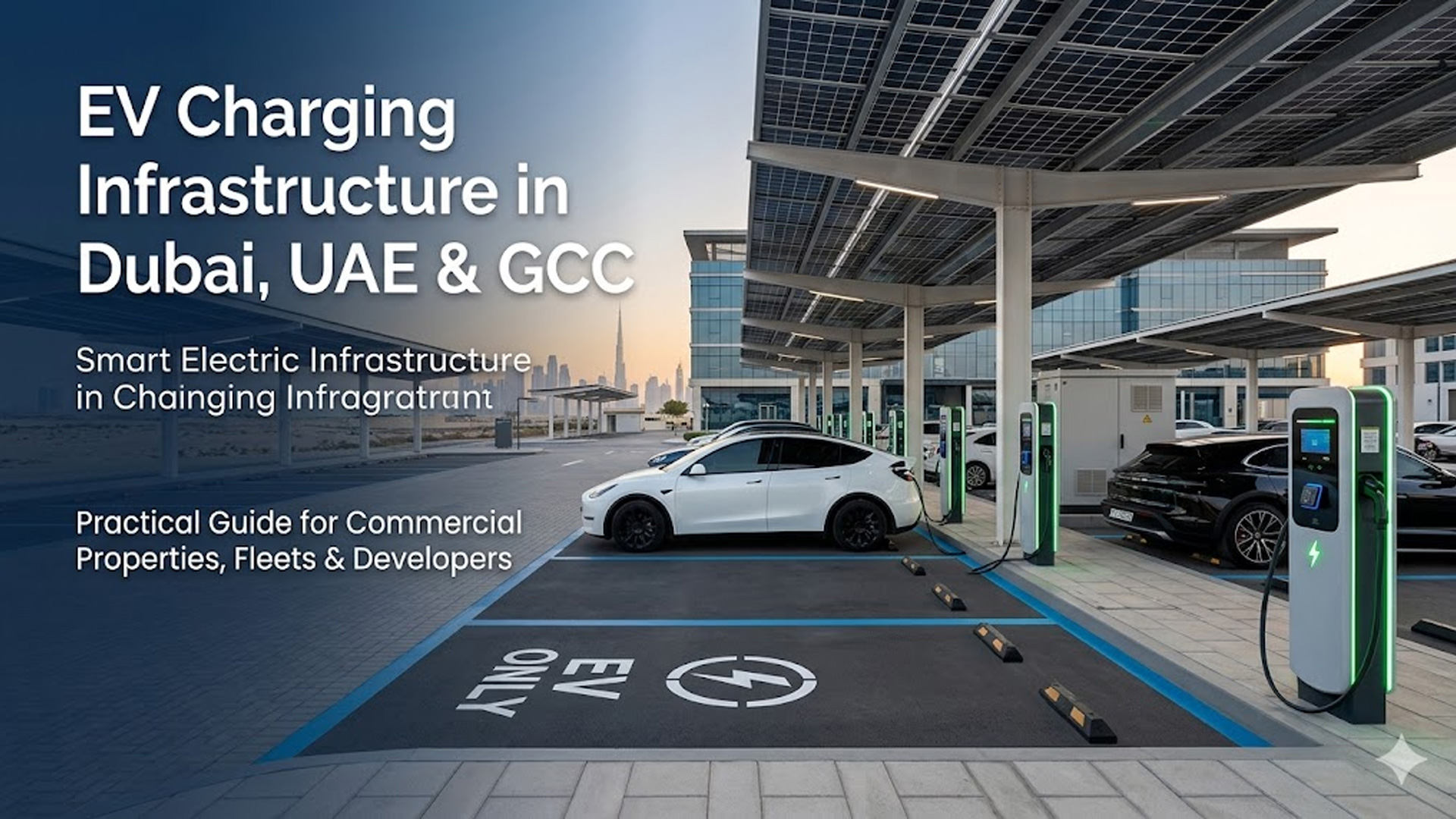
EV Charging Is No Longer a “Future Upgrade” — It Is Becoming a Real Facility Requirement Across the GCC ⚡
Electric mobility is growing across Dubai, the UAE, and the wider GCC. For commercial buildings, hotels, malls, residential communities, offices, developers, and fleet operators, the question is no longer whether EV charging will be needed. The real question is how to plan EV charging infrastructure in Dubai correctly from the beginning.
A poorly planned charging setup can create parking issues, electrical load problems, poor user experience, slow charging access, and expensive upgrades later. A well-planned system, however, can improve property value, support sustainability goals, attract EV-driving tenants, and prepare the site for long-term mobility demand.
This guide explains how businesses and property teams can approach EV charging infrastructure in Dubai, UAE, and GCC markets with a practical, scalable, and engineering-led mindset.
Why EV Charging Infrastructure Matters for Dubai and GCC Properties
Dubai’s commercial and residential landscape is changing quickly. More drivers are considering electric vehicles, companies are reviewing greener transport options, and property owners are looking for ways to make buildings more future-ready.
For a hotel, EV charging can improve guest convenience. For a mall, it can increase visitor dwell time. For an office building, it can support employees and tenants. For a residential community, it can become a key lifestyle feature. For fleet operators, it can support lower-emission transport planning.
This is why professional EV charging systems in Dubai should be planned as part of the wider facility strategy, not treated as a quick electrical add-on.
Start with the Right Site Assessment
Every site has different charging needs. A villa does not need the same system as a hotel. A mall does not need the same setup as a fleet depot. A commercial tower does not need the same charging plan as a logistics facility.
Before installing EV chargers, property owners should assess:
- Available electrical capacity.
- Current and future EV demand.
- Parking layout and traffic movement.
- Charging speed requirements.
- User type: residents, guests, employees, visitors, or fleet drivers.
- Access control and payment requirements.
- Potential solar integration or future expansion.
A clear site assessment helps prevent overloading, poor charger placement, and expensive redesign later.
AC Charging vs DC Fast Charging: Which One Fits Your Property?
Not every location needs the fastest charger available. The right charging type depends on how long users usually stay at the site.
AC chargers are often suitable for homes, residential buildings, offices, hotels, and locations where vehicles remain parked for several hours. They are practical for overnight or workday charging.
DC fast chargers are better for locations where users need quicker charging, such as retail destinations, public charging hubs, fleet depots, highway stops, and high-turnover parking areas.
For many commercial sites, a mixed charging strategy may work best. Slower charging can serve long-stay users, while faster charging can support visitors or fleet operations.
Scalability Is the Smartest EV Charging Strategy
Many properties do not need dozens of EV chargers on day one. But they do need a plan that allows expansion without major disruption later.
A scalable EV charging setup can include electrical infrastructure planning, spare capacity, cable routing, smart load management, and space allocation for future chargers. This helps properties grow with demand instead of rebuilding the system every time EV usage increases.
For businesses planning long-term charging capacity, RBC Engineering’s EV charging capacity expansion guide is a useful next step for understanding how charging infrastructure can grow over time.
Smart Load Management Protects the Building
One of the biggest mistakes in EV charging planning is ignoring electrical load. If multiple chargers operate at the same time, the building’s electrical demand can increase significantly.
Smart load management helps distribute available power more efficiently. Instead of allowing all chargers to pull maximum power at once, the system can balance charging based on real-time demand, vehicle needs, and site capacity.
This is especially important for commercial buildings, residential communities, and fleet locations where multiple vehicles may charge at the same time.
Access Control and Payment Systems Matter
EV charging is not only about hardware. Properties also need to think about how users access the chargers and how usage is managed.
For private buildings, access may be limited to residents, tenants, employees, or approved fleet users. For commercial locations, payment systems may be needed for visitors or customers. For fleet operators, tracking energy use per vehicle can be important for reporting and cost control.
RBC Engineering’s content on EV charging payments and access control supports this planning stage for sites that need a more structured charging experience.
Solar and EV Charging Can Work Together
Many UAE and GCC properties are also exploring solar energy as part of their sustainability strategy. Solar and EV charging can complement each other when designed properly, especially for commercial sites, villas, warehouses, and parking facilities with usable roof or canopy space.
A solar-supported EV charging setup can help properties reduce dependency on grid energy during suitable production periods and improve the sustainability profile of the charging station.
For sites reviewing this option, RBC Engineering provides support for solar energy systems in Dubai and EV charging integration planning.
EV Charging for Commercial Buildings
Commercial buildings can use EV charging as a tenant benefit and future-ready facility upgrade. Office tenants increasingly value practical amenities, and EV charging can support employee convenience, visitor satisfaction, and sustainability reporting.
The most important considerations are charger location, access rules, power capacity, billing structure, and maintenance responsibility. If these details are not planned early, the system may create confusion later.
EV Charging for Hotels, Malls, and Retail Destinations
Hotels and malls can benefit from EV charging because users may remain on-site long enough to charge comfortably. For hotels, charging can improve guest experience. For malls and retail destinations, charging can become part of the visitor journey.
In these locations, visibility, ease of use, payment options, safety, and charger uptime are especially important. A charger that is difficult to access or frequently out of service can damage user confidence.
EV Charging for Fleets and Industrial Sites
Fleet charging requires more technical planning than standard guest charging. Businesses must consider vehicle routes, charging windows, depot layout, power demand, operational timing, and backup planning.
For industrial and logistics locations, EV charging may also need to be planned alongside broader industrial plant equipment in UAE and facility infrastructure requirements.
Maintenance Keeps EV Charging Reliable
Installing chargers is only the first step. Long-term performance depends on monitoring, maintenance, inspection, software support, and timely repairs.
Regular maintenance helps protect charger uptime, user experience, electrical safety, and operational reliability. This is especially important for commercial and public-facing chargers, where downtime can affect customers, tenants, or fleet schedules.
Common EV Charging Planning Mistakes to Avoid
- Installing chargers without checking future electrical capacity.
- Choosing charger speed without understanding user parking time.
- Ignoring payment, access control, and usage tracking.
- Placing chargers where parking flow becomes difficult.
- Failing to plan future expansion.
- Not considering maintenance and uptime support.
- Treating EV charging as a simple plug installation instead of infrastructure.
Why RBC Engineering Is a Practical EV Charging Partner
RBC Engineering supports Dubai and UAE clients with EV charging systems, solar energy systems, industrial equipment, water systems, and broader engineering services in Dubai.
This wider engineering capability is useful because EV charging often connects with electrical planning, solar integration, building operations, access control, and long-term facility maintenance.
FAQs About EV Charging Infrastructure in Dubai
What is EV charging infrastructure?
EV charging infrastructure includes chargers, electrical connections, load management, access control, payment systems, safety planning, maintenance support, and future expansion provisions for electric vehicle charging.
Which EV charger is best for commercial properties?
The best charger depends on user behavior. AC chargers are suitable for longer parking times, while DC fast chargers are better for quicker charging needs, fleet depots, and high-turnover locations.
Can EV chargers be integrated with solar energy?
Yes, EV charging can be planned with solar energy systems where site conditions, electrical design, and usage patterns make integration practical.
Does RBC Engineering support EV charging infrastructure in Dubai?
Yes, RBC Engineering supports EV charging systems, solar energy systems, and related engineering solutions for residential, commercial, and industrial clients in Dubai and across the UAE.
Conclusion
Planning EV charging infrastructure in Dubai, UAE, and GCC markets requires more than installing chargers. The best results come from proper site assessment, scalable design, load management, access planning, maintenance support, and future-ready thinking.
As electric mobility continues to grow, properties that plan early will be better prepared for tenant demand, customer expectations, fleet needs, and sustainability goals.
Need EV Charging Infrastructure in Dubai, UAE or GCC?
Connect with RBC Engineering for EV charging systems, solar integration, commercial charging solutions, and engineering-led support for future-ready facilities.
Build EV charging infrastructure that is practical today, scalable for tomorrow, and ready for real GCC operating conditions.