

Chiller Selection Should Begin With the Heat Load — Not With a Ton-of-Refrigeration Estimate
Finding an Industrial Chiller Supplier Saudi Arabia project teams can work with effectively involves more than obtaining several quotations for the same nominal cooling capacity.
Industrial and commercial cooling requirements vary according to the process, operating temperature, flow, working hours, outdoor conditions, building or production load and the consequences of cooling failure.
A manufacturing facility running process equipment throughout the day has a different requirement from a hotel, warehouse or commercial building.
This is why a chiller should be selected around actual operating conditions rather than a generic capacity figure.
Understand the Cooling Load First
The cooling load describes how much heat the system needs to remove.
For industrial facilities, heat may come from:
- Production machinery
- Manufacturing processes
- Process fluids
- Heat exchangers
- Hydraulic equipment
- Electrical equipment
- Production spaces
Commercial properties may have loads associated with occupants, building envelope, lighting, equipment and ventilation.
The required chiller capacity should be developed from these loads rather than selected solely from another project’s equipment size.
Process Cooling Requires More Than a Chiller
In industrial applications, cooling is often part of the production process itself.
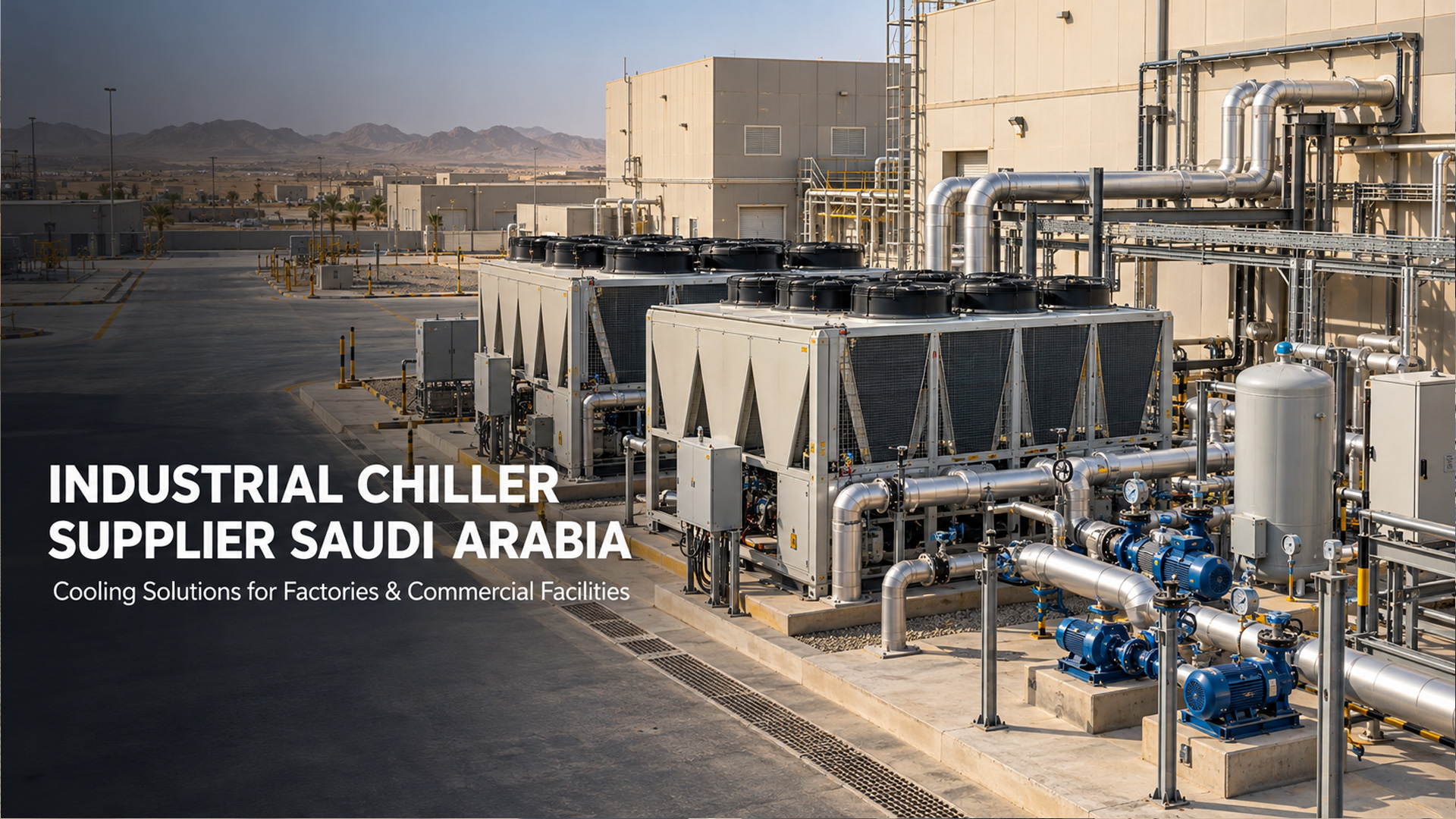
A complete process cooling Saudi Arabia system may include:
- Chillers
- Pumps
- Buffer tanks
- Piping
- Heat exchangers
- Filters
- Valves
- Instrumentation
- Controls
- Water-treatment components
The equipment should therefore be evaluated as a system.
Required Supply and Return Temperatures Matter
Cooling capacity alone does not describe the actual duty.
The supplier needs to understand what fluid temperature the process requires and what temperature the fluid will return at after absorbing heat.
These conditions influence:
- Chiller performance
- Flow rate
- Compressor duty
- Pump selection
- Heat-exchanger operation
Specifying unnecessarily low supply temperatures can increase the cooling burden without delivering a corresponding process benefit.
Flow Rate Must Match Heat-Transfer Requirements
The cooling fluid needs to circulate through the process at a suitable flow rate.
Insufficient flow can limit heat transfer.
Excessive flow may increase pumping energy and pressure losses.
Pump selection should therefore account for both the required flow and total system resistance.
Air-Cooled or Water-Cooled?
An industrial chiller KSA project may consider air-cooled or water-cooled equipment depending on capacity and site requirements.
Air-Cooled Chillers
These reject heat directly to outdoor air and can offer a simpler overall installation where an additional cooling-water circuit is undesirable.
Water-Cooled Chillers
These use a condenser-water loop and are usually part of a broader arrangement involving additional pumps, heat-rejection equipment and water management.
Neither option should be considered universally superior.
The decision should reflect site conditions, water availability, capacity, plant layout, maintenance requirements and lifecycle objectives.
Outdoor Operating Conditions Need to Be Included in Selection
Cooling equipment should be evaluated for the environment in which it will operate.
For outdoor air-cooled systems, heat rejection becomes particularly important during high-temperature conditions.
Equipment placement should also prevent hot discharge air from being drawn back into the condenser intake.
Project teams should review performance at relevant design conditions rather than comparing catalogue capacities without context.
Part-Load Performance Deserves Serious Attention
Peak cooling conditions do not necessarily occur every hour.
Factories may operate fewer production lines during some shifts. Hotels and commercial buildings may have significant variations in occupancy and cooling demand.
A properly selected system should therefore perform effectively when the actual load drops below the design peak.
This makes part-load performance an important discussion during supplier evaluation.
Modular Capacity Can Be Useful for Variable Loads
Some facilities may benefit from dividing total capacity across multiple units rather than depending on one large machine.
Potential benefits can include:
- Staged operation
- Improved response to varying loads
- Partial redundancy
- Maintenance flexibility
- Future expansion options
Whether modular capacity is appropriate depends on the project and should be evaluated against cost and system complexity.
Redundancy Should Reflect the Cost of Losing Cooling
If cooling failure simply reduces comfort temporarily, the business consequence differs from a process plant where production stops immediately.
Critical industrial applications may therefore justify:
- Standby pumps
- Multiple chillers
- Reserved capacity
- Alternative cooling arrangements
The redundancy strategy should be based on downtime risk rather than an arbitrary percentage.
Water Quality Can Influence Cooling Reliability
In water-based cooling systems, scale, corrosion, fouling and contamination can affect heat transfer and equipment condition.
The water circuit should therefore be considered as part of the cooling system rather than treated as an unrelated utility.
Where needed, filtration, conditioning or water-treatment measures should be incorporated into the project.
Controls Should Make the System More Responsive
Useful control functions may include:
- Supply-temperature control
- Pump sequencing
- Flow monitoring
- Pressure monitoring
- Tank-level control
- Equipment staging
- Alarm functions
- Operating-status monitoring
For multi-chiller installations, controls should coordinate which units operate as demand changes.
Think About Pump Energy as Well as Chiller Energy
The chiller usually receives most of the attention because it is a major energy-consuming component.
However, pumps can also operate for many hours.
Pipe sizing, system resistance, control strategy and unnecessary flow can influence pumping energy over the life of the project.
Plant Layout Affects Chiller Performance and Maintenance
A suitable equipment room or outdoor installation area should consider:
- Airflow
- Maintenance clearance
- Pipe routing
- Drainage
- Electrical access
- Noise considerations
- Ventilation
- Replacement routes
Equipment should not simply be fitted into the smallest available space.
Maintenance Requirements Should Be Understood Before Purchase
Before approving equipment, buyers should understand routine requirements for:
- Filters
- Heat exchangers
- Compressors
- Pumps
- Electrical components
- Sensors
- Water treatment where applicable
Maintenance planning becomes particularly important for facilities where cooling is operationally critical.
Lifecycle Cost Can Change the Commercial Comparison
Two chillers can have different purchase prices but also different operating characteristics.
Lifecycle considerations include:
- Electricity consumption
- Part-load performance
- Pump energy
- Maintenance
- Water use where applicable
- Spare parts
- Downtime
For equipment operating for many hours each year, lifecycle cost can become more important than a small difference in initial price.
What Should Be Included in a Saudi Industrial Chiller RFQ?
- Project location
- Cooling application
- Required capacity
- Supply-water temperature
- Return-water temperature
- Flow requirement
- Operating hours
- Normal and peak loads
- Electrical supply
- Installation environment
- Available space
- Existing pumps or tanks
- Control requirements
- Redundancy requirements
- Future expansion
- Project schedule
Compare More Than Nominal Capacity
When evaluating suppliers, compare:
Cooling Load + Design Conditions + Capacity + Temperatures + Flow + Chiller Configuration + Pumps + Controls + Materials + Water Requirements + Installation Scope + Commissioning + Maintenance Requirements
Building RBC Engineering’s Saudi Cooling Cluster
RBC Engineering supports commercial and industrial cooling, water cooling, chillers and related engineering-equipment requirements.
The new Saudi cooling cluster also connects naturally with RBC Engineering’s existing EV charging systems in Saudi Arabia page and the expanding industrial-equipment and water-treatment content for the Kingdom.
For additional technical information, project teams can review RBC Engineering’s water chiller guide and cooling systems selection guide.
Frequently Asked Questions
How should an industrial chiller be sized in Saudi Arabia?
Start with the real heat load, required fluid temperatures, flow, operating hours, site conditions and future expansion rather than using another facility’s chiller capacity as the benchmark.
Are air-cooled chillers suitable for industrial applications?
They can be, depending on capacity, site conditions, heat rejection, available space and project requirements.
Why does part-load efficiency matter?
Most facilities do not remain at peak cooling demand continuously. Equipment performance at normal operating loads can therefore have a significant effect on long-term energy use.
When should a project consider redundant cooling capacity?
Redundancy should be considered where loss of cooling would stop production, damage critical equipment or create substantial operational losses.
Should chiller proposals include pumps and controls?
The required scope depends on the project, but buyers should identify clearly whether pumps, tanks, controls, instrumentation and commissioning are included before comparing quotations.
Discuss Your Saudi Industrial Cooling Requirement With RBC Engineering
Share your required cooling capacity, process temperatures, operating profile and site information with RBC Engineering to discuss an appropriate cooling-system configuration.
Good chiller selection begins with understanding the heat your facility needs to remove — not simply choosing the largest machine the budget allows.