

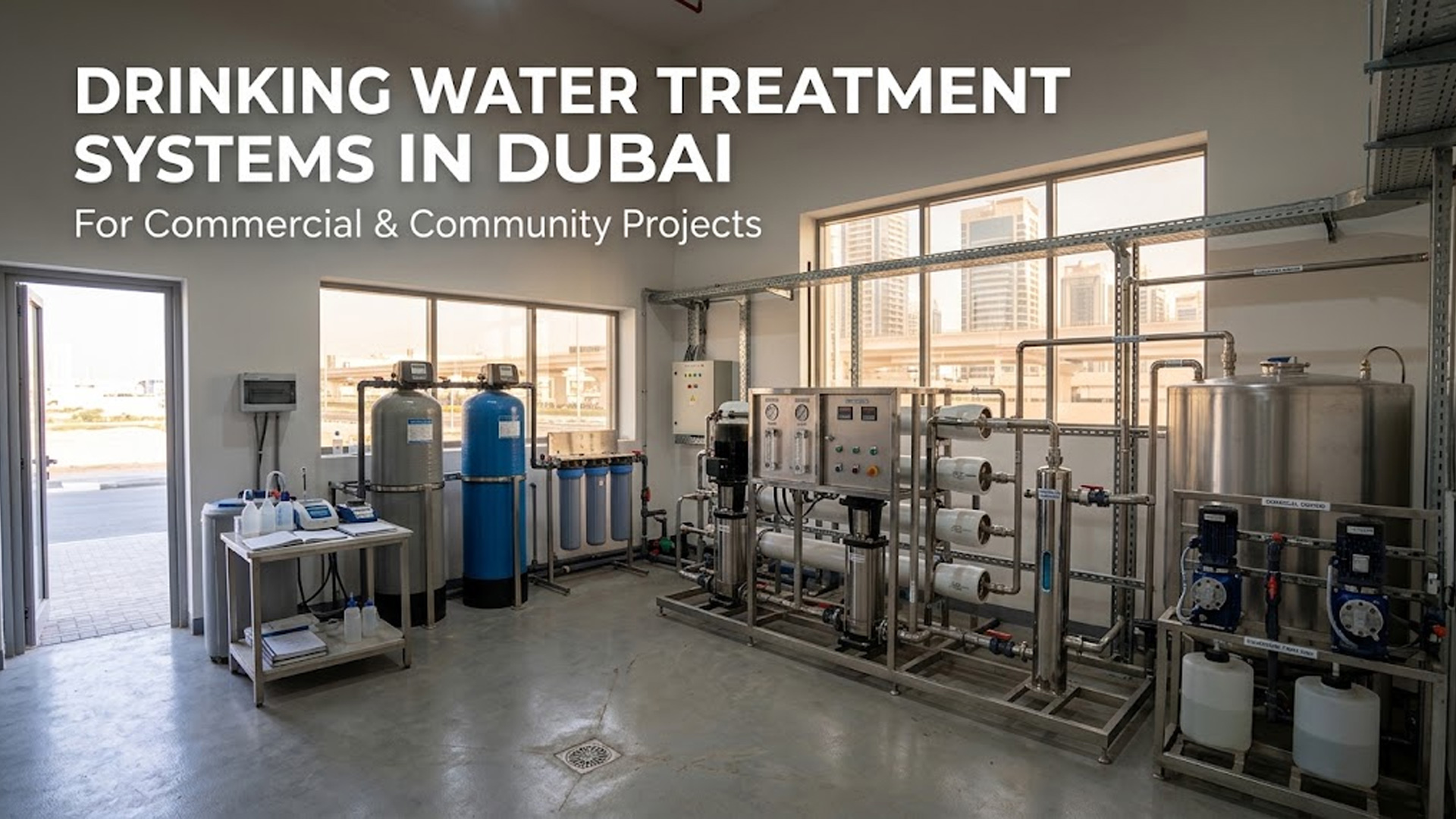
Producing drinking water is a water-quality responsibility, not simply a matter of adding an RO membrane or UV unit.
A drinking water treatment system in Dubai should be designed around the actual source water and the quality required at the point where people will consume it. The appropriate process for a commercial building supplied with relatively stable incoming water may be very different from the treatment required for a remote facility, hospitality project, staff accommodation or site using a higher-salinity source.
The equipment list should therefore follow the water analysis and final quality requirement. Filtration, activated carbon, softening, reverse osmosis, disinfection, storage and monitoring can all play a role, but not every project requires every stage.
Direct answer: A drinking-water treatment system should be selected from feed-water analysis, required final water quality, daily and peak demand, storage conditions and distribution arrangements. The treatment train may include pretreatment, filtration, activated carbon, softening, reverse osmosis, appropriate disinfection and post-treatment. Final drinking-water suitability should be verified through appropriate testing rather than assumed from the equipment installed.
Define the Drinking-Water Requirement Before Selecting Equipment
The phrase “drinking-water system” can hide several different engineering questions.
Before equipment is selected, establish:
- Where the source water comes from
- Whether recent laboratory analysis is available
- How the water is currently stored
- Required treated-water volume
- Peak consumption
- Whether the system serves drinking points only or a larger distribution network
- Required final water-quality parameters
- Whether remineralisation or pH adjustment may be required
- How treated water will be stored
- How long water may remain in storage
- How the distribution system will be maintained
- Who is responsible for routine water-quality testing
These questions prevent a common mistake: focusing entirely on the treatment machine while ignoring storage, distribution and operation.
Source-Water Analysis Determines the Treatment Train
A water-treatment proposal should respond to measured water quality rather than assumptions based only on location.
Depending on the source and intended use, analysis may need to identify parameters related to:
- Turbidity
- Suspended solids
- Total dissolved solids
- Hardness
- pH
- Chloride and salinity
- Iron or other relevant minerals
- Organic loading where relevant
- Microbiological quality
- Other source-specific contaminants
The important parameters vary by project. The goal is not to test randomly for everything but to establish a reliable basis for treatment design and final verification.
Typical Treatment Stages for Commercial Drinking Water
| Treatment Stage | When It May Be Used | Role in the System |
| Sediment filtration | Where suspended particles or turbidity need control | Protect downstream equipment and improve physical water quality |
| Activated carbon | Where suitable for identified taste, odour or chemical concerns | Adsorb selected compounds and support downstream treatment |
| Softening | Where hardness creates scale risk | Reduce hardness before sensitive downstream equipment |
| Reverse osmosis | Where dissolved-salt reduction is required | Reduce dissolved solids through membrane separation |
| Disinfection | Where microbiological control is required | Provide an appropriate microbial-control barrier |
| Post-treatment | Where final water chemistry requires adjustment | Condition treated water for the intended application |
The final arrangement should be based on the feed water and target quality, not on the assumption that a longer treatment train is automatically superior.
When Reverse Osmosis Is Necessary—and When It Is Not
RO is widely associated with drinking-water purification because it can reduce dissolved salts and many other dissolved substances. However, that does not mean every commercial drinking-water treatment system requires reverse osmosis.
If the incoming water already meets the relevant dissolved-solids requirements and the project concern is limited to sediment, taste or another specific issue, a different treatment approach may be more appropriate.
Where RO is justified, design inputs should include:
- Feed-water salinity
- Hardness
- Required product-water quality
- Required flow
- Water temperature
- Pretreatment requirements
- Membrane recovery
- Reject-water arrangements
- Storage requirement
- Post-treatment requirement
For projects specifically evaluating purification equipment, RBC Engineering’s water purification equipment service provides a related technical route within the wider water-treatment cluster.
Drinking Water From High-Salinity Sources
Where the source contains substantial salinity, ordinary filtration may be unable to meet the required dissolved-solids reduction.
These applications may require a desalination approach based on the source-water characteristics. Seawater and brackish-water treatment involve different pressure, pretreatment, membrane and concentrate-management considerations from conventional commercial filtration.
Projects with saline source water should therefore be assessed through the dedicated water desalination equipment scope.
Disinfection Is Only One Part of Microbiological Control
Disinfection equipment is important where microbiological control is required, but the system should not depend on a final disinfection device while ignoring the rest of the water path.
Microbiological risk can also be affected by:
- Untreated-water tank condition
- Filter maintenance
- Biofilm formation
- Treated-water storage
- Stagnant pipework
- Distribution temperature
- Maintenance practices
- Sampling procedures
A suitable treatment strategy should therefore consider treatment, storage, distribution and operation together.
Treated-Water Storage Must Be Included in the Design
Storage helps balance treatment production against periods of high demand, but a storage tank also becomes part of the water-quality system.
The tank arrangement should consider:
- Required usable capacity
- Expected turnover
- Protection from contamination
- Access for inspection and cleaning
- Level controls
- Overflow arrangements
- Vent protection
- Pump suction requirements
- Distribution pressure
Oversizing storage without considering turnover can create different operational concerns from a tank that is too small to meet peak demand.
Drinking-Water Treatment for Hotels and Hospitality Facilities
Hospitality projects may have several water uses within one property. Drinking water, cooking water, guest-room water, laundry water, swimming-pool make-up and cooling-system water should not automatically be assigned the same treatment requirement.
A well-defined project separates the different water uses and applies treatment where it produces a measurable operational or water-quality benefit.
For drinking-water applications, demand may vary with occupancy, restaurants, events and seasonal utilisation. Treatment production and storage should be sized around those patterns rather than only the building’s theoretical maximum occupancy.
Drinking-Water Systems for Offices and Commercial Buildings
An office or commercial facility may require treatment for drinking stations, pantry use, food-service areas or a central treated-water network.
Useful design questions include:
- How many consumption points are served?
- Is treatment centralised or decentralised?
- What is the expected peak demand?
- Will treated water be stored centrally?
- How far will treated water travel through the building?
- Who will maintain filters and treatment equipment?
- How will water quality be monitored?
These considerations help determine whether the project is best served by a central plant, smaller point-of-use equipment or a combination of approaches.
Community, Staff Accommodation and Remote-Site Applications
Projects serving larger groups of people require careful attention to demand variation, storage, redundancy, operation and maintenance.
A remote site may also have constraints that are less important in a city-centre building, including:
- Limited source-water options
- Higher salinity
- Variable electrical supply
- Limited technical staff
- Longer spare-parts lead times
- Higher dependence on treated-water storage
The system should be realistic for the people who will operate it. A technically sophisticated design can become unreliable if maintenance requirements exceed the resources available at the site.
How Drinking-Water Treatment Fits Within the Wider Water System
The drinking-water plant is one child application within a broader water treatment solution.
A facility may also require separate treatment for process water, cooling make-up, equipment protection or wastewater. Keeping those service owners distinct makes it easier to specify the correct quality for each application instead of over-treating every water stream to the same standard.
A Practical Drinking-Water Project Process
- Confirm the source
Identify where the feed water comes from and whether its quality changes over time.
- Review laboratory analysis
Use representative data to identify the parameters that determine treatment selection.
- Define final water quality
Establish the required quality at the actual point of consumption.
- Calculate daily and peak demand
Determine treatment capacity and storage around realistic consumption patterns.
- Select the treatment train
Combine only the pretreatment, membrane, filtration, conditioning and disinfection stages required for the project.
- Design storage and distribution
Ensure treated water remains protected after it leaves the treatment equipment.
- Define monitoring
Identify routine measurements, sampling points and testing responsibilities.
- Plan maintenance and consumables
Establish how filters, membranes, dosing chemicals, UV components and other service items will be managed.
- Test before final acceptance
Verify actual treated-water quality through appropriate sampling and testing after commissioning.
Maintenance Requirements Should Be Clear Before Purchase
Buyers should understand the ongoing operating requirement before approving a system.
Depending on the equipment, maintenance can involve:
- Cartridge replacement
- Media replacement or backwashing
- Carbon replacement
- Softener regeneration
- RO membrane cleaning
- UV-lamp or related component maintenance
- Dosing-system inspection
- Pump servicing
- Instrument calibration
- Tank cleaning
- Water-quality sampling
The schedule should follow actual water quality, operating conditions and manufacturer requirements rather than a universal maintenance interval.
What to Send When Requesting a Drinking-Water System Proposal
- Project location
- Feed-water source
- Recent water analysis
- Required drinking-water application
- Number of users where relevant
- Average daily demand
- Peak demand
- Operating hours
- Available plant-room space
- Storage requirement
- Electrical supply
- Installation responsibility
- Expected maintenance arrangement
Plan the Drinking-Water System Around Your Actual Source and Demand
Provide RBC Engineering with the project location, source-water analysis, required treated-water use, daily volume, peak demand, available space and expected installation scope. That information creates a much stronger basis for equipment selection than specifying an RO capacity before the water requirement is understood.
Request a Drinking-Water Treatment Review
Frequently Asked Questions
Does drinking-water treatment always require reverse osmosis?
No. RO is useful when dissolved-solids reduction or another membrane-separation objective is required. The correct treatment depends on the incoming water analysis and final water-quality target.
What should be tested before choosing a drinking-water system?
The testing programme should be relevant to the source water and intended use. Typical considerations include physical, chemical and microbiological parameters that affect treatment selection and final water quality.
Is UV treatment enough to make water suitable for drinking?
UV can form part of a disinfection strategy, but it does not correct every physical or chemical water-quality problem. The complete source-water condition and treatment train must be evaluated.
Why is treated-water storage important?
Storage helps meet peak demand when treatment production is lower than short-term consumption, but the tank must also be designed and maintained as part of the overall water-quality system.
Can drinking-water treatment be centralised for a commercial building?
Yes, where a central system fits the building layout, demand and maintenance model. Some projects may instead use decentralised or point-of-use treatment depending on the application.
What is the difference between water purification and drinking-water treatment?
Purification describes treatment processes used to remove selected contaminants. Drinking-water treatment has the additional objective of achieving and maintaining the required quality for human consumption at the point of use.
How often should drinking-water equipment be serviced?
There is no single interval for every system. Service frequency depends on equipment type, feed-water quality, production volume, operating conditions and manufacturer requirements.
How is final drinking-water quality confirmed?
It should be confirmed through appropriate testing and sampling after treatment, with ongoing monitoring arranged according to the project and applicable requirements.