

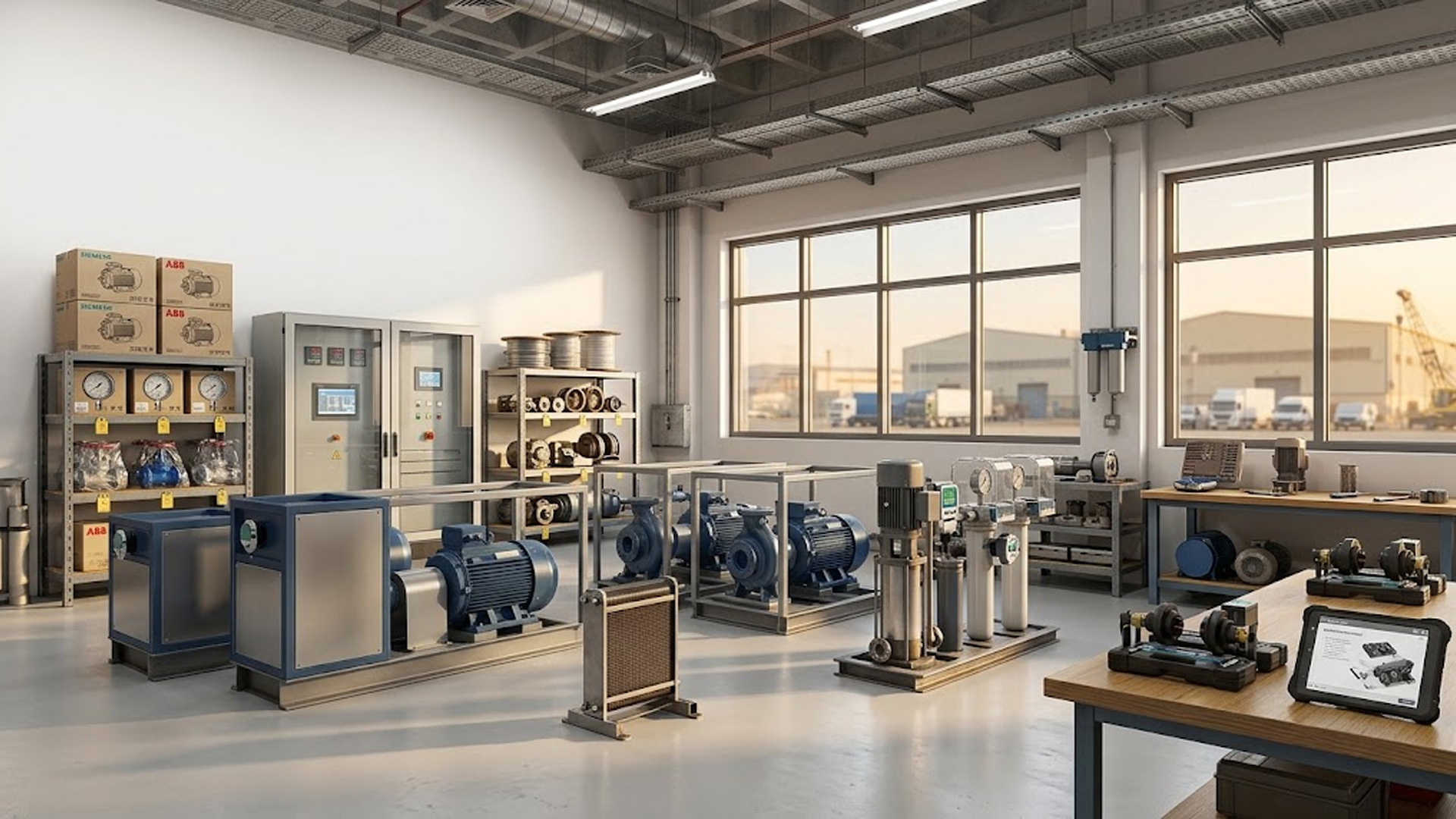
Successful Equipment Procurement Starts With the Process Requirement — Not With a Supplier Catalogue
Sourcing Industrial Plant Equipment Saudi Arabia projects require is rarely as simple as choosing a machine from a catalogue and comparing prices. Industrial facilities can involve several connected systems, different operating conditions, production targets, utilities, controls and maintenance requirements.
An equipment item that looks suitable on paper may create difficulties later if its capacity, electrical requirements, operating pressure, connection points, controls or spare-part requirements do not match the wider plant.
For factories, contractors, industrial facilities, production sites and project procurement teams across Saudi Arabia, a stronger approach is to define the operating requirement first and then source equipment around that requirement.
The objective is not simply to purchase industrial equipment. It is to purchase equipment that can be integrated, operated and maintained within the real project environment.
What Does Industrial Plant Equipment Include?
The term industrial plant equipment Saudi Arabia can cover a broad range of machinery and supporting systems.
Depending on the industry and project, this may include:
- Pumps and pumping systems
- Industrial cooling equipment
- Chillers
- Water-treatment systems
- Filtration equipment
- Heat exchangers
- Tanks and vessels
- Industrial cleaning equipment
- Process-support equipment
- Valves and piping accessories
- Electrical and control components
- Instrumentation
- Spare parts
- Related engineering equipment
The exact scope depends on what the plant produces and how its processes operate.
This is why buyers should avoid treating industrial equipment KSA procurement as one generic product category.
Begin With the Actual Process Requirement
Before approaching suppliers, project teams should define what the equipment must do.
Useful information may include:
- Required production capacity
- Operating pressure
- Required temperature
- Flow rate
- Fluid or material being handled
- Operating hours
- Electrical supply
- Expected duty cycle
- Environmental conditions
- Control requirements
- Future expansion plans
The more clearly these requirements are defined, the easier it becomes to compare technical proposals.
Capacity Should Match Real Production Demand
Oversizing is often treated as a simple safety margin, but bigger equipment is not automatically better.
A machine that is substantially larger than the actual requirement may cost more to purchase, consume more resources and operate inefficiently at normal loads.
Undersized equipment creates the opposite problem.
It may operate continuously near its limit, struggle during peak production and leave little capacity for expansion.
A professional industrial equipment supplier Saudi Arabia discussion should therefore examine:
- Normal production demand
- Peak production demand
- Operating schedule
- Expected utilisation
- Planned expansion
- Standby requirements
Check Equipment Compatibility Before Purchase
Compatibility is one of the most important parts of industrial procurement.
Equipment may need to connect with existing machines, piping, pumps, electrical systems, control panels or plant utilities.
Before finalising an order, buyers should verify:
- Connection sizes
- Flange standards
- Pressure ratings
- Voltage and frequency
- Motor requirements
- Communication protocols
- Control interfaces
- Physical dimensions
- Foundation requirements
- Installation clearances
A technically capable machine can still be unsuitable if it cannot integrate with the surrounding plant.
Do Not Evaluate Individual Equipment in Isolation
Many industrial systems depend on several components working together.
A chiller depends on pumps, controls and the cooling circuit. A water-treatment system may depend on pretreatment, storage and transfer pumps. A process line may depend on several machines operating at compatible capacities.
This means procurement teams should consider the relationship between equipment rather than reviewing every machine independently.
RBC Engineering’s existing guidance on industrial plant equipment and spare parts also highlights the importance of reviewing complete project requirements rather than isolated components.
Utility Requirements Should Be Confirmed Early
Industrial equipment may require electricity, water, compressed air, drainage, ventilation or another supporting utility.
These requirements should be understood before equipment arrives on site.
Project teams should confirm:
- Available electrical capacity
- Voltage and phase
- Water supply requirements
- Drain requirements
- Compressed-air requirements
- Cooling requirements
- Ventilation requirements
Ignoring utilities during procurement can lead to expensive modifications during installation.
Materials Should Suit the Process
Equipment materials can influence reliability, maintenance and service life.
Material selection should consider what the equipment will handle and the environment in which it will operate.
Depending on the application, buyers may need to review construction materials for:
- Pumps
- Tanks
- Vessels
- Piping
- Valves
- Heat exchangers
- Skids
- Wetted components
The most expensive material is not automatically the correct choice.
The appropriate material is the one that matches the process conditions and expected operating environment.
Automation Should Serve the Operation
Automation can improve consistency and provide useful monitoring, but it should be selected around the plant’s actual needs.
Depending on the equipment, controls may include:
- Automatic start and stop
- Pressure monitoring
- Flow monitoring
- Temperature monitoring
- Level controls
- Variable-speed control
- Alarm functions
- Equipment sequencing
- Remote-status signals
More automation is not always better.
The best control system is one that provides enough visibility and protection without creating unnecessary complexity for operators and maintenance teams.
Plan for Expansion Before the Plant Reaches Capacity
Industrial facilities often change after commissioning.
Production lines may be added, output targets may increase or additional machines may need to connect to existing utilities.
This should be discussed during procurement.
The initial equipment does not always need to be oversized significantly, but the design can consider future connection points, modular capacity or practical space for additional equipment.
A small amount of planning can make later expansion much easier.
Spare Parts Availability Can Be as Important as Initial Equipment Quality
Industrial equipment eventually requires service.
Even high-quality machinery can experience normal wear, and consumable components will need replacement.
Before approving a supplier, buyers should understand which parts are critical to operation.
Examples may include:
- Seals
- Bearings
- Filters
- Belts
- Valves
- Sensors
- Motors
- Control components
- Pump parts
- Consumables
A lower purchase price can lose its advantage quickly if a small unavailable component causes extended production downtime.
Maintenance Access Should Be Considered During Layout Planning
Plant layout should allow equipment to be maintained safely and practically.
Project teams should consider whether technicians have sufficient clearance to:
- Remove filters
- Open panels
- Service motors
- Remove pumps
- Inspect valves
- Replace components
- Access instruments
Large equipment should also have a realistic replacement route.
A plant room may look efficient on a drawing but become difficult to operate if equipment is installed with insufficient service clearance.
Compare Total Equipment Scope Before Comparing Price
Two suppliers may quote similar equipment capacities while offering significantly different scopes.
One quotation may include controls, accessories, commissioning support and critical spares. Another may cover the basic machine only.
A professional comparison should review:
Capacity + Technical Specification + Materials + Controls + Accessories + Utilities + Installation Requirements + Commissioning + Documentation + Spare Parts + Support
Only after these items have been compared should total price become the main commercial discussion.
Lifecycle Cost Matters for Industrial Equipment
The initial purchase price is only part of the cost of owning industrial machinery.
Long-term expenditure may include:
- Electricity
- Water
- Consumables
- Lubrication
- Service
- Spare parts
- Labour
- Cleaning
- Unplanned downtime
Equipment that costs less initially but requires frequent intervention may be more expensive over its operating life.
What Should Saudi Buyers Include in an Industrial Equipment RFQ?
A clear RFQ helps suppliers respond with proposals that can be compared more accurately.
Where applicable, include:
- Project location
- Application
- Required capacity
- Operating conditions
- Process temperature
- Pressure requirements
- Flow requirements
- Electrical information
- Control requirements
- Preferred materials
- Available space
- Connection requirements
- Operating hours
- Future expansion plans
- Required documentation
- Project schedule
RBC Engineering and Industrial Equipment Requirements
RBC Engineering supports commercial and industrial project requirements across multiple engineering equipment categories.
These include industrial plant equipment, cooling systems, water treatment, cleaning equipment, EV charging, solar-energy systems and related engineering solutions.
Saudi project teams can begin discussions by sharing technical specifications, required capacity, operating conditions and integration requirements.
For additional information, review RBC Engineering’s existing industrial plant equipment and spare parts guide.
Frequently Asked Questions
What information should I provide when sourcing industrial plant equipment in Saudi Arabia?
Provide the application, required capacity, operating conditions, electrical supply, dimensions, process requirements, controls, connection specifications and project schedule.
Why is equipment compatibility important?
Industrial equipment often connects with existing utilities, controls, piping and machinery. Compatibility problems can increase installation cost and delay commissioning.
Should I buy equipment with extra capacity for future expansion?
Future growth should be considered, but excessive oversizing may increase capital and operating costs. Modular expansion or planned connection capacity can sometimes be more practical.
Why should spare parts be reviewed before purchase?
Critical spare-part availability can directly affect downtime. Buyers should identify routine consumables and operationally important replacement components before equipment enters service.
How should industrial equipment quotations be compared?
Compare the complete technical specification, materials, controls, accessories, utilities, documentation, commissioning requirements, spare parts and maintenance needs before comparing price.
Discuss Your Saudi Industrial Equipment Requirements With RBC Engineering
If your project involves factory equipment, process-support systems, cooling, water treatment or related industrial machinery, share your technical requirements with RBC Engineering.
Good industrial procurement is not about buying the largest or cheapest machine. It is about selecting equipment that fits the process and works with the complete plant.