

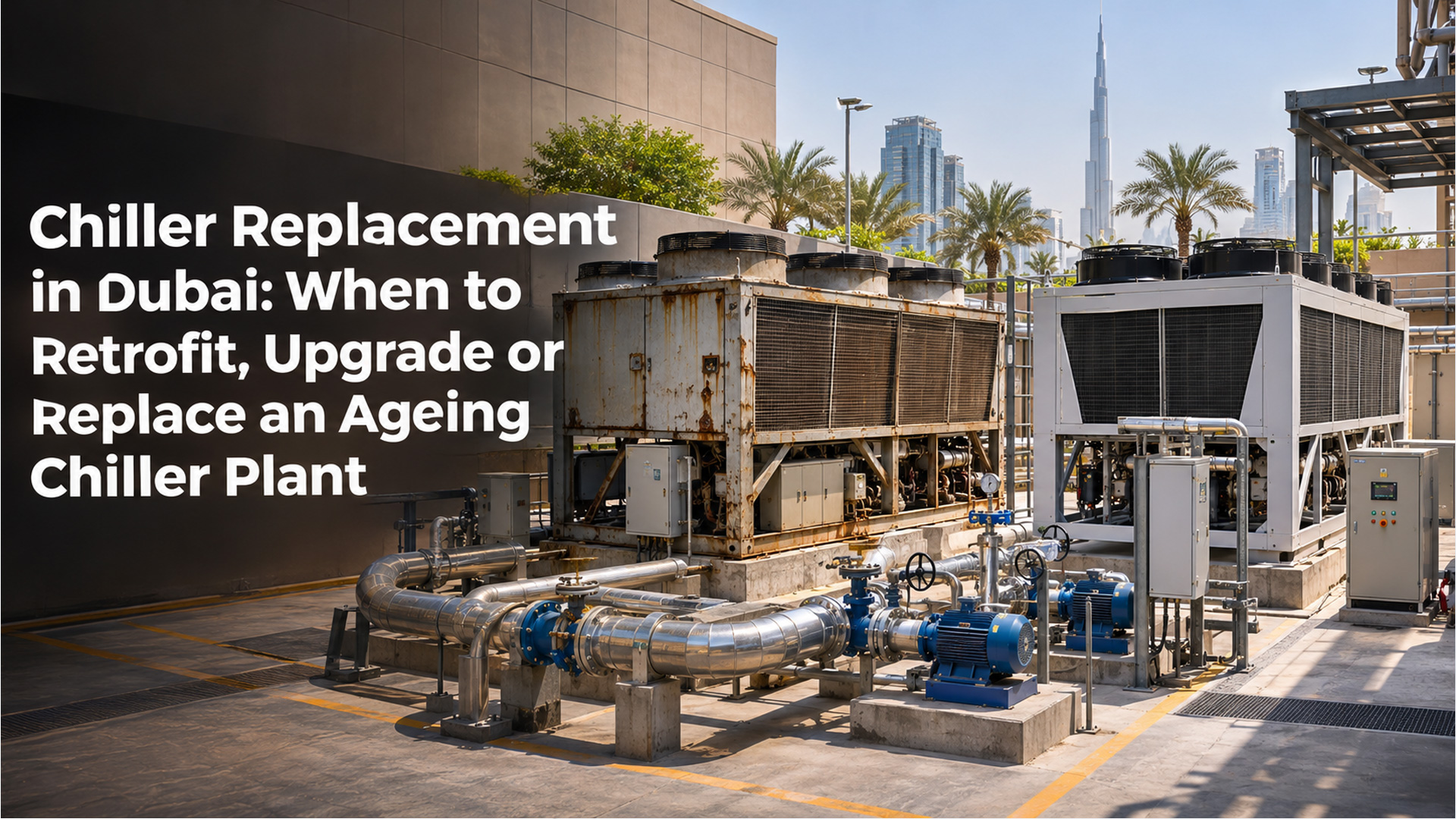
❄️ Repair, retrofit or replace? Making the call with real performance data protects both the cooling and the budget.
Every ageing chiller eventually reaches a point where each repair buys less time than the last. Compressors need rebuilding, refrigerant leaks return, efficiency falls and spare parts take longer to arrive. Yet replacing a chiller is a major capital decision, and in occupied buildings or running factories, the changeover itself carries risk. That is why chiller replacement in Dubai should be a planned engineering decision, not a reaction to the next breakdown.
This guide explains the signs that a chiller is approaching the end of its useful life, the options between simple repair and full replacement, and how to plan a changeover with minimal disruption.
Direct answer: Replace a chiller when repair costs, energy losses, refrigerant issues and downtime risk together outweigh the cost of new equipment over the remaining planning period. Before deciding, measure actual cooling load and efficiency, review maintenance history and refrigerant type, and compare repair, retrofit and replacement on lifecycle cost. A replacement should be resized to current load, not copied from the original nameplate.
Signs a Chiller Is Nearing the End of Its Useful Life
- Repeated major repairs, especially compressor failures
- Recurring refrigerant leaks or difficulty sourcing the refrigerant
- Rising energy use for the same cooling output
- Inability to hold chilled water temperature on peak days
- Obsolete controls that cannot integrate with the building management system
- Spare parts that are discontinued or have long lead times
- Corrosion of heat exchangers, casings or structural frames
No single sign proves a chiller must be replaced. Together, they indicate that a structured assessment is due.
Repair, Retrofit or Replace: The Three Paths
| Option | What it involves | When it fits |
| Repair | Fix failed components and restore operation | Chiller is mid-life, efficient, and the fault is isolated |
| Retrofit or upgrade | Replace controls, add variable-speed drives, upgrade components or convert refrigerant where supported | Core machine is sound but performance or controls are outdated |
| Replace | Install new chiller(s), often with plant redesign | Major components failing, efficiency poor, refrigerant obsolete or load changed |
Retrofit options depend heavily on the manufacturer and model. Some machines accept new controls or drives economically. Others make retrofit a poor investment because the remaining components are also near the end of their life.
Refrigerant Considerations
Older chillers may use refrigerants that are being phased out under the Montreal Protocol, such as R-22, an HCFC. As supply tightens, refilling these machines becomes more expensive and uncertain. Newer refrigerants have different properties, so converting an existing chiller is not always straightforward or recommended by the manufacturer. Confirm the current regulatory position and refrigerant availability for your equipment before committing to a long-term repair strategy.
Measure Before You Decide
A replacement decision should rest on data, not nameplate assumptions.
- Actual cooling load: buildings often change over a chiller’s lifetime through refurbishments, occupancy changes or tenant fit-outs. Many original plants were also oversized.
- Operating efficiency: measured power input against cooling output at different loads.
- Maintenance records: repair frequency, cost and parts history.
- Condition survey: heat exchangers, compressors, electrical systems and controls.
- Condenser water quality: poor water treatment can make a healthy chiller look tired.
Key insight: Never replace a chiller like-for-like by default. Resizing to the current measured load, often with better part-load efficiency, is where much of the long-term saving comes from.
Calculating Lifecycle Cost
Compare options over the same planning period, typically the remaining expected life of the building or process. Include:
- Capital cost of equipment and installation
- Energy consumption at realistic load profiles
- Maintenance and repair cost projections
- Refrigerant costs and availability risk
- Downtime cost for the business
- Any changes needed to pumps, cooling towers, pipework or electrical supply
Energy usually dominates the lifecycle cost of chillers in Dubai’s long cooling season. Our guide to energy-efficient chiller systems explains how efficiency ratings and part-load performance affect running cost.
Planning a Changeover With Minimal Disruption
Sequence the work
Multi-chiller plants can often replace one machine at a time while the others carry the load, ideally during cooler months when demand is lower.
Temporary cooling
Single-chiller sites may need temporary cooling during the changeover. Plan connection points, power supply and space in advance.
Access and rigging
Confirm how the old unit leaves and the new one enters: crane access, roof loading, door openings and lifting routes. These practical details can drive the choice of equipment.
Supporting systems
A new chiller may need changes to pumps, valves, controls, cooling towers or electrical protection. Variable-flow designs and modern controls deliver their efficiency only when the rest of the plant supports them.
Commissioning
Test the new chiller under load, verify controls integration and record baseline performance so future efficiency can be tracked.
Air-Cooled or Water-Cooled for the Replacement?
Replacement is also a chance to revisit the plant type. Water-cooled chillers are generally more efficient but need cooling towers, water and treatment. Air-cooled chillers avoid tower water use but consume more energy in high ambient temperatures. Space, water availability, maintenance capability and operating cost should all inform the choice. Our commercial chiller unit supply guide covers selection in more detail.
Key insight: Plan replacement before failure. A planned changeover in the cooler months costs far less, and risks far less, than an emergency replacement in August.
How RBC Engineering Supports Chiller Replacement
RBC Engineering provides chillers unit supply and services for commercial, industrial and process cooling applications in Dubai and the UAE. For a replacement review, share the existing chiller make, model, age and refrigerant, maintenance history, operating data if available, building or process load changes and site access constraints. Where the existing chiller may still be serviceable, see our guide to chiller repair and maintenance in Dubai.
Industrial users can also review options for process cooling systems, and compare suppliers through our article on choosing a cooling systems supplier in Dubai or an industrial chiller manufacturer.
Frequently Asked Questions
How long does a commercial chiller last?
Service life varies with chiller type, operating hours, maintenance quality and water treatment. Rather than relying on age alone, assess condition, efficiency and repair history.
Is it cheaper to repair or replace a chiller?
Repair is cheaper in the short term. Replacement can be cheaper over the building’s remaining life when energy savings, reduced repairs and lower downtime risk are included.
Can I replace a chiller with a smaller one?
Often yes, if the measured load has fallen or the original plant was oversized. A load assessment should confirm the correct capacity.
What happens to chillers using R-22?
R-22 is an HCFC being phased out under the Montreal Protocol, so supply and cost can become a concern. Check current regulations and manufacturer guidance before planning a long-term repair.
How long does a chiller replacement take?
It depends on plant size, access and supporting works. Multi-chiller plants can be replaced in stages to maintain cooling throughout.
Should I replace the cooling tower at the same time?
Not necessarily, but the tower, pumps and water treatment should be assessed together, because they affect the new chiller’s efficiency.
Make the Decision on Your Terms
A considered chiller retrofit or replacement starts with measured load and performance, compares options on lifecycle cost, and plans the changeover around the building’s operations. Done this way, the new plant runs more efficiently and the transition happens on your schedule rather than the old chiller’s.
Reviewing an ageing chiller plant in Dubai? Call RBC Engineering on +971 55 502 2471, email info@rbcengineering.ae, or share your chiller details to discuss repair, retrofit and replacement options.