

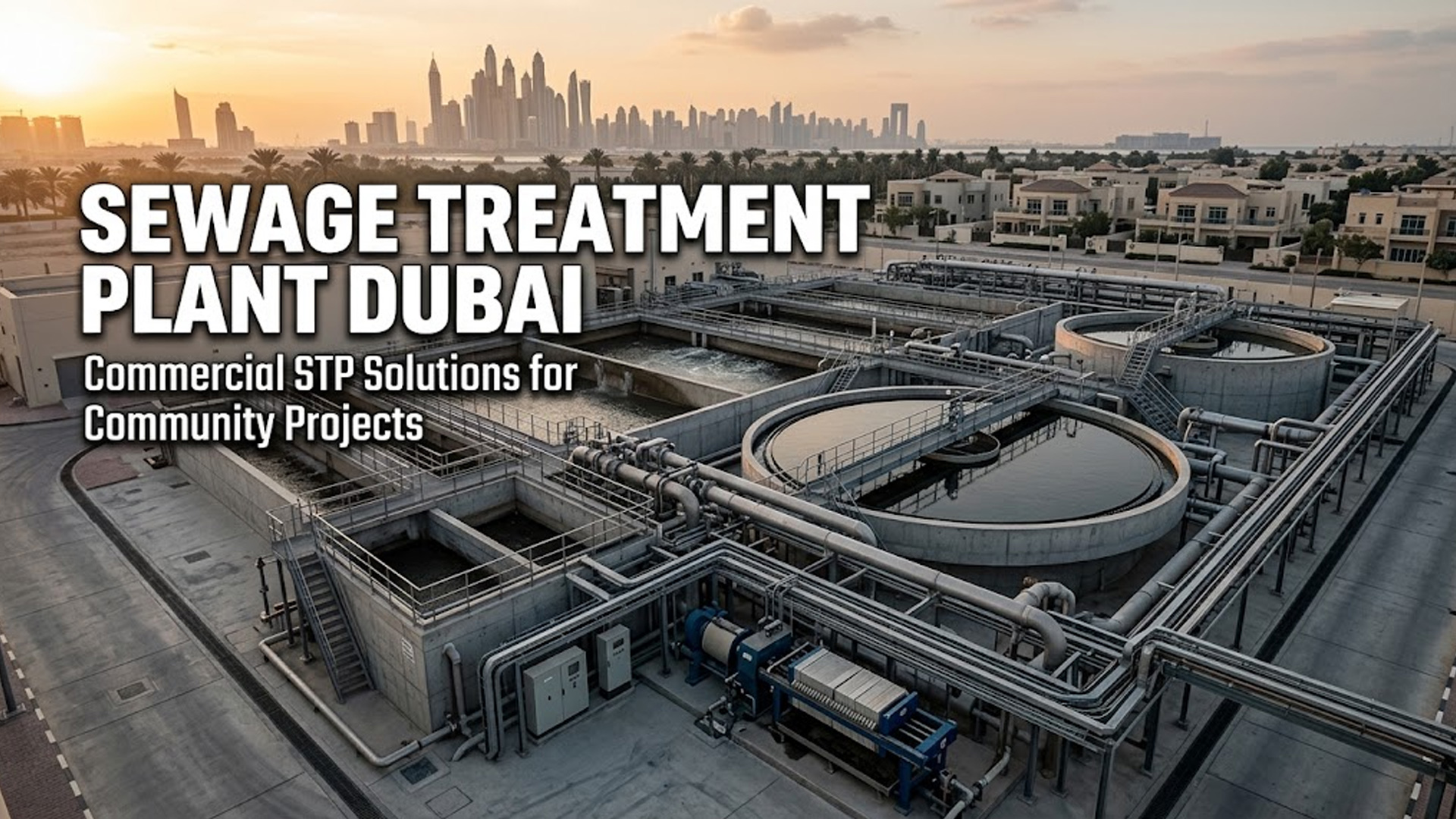
STP design should respond to occupancy, peak flows, influent strength, site constraints and the required treated-water destination—not only population figures.
A sewage treatment plant in Dubai needs to handle wastewater that changes throughout the day. Morning and evening peaks, varying occupancy, kitchen discharges and periods of low utilisation can all affect biological treatment and overall plant stability.
For hotels, staff accommodation, commercial compounds, institutions and community developments, the right STP is therefore not simply a tank sized from a population estimate. Flow profile, wastewater characteristics, treated-water requirements, available footprint, odour management, sludge handling and operator capability all need to be considered.
Direct answer: A sewage treatment plant should be designed around average and peak sewage flow, organic and solids loading, required effluent quality, site area and expected operation. A typical process can include screening, equalisation, biological treatment, solids separation, filtration, disinfection and sludge handling, but the exact configuration depends on the project.
What Is a Sewage Treatment Plant?
An STP treats predominantly domestic-type wastewater generated from toilets, washrooms, showers, kitchens and related building activities.
This wastewater normally contains:
- Biodegradable organic matter
- Suspended solids
- Nutrients
- Microorganisms
- Detergents and household-type cleaning residues
- Oil and grease where kitchen wastewater is connected
Industrial process effluent can behave very differently and should not automatically be routed into a sewage plant without understanding its effect on treatment.
Average Flow Is Only the Starting Point
Daily sewage volume helps establish capacity, but STP performance can be strongly affected by short-term peak flows.
Design should consider:
- Average daily flow
- Peak hourly flow
- Minimum flow
- Occupancy pattern
- Weekday versus weekend use
- Seasonal occupancy
- Future development phases
A hotel may experience very different loading from an office building even when their average daily wastewater volumes are similar.
Influent Quality Matters
Where representative analysis is available, sewage characteristics can help establish the required biological and solids-treatment capacity.
Relevant parameters may include:
- Suspended solids
- Organic loading
- pH
- Nutrients
- Oil and grease where relevant
- Temperature
- Other site-specific conditions
The design basis should reflect realistic wastewater quality rather than a generic assumption wherever project information is available.
Main STP Treatment Stages
Screening
Screening removes larger materials that could interfere with pumps, piping and downstream treatment equipment.
Equalisation
Equalisation buffers short-term flow and concentration changes, creating more stable conditions for the main treatment process.
Biological treatment
Biological treatment uses microorganisms to reduce biodegradable organic matter. Several process configurations can be used depending on footprint, performance target and operating requirements.
Solid-liquid separation
After biological treatment, solids need to be separated from the treated water using the selected clarification, filtration or membrane process.
Polishing
Additional filtration may be required depending on the required final water quality.
Disinfection
Disinfection can form the final microbiological-control stage where required for the intended discharge or reuse route.
Sludge treatment
Biological treatment creates excess solids. These must be stored, thickened, dewatered or removed according to the chosen plant design and project arrangements.
STP Technologies Should Be Compared by Project Requirement
No single process is automatically best for every development.
Technology comparison should consider:
- Influent loading
- Required effluent quality
- Available footprint
- Power consumption
- Operator involvement
- Sludge production
- Maintenance requirements
- Future expansion
A highly compact process may suit a site with limited land, while another project may place greater importance on simple operation or phased expansion.
Commercial Sewage Treatment Applications
Commercial sewage treatment plants can be relevant for:
- Hotels
- Residential compounds
- Staff accommodation
- Labour camps
- Schools
- Community facilities
- Commercial developments
- Remote sites
- Mixed-use projects
Kitchen Wastewater Needs Special Attention
Commercial kitchens can introduce oil, grease and high organic loading into the wastewater system.
Suitable grease management and pretreatment may be required before kitchen wastewater reaches the biological treatment process.
Ignoring this issue can create operational problems in tanks, piping and treatment equipment.
Odour Management Should Be Designed Early
STPs can be located close to occupied buildings, parking areas or property boundaries. Odour control therefore needs to be considered during layout planning.
Potential factors include:
- Tank covers
- Ventilation
- Air extraction
- Process stability
- Sludge storage
- Screenings management
- Location of treatment equipment
Packaged STP Versus Site-Built Treatment Plant
A packaged STP can offer a compact or modular arrangement for suitable projects.
However, packaged does not mean one standard plant will work for every application.
| Factor | Packaged Approach | Site-Built Approach |
| Modularity | Can offer repeatable modular equipment | Can be developed around project-specific civil works |
| Installation | May reduce some site fabrication | Can involve more site construction |
| Customisation | Possible within equipment and process limits | Can offer greater civil-layout flexibility |
| Future expansion | Depends on modular strategy | Depends on available land and original design |
Treated Sewage Reuse
Treated water may be considered for specific non-potable reuse applications where project requirements allow.
Potential applications can include:
- Irrigation
- Flushing
- Selected cleaning uses
- Other defined non-potable applications
The treatment and polishing process should be developed for the intended reuse target rather than assuming all treated sewage can be reused in the same way.
STP Versus Industrial Effluent Treatment
Sewage treatment and industrial effluent treatment should have separate keyword and engineering ownership.
An STP primarily treats domestic-type wastewater. Industrial wastewater may contain process chemicals, extreme pH, oils, dissolved metals, high salinity or contaminants that require specific pretreatment.
The broad wastewater treatment plant service can help project teams determine which treatment route fits the wastewater source.
How STP Planning Connects With Water Treatment
Facilities should consider the complete water cycle rather than treating clean-water production and sewage management as unrelated systems.
RBC Engineering’s water treatment solutions cover incoming-water requirements, while the sewage plant handles wastewater produced after use.
A Practical STP Project Process
- Confirm the source and type of sewage.
- Estimate average and peak flows.
- Review representative wastewater characteristics.
- Define discharge or reuse requirements.
- Select the biological treatment concept.
- Design equalisation and hydraulic capacity.
- Plan solids separation and polishing.
- Define disinfection where required.
- Plan sludge handling.
- Review odour, access and civil requirements.
- Define instrumentation and control.
- Commission the plant under actual loading.
Operation and Maintenance
Biological treatment requires ongoing operation rather than occasional maintenance only.
Typical operator responsibilities can include:
- Checking pumps and blowers
- Monitoring tank levels
- Inspecting aeration
- Managing sludge
- Cleaning screens
- Checking dosing systems where used
- Sampling treated water
- Reviewing alarms
- Maintaining instruments
Information Required for an STP Enquiry
- Project location
- Type of development
- Expected occupancy
- Average sewage flow
- Peak flow where available
- Wastewater analysis where available
- Required discharge or reuse route
- Available plant area
- Site utilities
- Expected installation scope
- Operator availability
Plan a Sewage Treatment Plant Around Real Site Loading
Provide RBC Engineering with the project type, expected occupancy, average and peak sewage flow, available analysis, required treated-water destination and available plant area. These inputs provide a stronger basis for STP selection than population or flow capacity alone.
Discuss a Sewage Treatment Project
Frequently Asked Questions
What is the purpose of a sewage treatment plant?
An STP treats domestic-type wastewater to reduce organic matter, solids and other contaminants before the treated water follows its defined discharge or reuse route.
How is an STP sized?
Sizing should consider average flow, peak flow, occupancy patterns, influent strength, required treated-water quality and future demand.
What is the difference between STP and ETP?
An STP primarily treats domestic-type sewage, while an ETP is designed around industrial process wastewater and its specific contaminants.
Can treated sewage be reused?
Potentially, where the treatment and final water quality are appropriate for a defined reuse application and applicable project requirements are satisfied.
What is a packaged sewage treatment plant?
It is a treatment arrangement in which major process equipment is supplied in a compact or modular configuration, but it still needs to be selected for the actual sewage characteristics and flow.
Why is equalisation important in sewage treatment?
Equalisation reduces the impact of short-term changes in flow and wastewater strength, helping downstream treatment operate more consistently.
Does an STP require regular operation?
Yes. Biological plants require monitoring, equipment checks, sludge management, cleaning and water-quality verification.