

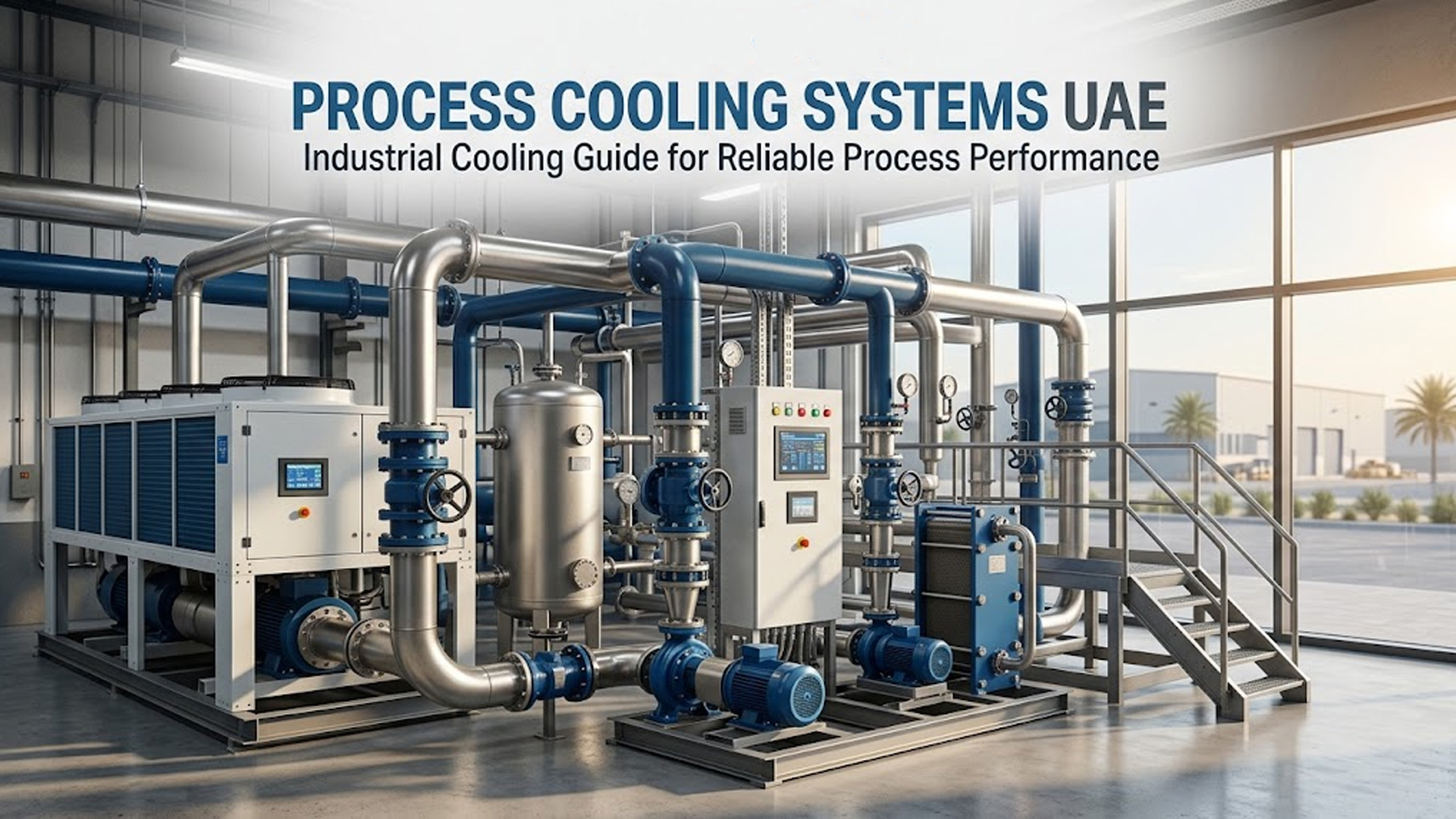
The Chiller Is Important – But It Is Only One Part of the Cooling System
When industrial facilities begin searching for Process Cooling Systems UAE, the conversation often moves immediately to chiller capacity. That is understandable, but it can also narrow the project too early.
Process cooling is not simply about buying a chiller.
It is about removing heat from a process in a controlled, repeatable and maintainable way. The chiller may generate the cooling capacity, but pumps, fluid conditions, piping, heat exchangers, controls, heat rejection, operating temperatures and process load all affect how the complete system performs.
This distinction matters for factories, manufacturing facilities, food-related operations, industrial equipment, production lines, commercial plants and other UAE facilities where temperature stability can directly influence equipment reliability or process output.
A better cooling decision starts by understanding where the heat is coming from, how much heat needs to be removed and how the system will behave when the production load changes.
What Is a Process Cooling System?
A process cooling system removes unwanted heat from industrial equipment, production processes or another controlled application.
Depending on the project, the system may use chilled water, another suitable process fluid or a dedicated refrigeration arrangement.
The complete setup can include:
- A chiller or cooling unit
- Primary or secondary pumps
- Piping and valves
- Heat exchangers
- Buffer or storage tanks
- Filters or strainers
- Temperature and pressure instruments
- Flow monitoring
- Controls and alarms
- Heat-rejection equipment
- Water-treatment or water-conditioning components
The exact configuration depends on the process.
This is why a professional industrial cooling systems UAE assessment should consider the entire loop instead of treating the chiller as an isolated machine.
Start With the Heat Load
Cooling-system selection should begin with the actual heat that needs to be removed.
A rough equipment capacity estimate may be useful early in a project, but final selection should consider the real operating load.
Questions may include:
- What equipment or process creates the heat?
- Is the heat load stable or variable?
- What inlet and outlet temperatures are required?
- How many hours does the process run?
- Does production operate continuously or in batches?
- Are several machines cooled by the same system?
- Will future equipment be added?
If the load changes significantly during the day, the cooling system should be able to respond appropriately rather than operating efficiently at only one condition.
Process Cooling Is Different From Comfort Cooling
Building air conditioning primarily exists to maintain comfortable indoor conditions.
Process cooling has a different responsibility.
It may need to maintain a fluid temperature, remove heat from machinery, control a manufacturing stage or keep equipment within a defined operating range.
The acceptable temperature variation can therefore be much narrower.
In some applications, a cooling interruption may affect production rather than simply occupant comfort.
This is why buyers searching for a process chiller UAE should explain exactly what the system is cooling rather than asking suppliers only for a nominal refrigeration capacity.
Select the Required Supply Temperature Carefully
Lower temperatures generally demand more from refrigeration equipment.
A facility should therefore avoid specifying unnecessarily low chilled-water temperatures “for safety” unless the process actually requires them.
The required supply and return temperatures influence equipment selection, system efficiency, flow rate and control strategy.
If the production process can operate reliably at a slightly higher fluid temperature, that may simplify the cooling requirement.
The correct setpoint should come from the process need rather than an arbitrary number.
Flow Rate Matters as Much as Temperature
A chiller can produce cold fluid, but that fluid still needs to move through the process at the required rate.
Insufficient flow can limit heat transfer. Excessive flow can increase pumping energy and create unnecessary pressure losses.
Pump selection therefore deserves the same engineering attention as chiller selection.
The calculation should account for pipe length, fittings, valves, filters, heat exchangers, elevation where relevant and other sources of pressure drop.
Air-Cooled or Water-Cooled?
Both arrangements can be appropriate depending on project conditions.
Air-cooled equipment rejects heat directly to ambient air and can simplify the overall installation because it does not require a cooling tower loop.
Water-cooled systems can be suitable for other applications but introduce additional components and water-management requirements.
The correct decision may depend on capacity, available space, operating profile, water availability, plant layout, maintenance strategy and lifecycle priorities.
There is no universal answer that applies to every industrial process cooling UAE project.
UAE Ambient Conditions Should Be Part of Equipment Selection
Cooling equipment must be selected around the environment in which it will actually operate.
Outdoor temperature and installation conditions affect heat rejection.
Project teams should therefore ensure that quoted performance is evaluated at appropriate design conditions rather than relying solely on an ideal catalogue rating.
Equipment location also matters.
Restricted airflow, recirculation of hot discharge air or inadequate maintenance clearance can reduce the effectiveness of an otherwise correctly sized unit.
Do Not Ignore the Process-Water Side
The fluid circulating through the system can affect reliability.
Poor water conditions may contribute to scaling, corrosion, fouling or reduced heat transfer depending on the system design and materials involved.
Where the cooling circuit requires water conditioning, filtration or treatment, those requirements should be considered during system design.
RBC Engineering also provides information on water cooling and heating equipment for commercial and industrial applications.
Closed-Loop and Open-Loop Considerations
Closed-loop cooling arrangements circulate the process fluid within a contained circuit, which can provide greater control over fluid quality and reduce exposure to external contamination.
Open systems interact more directly with the environment and may introduce additional water-quality and treatment considerations.
The choice depends on the cooling method and facility requirements.
Controls Should Follow the Process
A process-cooling control system should respond to what the production environment actually needs.
Useful control functions may include temperature control, pump sequencing, tank-level control, flow monitoring, pressure monitoring, alarm management and staged capacity control.
Variable-speed equipment may also be appropriate where load changes substantially, depending on the system design.
The aim is not to automate everything simply because the technology is available.
The aim is stable operation with useful monitoring and manageable complexity.
Plan for Partial Loads
Industrial processes do not always operate at full capacity.
A production line may run at 40% one day and 90% the next. Several machines may start and stop independently. Seasonal production may also change cooling demand.
A cooling system selected only around peak load may spend much of its operating life at lower demand.
Part-load performance should therefore be part of the supplier discussion.
Redundancy Depends on the Cost of Downtime
Not every project requires standby equipment.
However, if loss of cooling immediately stops production or risks damaging critical equipment, redundancy becomes a business discussion rather than simply a mechanical one.
Possible strategies can include multiple smaller units, duty/standby pumps, modular capacity or other arrangements appropriate to the application.
Before adding redundancy, compare its cost with the operational consequence of losing cooling.
Buffer Tanks Can Help Stabilise Certain Systems
Some process-cooling systems benefit from additional fluid volume.
A buffer tank can help reduce short cycling and provide thermal stability where loads change rapidly or the total circuit volume is low.
Whether one is required depends on the chiller, control method, system volume and process behaviour.
Installation Layout Can Affect Performance
Even correctly selected equipment can underperform when installed poorly.
During design, consider:
- Airflow around outdoor equipment
- Pipe routing
- Pump access
- Filter and strainer access
- Drainage
- Maintenance clearance
- Electrical access
- Noise requirements
- Future equipment replacement routes
A compact plant room is useful only if the equipment can still be operated and serviced properly.
Evaluate the Complete Cooling System in the RFQ
If different suppliers quote different scopes, comparing chiller prices alone can lead to the wrong conclusion.
An RFQ for Process Cooling Systems UAE should make the expected scope clear.
Where relevant, include:
Cooling Load + Required Temperatures + Flow + Pumps + Heat Rejection + Controls + Tanks + Piping Interface + Water Quality + Instrumentation + Redundancy + Installation Conditions + Commissioning Requirements
This helps suppliers prepare proposals that are easier to compare technically.
How Process Cooling Differs From Buying a Standard Chiller
Buying a standard chiller begins with equipment.
Engineering a process cooling system begins with the process.
That difference changes the entire procurement conversation.
RBC Engineering’s guides to water chillers in Dubai and selecting a cooling systems supplier in Dubai provide additional information for UAE commercial and industrial buyers.
Frequently Asked Questions
What information is needed to size an industrial process cooling system?
Useful information includes the process heat load, required supply and return temperatures, fluid type, flow requirement, operating hours, load variation, site conditions and plans for future expansion.
Is a larger chiller always safer?
No. Significant oversizing can create unnecessary capital cost and may affect operating behaviour. Equipment should be selected around realistic peak and part-load conditions.
Why are pumps important in process cooling?
Pumps maintain the flow required to transfer heat through the circuit. Pump sizing should account for required flow as well as pressure losses across piping, valves, filters and process equipment.
Should water quality be considered in a cooling system?
Yes, where water or a water-based fluid is used. Water conditions can affect heat exchangers, piping and other components, so suitable water management may be part of the system design.
When should redundancy be considered?
Redundancy becomes more important when cooling failure can stop production, affect critical equipment or create significant operational losses.
Plan Your UAE Process Cooling System Around the Real Load
A reliable cooling project starts with understanding the heat source, required temperature, flow, operating profile and consequences of downtime.
RBC Engineering can discuss commercial and industrial cooling requirements alongside chillers, water cooling equipment and related engineering systems.
Instead of starting with a chiller model, start with the heat that your process actually needs to remove.