

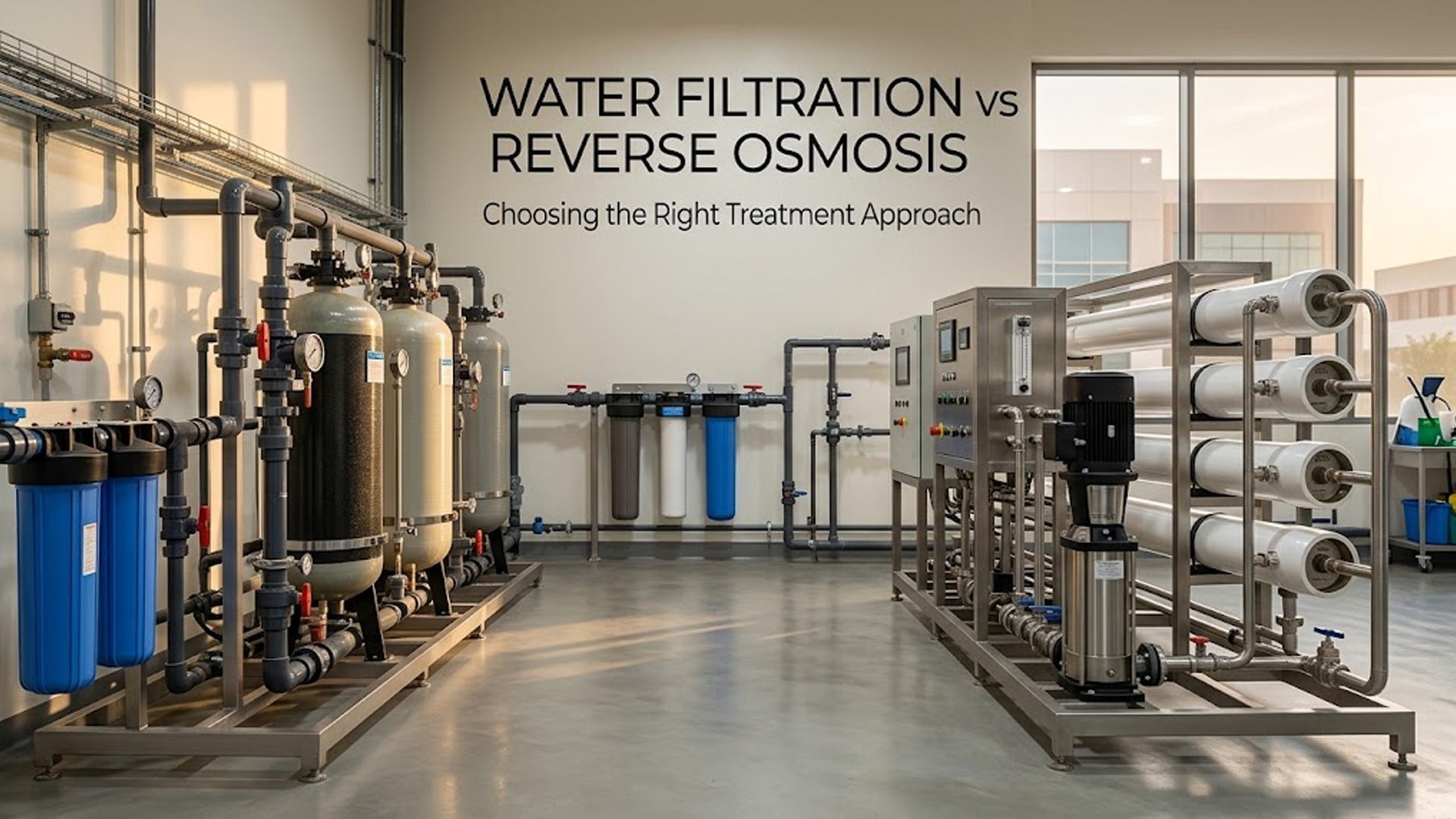
Water filtration and reverse osmosis are often compared as though buyers must choose one or the other. In practice, they perform different treatment functions, and many properly designed systems use filtration before RO rather than treating the two technologies as alternatives.
Conventional filtration is mainly used to remove suspended material or selected contaminants through filter media, while reverse osmosis uses a pressure-driven membrane process to reduce dissolved substances, including many dissolved salts. The correct choice depends on the feedwater analysis and required treated-water quality, and some projects need both technologies in the same treatment train.
What Does “Water Filtration” Actually Mean?
Filtration is a broad term rather than one specific machine.
A filtration process can use different media or membrane technologies depending on what needs to be removed.
Common examples include:
- screen or sediment filtration;
- sand or multimedia filtration;
- cartridge filtration;
- activated-carbon filtration;
- microfiltration; and
These technologies do not all remove the same substances. A cartridge filter designed to retain suspended particles performs a different task from activated carbon or an ultrafiltration membrane.
Therefore, asking for “a water filter” is normally only the beginning of the specification.
What Is Reverse Osmosis?
Reverse osmosis (RO) is a membrane-separation process. Pressure is applied to feedwater so that part of the water passes through a semi-permeable membrane while a more concentrated stream carries away rejected dissolved material.
RO is widely used where the treatment objective requires significant reduction of dissolved salts and other constituents that conventional particulate filtration cannot adequately address.
Applications can include:
- industrial process-water preparation;
- water purification;
- brackish-water treatment;
- desalination;
- utility-water preparation; and
- other applications requiring controlled dissolved-solids levels.
RBC Engineering’s water purification equipment category includes information relevant to RO and filtration-system requirements.
Water Filtration vs RO: The Main Difference
| Factor | Conventional Filtration | Reverse Osmosis |
| Main treatment role | Typically removes suspended material or selected contaminants depending on the filter media. | Reduces many dissolved constituents through membrane separation. |
| Dissolved salts | Conventional particulate filters do not significantly reduce dissolved salts. | Designed to reduce dissolved salts and many other dissolved substances. |
| Pressure requirement | Depends on the filtration technology and system configuration. | Requires sufficient pressure to drive membrane separation. |
| Reject stream | Some filtration systems use backwashing or produce spent media/filters. | Produces a concentrate stream in addition to the treated permeate stream. |
| Pretreatment role | Can be used as a standalone process or upstream of another treatment stage. | Often depends on suitable upstream pretreatment for reliable operation. |
When Filtration May Be the Appropriate Starting Point
Filtration may be relevant where the main treatment objective involves suspended or filterable material rather than dissolved salts.
Examples can include:
- sediment removal;
- protection of downstream equipment;
- turbidity reduction;
- removal of selected organic compounds using appropriate activated-carbon media;
- pretreatment before membrane systems; and
- process-specific particulate control.
The filter type, media, pore size and configuration still need to be matched to the actual water conditions.
When RO May Be Required
RO becomes relevant when the required water quality cannot be achieved through conventional filtration because the problem involves dissolved constituents.
Examples may include situations where the project needs to reduce:
- dissolved salts;
- specific dissolved ions;
- mineral content;
- conductivity; or
- other dissolved substances that the selected membrane can reject.
RO selection still requires appropriate feedwater data. Total dissolved solids or conductivity alone may not provide enough information to design the full treatment train because scaling, fouling and pretreatment requirements depend on wider water chemistry.
Engineering procurement insight: “Does this water need RO?” is better answered by comparing the feedwater analysis with the required finished-water specification. Choosing RO simply because it is perceived as the strongest treatment technology can add unnecessary complexity if dissolved-solids reduction is not actually required.
Why Filtration Often Comes Before RO
An RO membrane is not normally intended to act as the plant’s primary defence against every feedwater problem.
Depending on the source water, upstream treatment may be needed to control conditions that can contribute to:
- membrane fouling;
- scaling;
- pressure loss;
- reduced water production;
- more frequent cleaning; or
- shortened service life.
Pretreatment can involve filtration, ultrafiltration, softening, chemical dosing, activated carbon or other processes depending on the water chemistry and membrane requirements.
The correct sequence should be selected from the actual feedwater conditions rather than copied from a generic RO plant layout.
Where Ultrafiltration Fits
Ultrafiltration (UF) is a membrane-filtration technology that sits in a different treatment range from RO.
UF can be used to reduce suspended and colloidal material and can form part of pretreatment for downstream RO systems. It does not perform the same dissolved-salt separation as reverse osmosis.
This distinction is useful because buyers sometimes receive quotations where “membrane filtration” is described without explaining whether the supplier is proposing UF, RO or another membrane process.
Activated Carbon Is Also Different from RO
Activated carbon is commonly used to adsorb selected organic compounds and can be used for specific treatment purposes such as removing certain tastes, odours or oxidants where appropriate.
It should not be described as a substitute for RO when the project requires significant dissolved-salt reduction.
Likewise, RO should not automatically replace activated carbon or other upstream conditioning where those processes are needed to protect equipment or achieve the complete treatment objective.
What About Drinking-Water Applications?
Neither the word “filter” nor “RO” proves that the final water is suitable for drinking.
A potable-water system has to be assessed as a complete treatment and water-management process. Source-water risks, treatment stages, equipment condition, storage, distribution and finished-water testing can all affect water quality.
Where the application is health-sensitive, the applicable Dubai/UAE water-quality requirements should be confirmed and the treated water verified against the required specification.
Compare Lifecycle Requirements, Not Only Purchase Price
Filtration and RO systems have different operating requirements.
Depending on the design, lifecycle items can include:
- replacement filter cartridges;
- media replacement;
- membrane cleaning;
- membrane replacement;
- chemical consumption;
- pump maintenance;
- instrument calibration;
- backwash water;
- RO concentrate management;
- operator attention; and
- water-quality monitoring.
A meaningful quotation should make these requirements visible rather than focusing only on the purchase price of the main equipment.
How to Compare Two Proposed Systems
Ask each supplier to state:
- the feedwater basis used for selection;
- the required treated-water output;
- the target water quality;
- the complete treatment sequence;
- filter or membrane type;
- pretreatment stages;
- instrumentation;
- automation level;
- consumables;
- reject or backwash requirements;
- maintenance scope; and
- commissioning requirements.
Comparing these items usually gives a clearer picture than comparing nominal plant capacity alone.
RBC Engineering project insight: A filtration system and an RO system should not be compared only by the quality of the equipment. They should first be compared against the same treatment objective. If they are solving different water-quality problems, they are not competing technical alternatives.
What to Include in Your Project Enquiry
- water source;
- recent water analysis;
- required flow rate;
- required daily production;
- operating hours;
- current water-quality problem;
- target treated-water quality;
- intended application;
- existing filters or treatment equipment;
- site utilities;
- available footprint;
- storage requirements;
- reject or drainage constraints;
- automation requirements; and
- maintenance expectations.
For projects requiring a broader treatment assessment rather than only purification equipment, see RBC Engineering’s water treatment equipment information. Saline-water projects can also be reviewed under water desalination equipment.
Frequently Asked Questions
Is RO better than a normal water filter?
They solve different problems. RO is useful where dissolved constituents need to be reduced, while conventional filters may be more appropriate for suspended material or other specific filtration duties. The better system is the one matched to the required water quality.
Can a sediment filter remove dissolved salts?
No. A conventional sediment filter captures suspended particles and does not provide the dissolved-salt separation associated with reverse osmosis.
Does an RO system still need filters?
Many RO systems require pretreatment, which can include filtration or other conditioning processes. The exact pretreatment depends on the source-water chemistry and membrane requirements.
What is the difference between UF and RO?
Ultrafiltration primarily targets suspended and colloidal material at a different separation scale, while reverse osmosis is used to reduce dissolved salts and many other dissolved constituents. UF can also be used as pretreatment upstream of RO.
Does RO remove everything from water?
No treatment technology should be described as removing everything. Actual performance depends on membrane selection, feedwater conditions, operating parameters, pretreatment and the substance being considered.
How can I determine whether my project requires RO?
Compare a suitable feedwater analysis with the required finished-water quality. If dissolved constituents need significant reduction beyond what the proposed filtration process can achieve, RO or another suitable membrane process may be considered.
Discuss Your Water Purification Requirements
If you are comparing filtration, reverse osmosis or a combined treatment train, provide RBC Engineering with the available feedwater analysis and required output specification. Contact RBC Engineering to discuss the project and the information needed to evaluate appropriate water-purification equipment.