

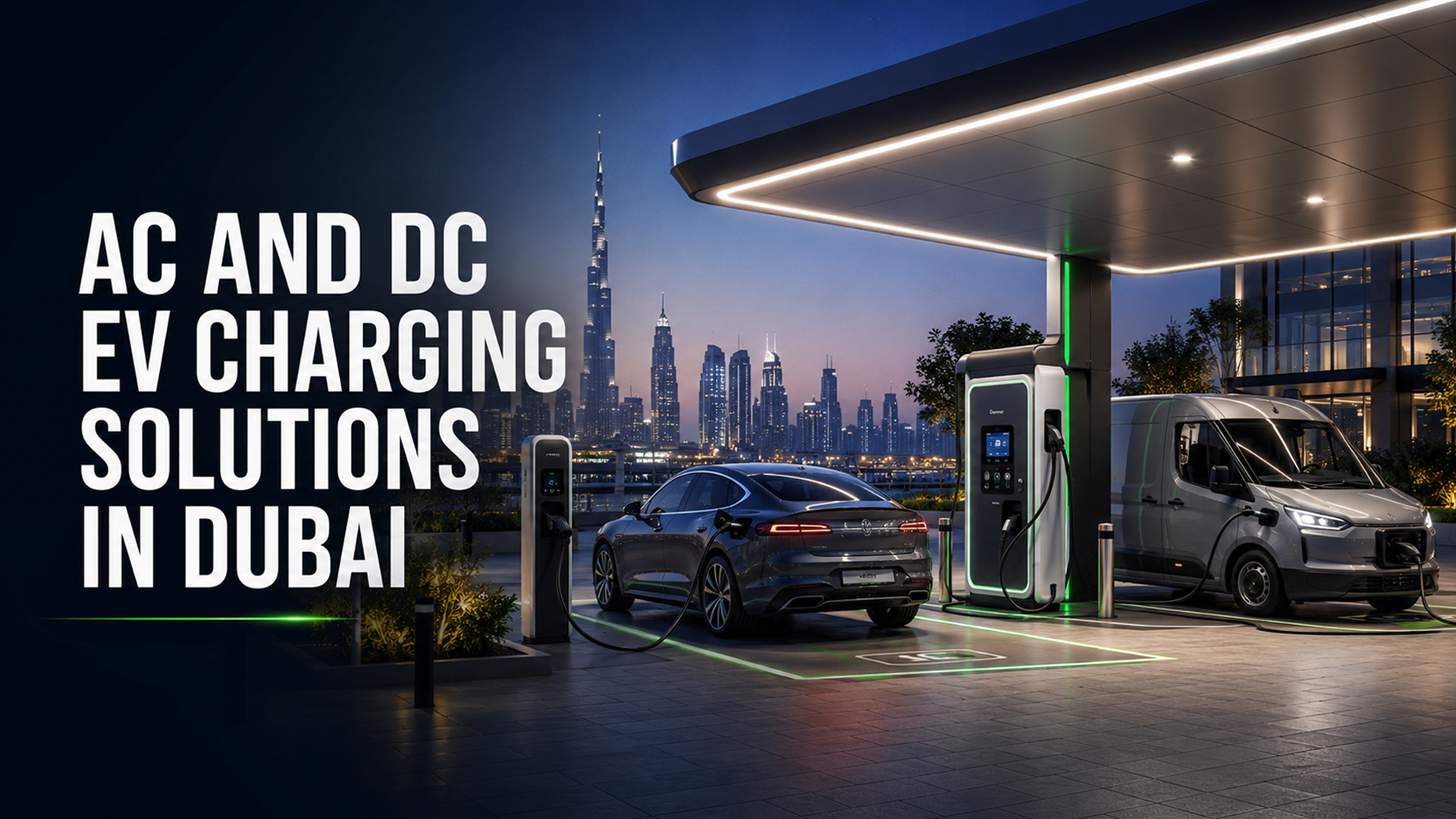
Choose charging equipment around real vehicle demand, parking time and available electrical capacity.
An EV charging project should not begin with the most powerful charger in a product catalogue. It should begin with the vehicles that will use the site, the energy they need, the time available for charging and the capacity of the existing electrical infrastructure.
EV charging solutions in Dubai combine suitable AC or DC chargers with electrical distribution, protection, load management, connectivity and user controls. AC chargers are generally suited to homes, offices and longer parking periods, while DC fast chargers are better suited to fleets, public locations and operations that require faster vehicle turnaround.
RBC Engineering helps clients define a practical charging approach for residential, commercial and fleet applications. Depending on the agreed scope, a project may include charger supply, technical planning, installation coordination, software configuration, testing, commissioning and maintenance planning.
What a Complete EV Charging Solution Includes
A dependable charging system involves more than installing a unit beside a parking bay. The charger must work safely with the property’s electrical supply, the connected vehicles, the intended users and the site’s operating schedule.
- Site assessment: Review parking spaces, cable routes, distribution boards, transformer capacity and equipment locations.
- Charging-demand analysis: Calculate vehicle numbers, daily energy requirements, parking duration and expected future growth.
- AC or DC charger selection: Match charging output to vehicle capability and operational need.
- Electrical planning: Define power supply, protection, isolation, earthing and metering requirements.
- Load management: Distribute available power across multiple chargers without creating unnecessary peak demand.
- User access: Configure charging for residents, employees, guests, customers, fleet drivers or the public.
- Software and communications: Support monitoring, scheduling, reporting, access control or billing where required.
- Testing and commissioning: Verify electrical safety, communication, charger operation and successful charging sessions.
- Operational planning: Establish inspection, maintenance, warranty and spare-parts responsibilities.
The highest charger rating is not automatically the best engineering choice. A properly managed system that matches the site’s real demand can deliver better performance than equipment the property cannot operate at full capacity.
AC EV Chargers vs DC Fast Chargers
AC and DC charging technologies solve different operational problems. The right option depends on how long vehicles remain parked, how quickly they must return to service, the available electrical capacity and the project budget.
| Project Factor | AC EV Charging | DC Fast Charging |
|---|---|---|
| Typical applications | Homes, residential buildings, offices, hotels and long-stay parking | Fleet depots, public stations, logistics facilities and high-turnover sites |
| Parking duration | Suitable when vehicles remain parked for several hours | Suitable when vehicles need shorter charging sessions |
| Electrical demand | Generally lower for each charging point | Usually requires greater incoming and distribution capacity |
| Installation requirements | Often simpler, depending on cable routes and available power | Usually more complex because of higher power and equipment requirements |
| Scalability | Multiple chargers can share capacity through intelligent load management | Expansion may require additional transformer or distribution capacity |
| Best operational fit | Predictable charging during longer parking periods | Rapid turnaround and higher daily utilisation |
Some sites need both technologies. A fleet depot may use AC chargers for vehicles parked overnight and DC chargers for vehicles with shorter operating windows.
AC EV Charging Solutions
AC charging is often the most practical option when vehicles remain parked long enough to receive the required energy without rapid charging. It can support one private parking bay or a managed network serving an entire residential or commercial property.
Where AC EV Chargers Work Well
- Private villas and residential parking
- Apartment buildings and residential communities
- Offices and employee car parks
- Hotels and serviced residences
- Retail and destination parking
- Fleet vehicles parked for extended periods
The charger should be selected according to the vehicle’s onboard charging capability, the available single-phase or three-phase supply and the time available for charging. Installing a higher-rated unit will not improve charging speed when the vehicle or electrical connection cannot accept that output.
Homeowners, residential developers and property managers can review RBC Engineering’s home EV charging system guide for additional planning considerations.
DC Fast Charger Solutions
DC fast charging is designed for projects where charging time has a direct effect on fleet availability, customer convenience or commercial operations. These systems require detailed assessment of available power, vehicle charging capability, simultaneous use and equipment location.
Where DC Fast Charging May Be Appropriate
- Commercial fleet depots
- Logistics and delivery operations
- Public charging stations
- Highway and service-area sites
- Transport and mobility operators
- Retail destinations with shorter customer visits
- Mixed fleets requiring different connector options
A charger’s maximum rating is not a guaranteed charging rate. Actual performance depends on the vehicle, battery temperature, state of charge, connector, charger configuration, simultaneous charging sessions and the power available at the site.
Project teams can review RBC Engineering’s current EV charging equipment before requesting a site-specific technical recommendation.
Commercial EV Charging for Buildings and Car Parks
A commercial charging network must serve its users without creating avoidable pressure on the building’s electrical infrastructure. Before selecting chargers, the property owner should define who will use them, how long vehicles will remain parked and how charging sessions will be controlled.
Questions to Resolve Before Installation
- Will the chargers serve employees, residents, hotel guests, customers or the public?
- How long will vehicles normally remain parked?
- Will charging be complimentary, restricted or paid?
- How many charging bays are required at launch?
- How many additional bays may be needed later?
- Does the property need access control, billing or usage reporting?
- Who will monitor faults and arrange maintenance?
Read RBC Engineering’s guide to commercial EV charging stations for offices, hotels, retail properties and managed car parks.
Fleet EV Charging Infrastructure
Fleet charging should be designed around operating schedules rather than the number of vehicles alone. The objective is to provide each vehicle with enough energy before its next planned departure while avoiding unnecessary electrical demand.
A fleet charging assessment should consider:
- Vehicle types and battery capacities
- Daily routes and expected energy consumption
- Arrival and departure schedules
- Required state of charge before departure
- Simultaneous charging demand
- Available transformer and distribution capacity
- Charger redundancy and fault response
- Future fleet and route expansion
A depot does not necessarily require one high-powered charger for every vehicle. Charging can often be scheduled and distributed according to departure priority, parking duration and available capacity.
Fleet charging capacity should be calculated from the energy vehicles need before departure, not by multiplying the number of parking bays by the maximum charger rating.
EV Charger Site Assessment and Design
A site assessment establishes whether the proposed charging system can be supported safely, practically and economically. It should be completed before charger quantities and output ratings are finalised.
Electrical Assessment
- Incoming utility supply
- Transformer rating and current loading
- Main and secondary distribution boards
- Available spare capacity
- Protection and isolation requirements
- Earthing and metering arrangements
- Existing building loads
- Expected future charging demand
Physical Site Assessment
- Parking layout and vehicle circulation
- Charger mounting positions
- Cable routes and required civil work
- Equipment clearances and ventilation
- Weather and environmental exposure
- Impact protection and signage
- Accessibility requirements
- Mobile, Wi-Fi or wired network availability
The detailed guide to EV charging station design explains additional layout, access and expansion considerations.
Smart Charging and Load Management
A property may be able to support several charging points without having enough power to operate every charger at maximum output simultaneously. Smart load management distributes the available capacity according to building demand, vehicle requirements and charging priorities.
A managed EV charging system may support:
- Dynamic power allocation
- Scheduled charging sessions
- User or vehicle prioritisation
- Remote monitoring and control
- Energy-consumption reporting
- Fault alerts
- RFID or mobile access
- Payment-system integration
- Charging-management platform connectivity
Load management helps the property use its available power more effectively, but it does not create additional electrical capacity. The design must still account for total demand and the time available to complete each charging session.
Payments, User Access and Charging Management
The access model should reflect the property and its users. A residential building may restrict charging to registered occupants, while a commercial operator may require automated billing, session records and different tariffs for different user groups.
Available operating models may include:
- Open plug-and-charge access
- RFID cards
- Mobile application access
- QR-code activation
- Restricted employee or fleet accounts
- Energy-based or time-based billing
- Parking-system integration
- Property-management integration
Review the guide to EV charging payments and access control when planning a managed or revenue-generating charging network.
Solar-Integrated EV Charging
Solar generation can contribute to EV charging, particularly where vehicles remain parked during daylight hours. A complete design must still account for changes in solar production, the building’s base load and charging demand outside solar-generation periods.
A solar-supported EV charging assessment should review:
- Existing or proposed solar capacity
- Daytime vehicle-charging demand
- Building energy consumption
- Available roof, carport or ground area
- Charging schedules
- Battery-storage requirements, where justified
- Grid import and export conditions
- Energy monitoring and control
Learn more about integrating EV charging with solar energy for residential, fleet and commercial projects.
How an EV Charging Project Is Developed
- Define the requirement: Confirm the users, vehicles, parking duration, energy demand and expansion plans.
- Assess the site: Review electrical capacity, equipment locations and cable routes.
- Select the charging approach: Determine whether the project requires AC, DC or mixed charging.
- Prepare the technical scope: Document equipment, electrical work, controls, communications and exclusions.
- Confirm approvals: Identify the documentation, inspections and permissions required for the project location.
- Install and configure: Complete the agreed electrical, civil, network and software work.
- Test and commission: Verify safety, connectivity, charging operation and user access.
- Handover and support: Provide the agreed records, training, warranty information and maintenance plan.
The final proposal should clearly define the responsibilities of RBC Engineering, the client, the electrical contractor, the software provider and any local implementation partner.
EV Charging Projects Across the UAE, GCC and Africa
Project enquiries may be submitted from Dubai, other UAE emirates, GCC countries and selected African markets. Cross-border work requires a clearly defined supply, installation, commissioning and support model for the destination country.
Regional proposals should confirm:
- Equipment supply and shipping responsibilities
- Local electrical and utility requirements
- Equipment certification and connector compatibility
- Installation-contractor responsibilities
- Commissioning arrangements
- Software connectivity and hosting
- Warranty administration
- Spare-parts availability
- Remote and on-site support responsibilities
Projects in South Africa, Kenya, Ghana, Mauritius, Zimbabwe and other African markets should be assessed against local power availability, installation requirements, vehicle demand and long-term maintenance needs before equipment is specified.
Request an EV Charging Proposal
Share the project location, property type, number of vehicles, parking duration and available electrical supply. Include any requirements for AC or DC charging, access control, payments, solar integration, installation, commissioning and future expansion.
RBC Engineering can review the information and recommend an appropriate charging approach based on the confirmed technical and operational scope.
Frequently Asked Questions
What is the difference between AC and DC EV charging?
AC charging supplies electricity through the vehicle’s onboard charger and is commonly used where vehicles remain parked for several hours. DC fast charging delivers electricity directly to the battery and is better suited to fleets, public charging and shorter turnaround times.
Which EV charger is suitable for a commercial property?
The correct charger depends on the users, parking duration, available power and whether charging will be complimentary, restricted or paid. Many commercial properties use managed AC chargers, while sites with faster vehicle turnover may also require DC charging.
Can several EV chargers share the same electrical capacity?
Yes. Dynamic load management can distribute available power across multiple chargers and respond to changes in building demand. The site must still have enough total capacity to complete the required charging sessions within the available time.
Can EV chargers be connected to a solar energy system?
Yes. Solar generation can support EV charging when production, building demand and vehicle schedules are coordinated. Battery storage may be considered when charging is required outside solar-generation hours, but it is not necessary for every project.
Does a DC charger always deliver its maximum rated power?
No. Actual charging power depends on the vehicle, battery temperature, state of charge, connector, charger configuration, simultaneous charging sessions and available site capacity.
What should be checked before installing an EV charger?
The site should be assessed for electrical capacity, protection, earthing, parking layout, cable routing, connectivity and future expansion. Applicable property, utility and regulatory requirements must also be confirmed before installation.
Can RBC Engineering assess EV charging projects outside the UAE?
Project enquiries can be reviewed for GCC countries and selected African markets. Each proposal must define equipment supply, shipping, local installation, approvals, commissioning, warranty and maintenance responsibilities.
What information is required for an EV charger quotation?
Provide the project location, number and type of vehicles, expected parking duration, charging requirements and available electrical supply. Site drawings and details about access control, billing, solar integration and future expansion can improve proposal accuracy.